
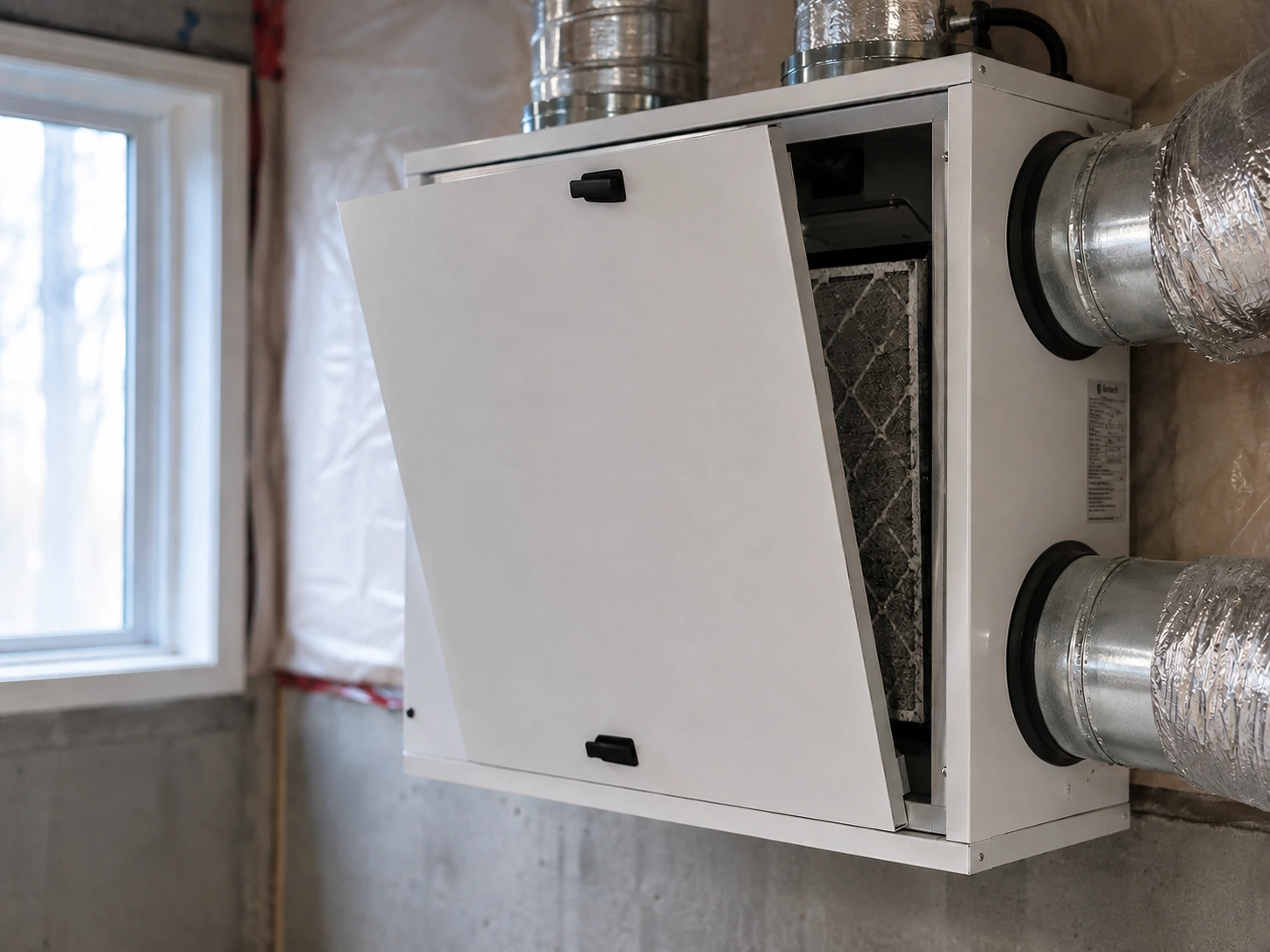
Walk into a newer Saskatchewan home and you’ll often find two separate systems in the mechanical room. The furnace heats and circulates air. A smaller box nearby handles ventilation. That second system is the HRV.
So, what is an HRV, exactly? If you’ve heard the term “air exchanger” from a builder, inspector, or technician, you may still have questions. This article explains what an HRV does, how it works, and what parts it uses.

Quick Answer: An HRV (Heat Recovery Ventilator) is a mechanical ventilation system. It exchanges stale indoor air for fresh outdoor air while recovering heat from the outgoing air. It runs independently of your furnace, using its own fans, filters, ductwork, and a heat-exchange core — the same mechanism Natural Resources Canada describes as recovering energy that would otherwise be lost.
What Is an HRV, and Why Sealed Prairie Homes Need One
Older housing stock in towns like Yorkton and Weyburn was, by modern standards, leaky — drafts around windows and doors let outside air trickle in constantly, whether anyone wanted it to or not. That was wasteful for heating bills, but it meant indoor air got a steady trickle of replacement without any equipment involved.
Builders now construct newer homes and retrofits with tighter envelopes that keep heated air inside and can reduce heating losses. As Natural Resources Canada notes, that airtightness limits the uncontrolled flow of air in and out of the house — which is good for the furnace bill, but also means moisture, cooking odours, off-gassing from furniture, and everyday CO2 from breathing have far fewer places to go on their own. That’s the gap an HRV is built to fill — not an add-on layered on top of tight construction, but the piece that makes deliberate ventilation possible once a home stops leaking air by accident.
We often see this on acreage properties after window and insulation upgrades. A homeowner assumes the tighter house only needs a better furnace filter. Then window condensation appears during the first winter. The homeowner also notices that the indoor air feels flat or heavy. That’s when an HRV often becomes part of the conversation. It’s less about the house being “wrong” and more that sealing it up removed the accidental airflow it used to rely on.
Inside the Core: Swapping Air Without Swapping Heat
The core performs the heat-recovery work and separates an HRV from a plain exhaust fan. Outside, the unit draws fresh air in through one hood and pushes stale air out through a separate one; inside, both streams pass through the core at the same time, routed through narrow, alternating channels that CMHC’s technical guidance confirms never let them physically mix.
Warm exhaust air transfers some of its heat through the core to the incoming outdoor air. The stale air still leaves the house. The fresh air still comes in. The heat would otherwise leave through the exhaust vent. Instead, the core transfers some of that heat to the incoming air. This reduces the amount of work the furnace needs to do during cold weather.

Dust, lint, and grease film can build up on those core channel walls over time and act like insulation, blunting the heat transfer the core exists to do — the unit keeps running, it just does less. That’s a cleaning and maintenance question more than a design one, and it’s covered by our air exchanger cleaning service rather than something a homeowner needs to diagnose on their own.
The HRV System Explained: Fans, Filters, and Ductwork
An HRV is more than a single appliance. Four main components work together to move and condition the air:
- Two fans — one pulling stale air out of the house, one pushing fresh air in, running simultaneously and independently of your furnace blower.
- Intake and exhaust filters — positioned to catch dust and larger airborne debris before it reaches the core, on both the outgoing and incoming air streams.
- The heat-exchange core — the component covered above, where the actual heat transfer happens.
- A dedicated duct loop — separate supply and return runs connecting the HRV to specific rooms (commonly bathrooms and kitchens for stale-air pickup, living spaces or bedrooms for fresh-air delivery), independent of the furnace’s duct network.
It’s usually a plain metal box with its own small control panel — easy to mistake for extra furnace equipment until you notice it has its own ductwork, its own fans, and its own job.

HRV or ERV — Does It Matter, and Do You Even Have One?
You’ll sometimes hear “air exchanger,” “HRV,” and “ERV” used almost interchangeably, and the distinction trips people up more than it should. As Natural Resources Canada explains, an HRV transfers heat only, while an ERV (Energy Recovery Ventilator) transfers heat and a portion of moisture along with it. The builder or contractor typically chooses the system during the home’s design. Both types can work well, but the right choice depends on the home’s ventilation needs.

Whether a home has one at all comes down largely to when it was built. Newer builds and homes with tighter envelopes are more likely to include an HRV. Common upgrades include new windows, added insulation, and air sealing. Some older farmhouses and acreage properties still rely on natural air leakage. That approach creates different ventilation conditions than a tightly sealed home.
We see this confusion in jobs across Yorkton and Saskatoon. A homeowner may point to the furnace return grille and call it “the air exchanger.” The actual HRV uses a separate duct loop that connects to different rooms. If you’re not sure which one you have — or whether you have one — that’s worth confirming before assuming either system is covering the other’s job.
Not sure whether the box in your mechanical room is an HRV, and whether it’s actually pulling its weight? Get in touch and we’ll take a look during a service visit — no guesswork required.
When an HRV Starts Working Against You Instead of For You
A well-maintained HRV should be nearly invisible — quiet fans, steady airflow, no smell. A neglected one tends to announce itself: weaker airflow at the vents, condensation returning to windows that used to stay clear, or a musty note in rooms nowhere near the bathroom.
Those symptoms, plus how often the system actually needs attention, are their own topics — our posts on how often to clean an air exchanger and HRV system maintenance cover that ground in detail.
Built and Certified to Work on These Systems Correctly
Because the core and the duct loop are specialized components rather than standard furnace parts, servicing them properly takes more than a shop-vac and a guess. Our technicians are Air Systems Cleaning Specialist (ASCS) certified through NADCA. We’ve applied that certification standard across more than 50,000 completed jobs over 27+ years as a family-run business. That experience matters when an HRV’s key components aren’t visible from the outside.
If your HRV service is bundled with a full duct or furnace cleaning, our air exchanger cleaning service covers the core, filters, and fans as part of that visit.
Frequently Asked Questions
Is an HRV the same thing as my furnace’s fresh-air intake?
No. A furnace fresh-air intake (if your model has one) simply pulls in outside air passively for combustion. An HRV is a powered, standalone system with its own fans and ductwork that actively exchanges indoor and outdoor air while recovering heat — it doesn’t rely on the furnace to run.
How do I tell if my home actually has an HRV?
Look in the mechanical room for a separate metal box with its own small control panel and its own duct runs, distinct from the furnace — often near the water heater. If you only find furnace ductwork and a single return grille, the home likely doesn’t have one installed.
Can I just run my bathroom fan instead of an HRV?
A bathroom fan exhausts air but doesn’t bring in an equal amount of fresh air or recover any heat, so it can actually depressurize a tightly sealed home — a risk Health Canada documents for exhaust-only devices without enough makeup air. An HRV balances intake and exhaust simultaneously, which is a different job entirely.
How long does an HRV core typically last?
Core lifespan varies by manufacturer and usage, but performance typically declines well before outright failure — a core that’s still “running” can already be doing a fraction of the job it used to if it hasn’t been cleaned regularly.
You Might Also Find This Helpful
- HRV System Maintenance: What It Actually Involves
- How to Clean an HRV Filter
- How Often to Clean an Air Exchanger
- Why Your Air Exchanger Smells Musty
Curious whether your HRV is actually recovering the heat you’re paying for? We’ll check it out and back the work with our 100% Satisfaction Guarantee.