
Quick Answer: If your air exchanger isn’t working properly, start with the basics. Weak or uneven airflow can be associated with a clogged HRV filter or dirty core. Dust and dirt buildup can restrict airflow and reduce ventilation efficiency. Natural Resources Canada provides HRV maintenance and troubleshooting guidance. Grinding or squealing motor noise, a unit that won’t run, or frost that doesn’t clear should be treated differently. These signs may warrant a service call rather than a cleaning.
In this article:
When Airflow Drops But the Fan Still Runs
Weak airflow is often the symptom that catches people off guard. The HRV sounds normal and the panel light is on, but a hand held up to a supply grille barely feels any movement. Homeowners may assume the fan motor is failing. However, restricted airflow can also result from buildup in the filter or heat-exchange core. Natural Resources Canada notes that dust and dirt buildup can restrict airflow and reduce HRV efficiency. Dirty filters can also reduce ventilation efficiency and contribute to unbalanced airflow. Natural Resources Canada explains HRV maintenance and airflow troubleshooting here.
A clogged HRV filter or a lint- and dust-packed core doesn’t announce itself the way a dead motor does. Common clogged HRV filter symptoms include uneven airflow between rooms and supply vents that feel weaker than they used to even though the fan is still running. That gradual decline is the pattern worth paying attention to — a sudden, total loss of airflow is a different problem entirely, and worth flagging separately (more on that below). That gradual decline is the pattern worth paying attention to — a sudden, total loss of airflow is a different problem entirely, and worth flagging separately (more on that below).
New Noises Aren’t Always a Cleaning Issue
It’s tempting to assume every new sound from the mechanical room means the unit needs a cleaning. Sometimes that’s right. A dull hum that has grown louder over a few months may be related to airflow restriction. Soft rattling can also come from loose dust or debris. Buildup inside the core or filter housing can restrict airflow and affect how the unit operates.
On builds across Saskatoon and Yorkton, our technicians regularly find homeowners assuming the fan motor is failing. Sometimes the actual issue is a core packed with lint and dust that restricts airflow. Cleaning may resolve noise related to that buildup. A sharp grinding, squealing, or clicking sound is different. Those sounds can point to a mechanical issue, such as a motor or bearing problem. If the sound has a clear mechanical quality, a repair assessment may be more appropriate than a cleaning appointment.
What Turns Up When the Core Actually Gets Opened
Visible dust on the vent covers is the easy sign to catch. It may only be the surface of what’s happening further back in the system. When we open the core on homes that haven’t been serviced in a couple of years, we often find more buildup than the homeowner expected. This can be especially noticeable on units running through a full Saskatchewan heating season.

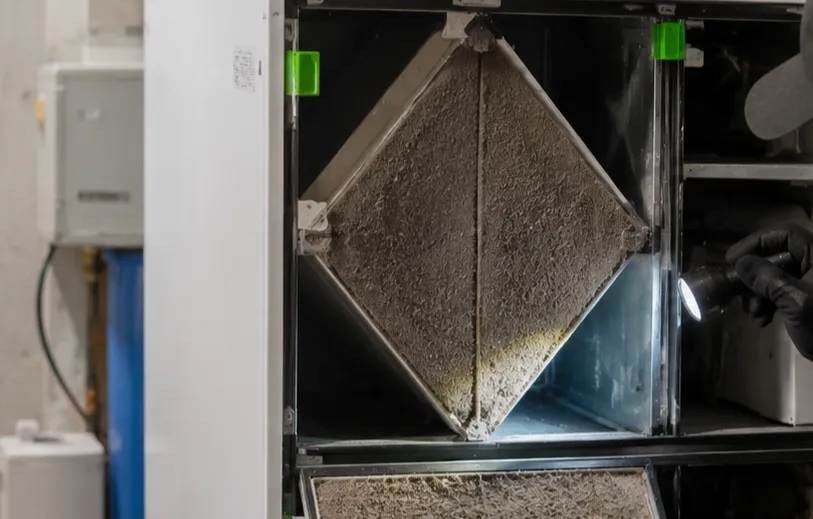
A dirty HRV heat-exchange core with visible dust and lint buildup.
On older bungalows and acreage properties, we may find the core’s heat-exchange channels partially packed with fine dust and lint. This buildup can restrict airflow and affect heat recovery. Since our technicians are ASCS-certified through NADCA, they’re trained to identify and clear this type of buildup correctly. That matters because the core’s channels can be delicate, and aggressive DIY cleaning can cause damage.
Condensation and Frost: A Prairie Winter Complication
Condensation on or around the air exchanger isn’t always a bad sign. Some condensation can be normal, especially in winter. The challenge is knowing when it becomes excessive. That can vary with the season and operating conditions.
On Prairie homes, frost can develop inside the heat-exchange system during very cold weather. This can happen even on units that were cleaned recently. That’s not necessarily a cleaning failure. Natural Resources Canada explains that many HRVs use automatic defrost during cold-weather operation. It also recommends checking the core in very cold weather to make sure the defrost mechanism is working properly. See Natural Resources Canada’s HRV guidance for frost and defrost troubleshooting.

Frost buildup inside an HRV can occur during very cold Prairie weather and does not always mean the unit needs cleaning.
Frost that builds up and stays can restrict airflow. It’s worth investigating rather than simply waiting it out. Persistent frost may involve the core, airflow, or the unit’s defrost operation. It shouldn’t automatically be treated as a cleaning issue.
A Word on Smells
Persistent musty or stale odours from the HRV are worth investigating. They can be linked to trapped dust and debris inside the core. Moisture on a neglected filter can also contribute to odour-causing buildup. That’s a real dirty HRV symptom, but it deserves its own explanation. We’ve covered the causes and fixes in detail in this post on musty air exchanger smells.
Cleaning Fix or Service Call? How to Tell the Difference
Most of what homeowners notice — reduced airflow, dust buildup, a duller hum, occasional condensation — points to a cleaning, not a repair. That’s the situation this article has mostly been describing, and it’s also the more common one.
The signs that shift toward a mechanical problem are more specific: a motor that won’t start at all, grinding or squealing that doesn’t change with airflow, frost that never clears through an entire cold snap, or a unit that trips a breaker. Those aren’t cleaning symptoms — they’re mechanical ones, and continuing to run the unit without addressing them can shorten its lifespan.

Some HRV symptoms may improve with cleaning, while motor, noise, frost, or electrical problems may require professional service.
If your air exchanger isn’t working properly and you’re not sure which category your situation falls into, a quick starting point is: check and replace the filter first, then look for an obvious blockage at the intake or exhaust hood. These are among the basic HRV maintenance checks recommended by the Canada Mortgage and Housing Corporation. CMHC’s HRV maintenance guidance covers filter and exterior-vent checks. After that, note whether airflow is still weak and whether any noise, frost, or condensation looks abnormal. If the problem persists, it’s worth asking for professional assessment rather than guessing and paying for the wrong service.
Not sure whether your air exchanger needs a cleaning or something more? Tell us what you’re noticing and we’ll help you figure out whether it’s a cleaning or something more — reach out for a free assessment.
FAQ
What are the signs my air exchanger needs cleaning?
The most common signs are weaker airflow, more noise than usual, visible dust around the vents, and condensation that wasn’t there before. When these show up gradually rather than suddenly, a cleaning is usually the fix — see the Quick Answer above for the full breakdown of cleaning versus mechanical signs.
Can I fix reduced HRV airflow myself before booking a cleaning?
Checking and replacing the filter yourself is reasonable and sometimes solves it. If airflow is still weak after a clean filter is in place, the core itself likely needs attention, which isn’t a DIY-friendly job on most residential units.
Is a humming or buzzing sound from my air exchanger always mechanical?
No — a low hum that’s grown gradually louder is often airflow restriction from a dirty core or filter. A sharp grinding or squealing sound is the one that usually points to a mechanical issue instead.
Why does my air exchanger frost up in winter even though it was recently cleaned?
Light, occasional frosting around the intake in cold weather is normal for HRVs and not necessarily a sign anything’s wrong. Frost that builds up and doesn’t clear is worth investigating, but a clean unit can still frost periodically simply due to outdoor conditions.
How do I know if it’s the filter or the core that’s dirty?
Start with the filter, since it’s the easiest component to check and maintain. If airflow is still weak after the filter has been cleaned or replaced, the core and other airflow restrictions may need further attention. CMHC provides basic HRV filter and vent maintenance guidance.
You Might Also Find This Helpful
- HRV System Maintenance: What a Regular Schedule Actually Involves
- How to Clean Your HRV Filter
- How Often You Should Actually Clean an Air Exchanger
- Why Your Air Exchanger Smells Musty (and What to Do About It)
Dun-Rite Vac has been cleaning air exchangers and HVAC systems across Saskatoon, Yorkton, Regina, Weyburn, and the surrounding areas since 1998, with ASCS-certified technicians behind every job. If your unit is showing any of the signs above, our air exchanger cleaning service is backed by our satisfaction guarantee — get in touch for a free quote and we’ll tell you straight whether it’s time to clean it or time to look at something else.