
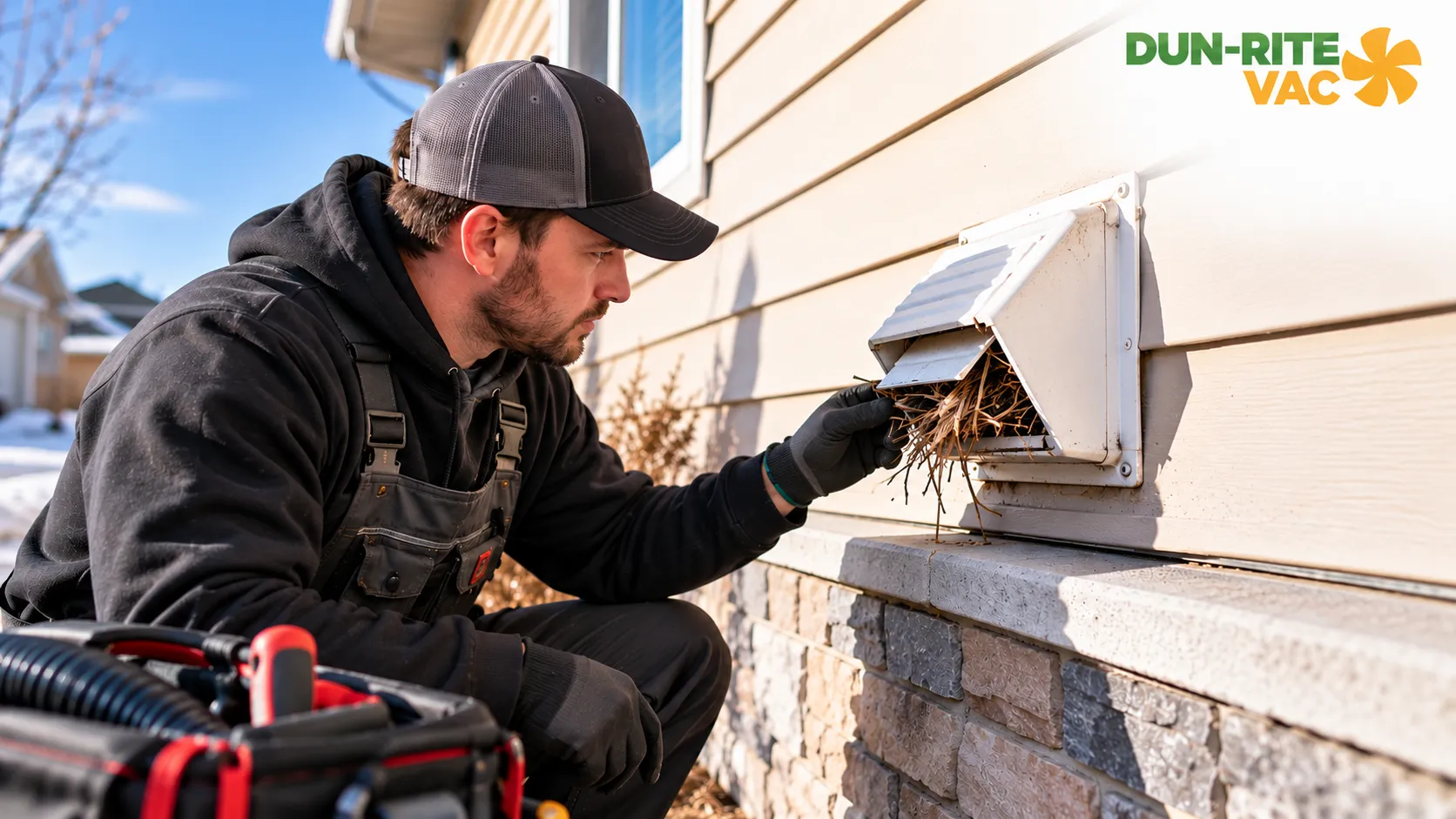
A bird nest in a dryer vent often shows up as towels that are still damp after a full cycle and a laundry room that feels warmer than it should. By the time you notice, nesting material may already be packed into the exterior hood. Here’s how to recognize the signs, why the dryer needs to stay off, when a wildlife professional has to step in first, and how to keep the problem from repeating.
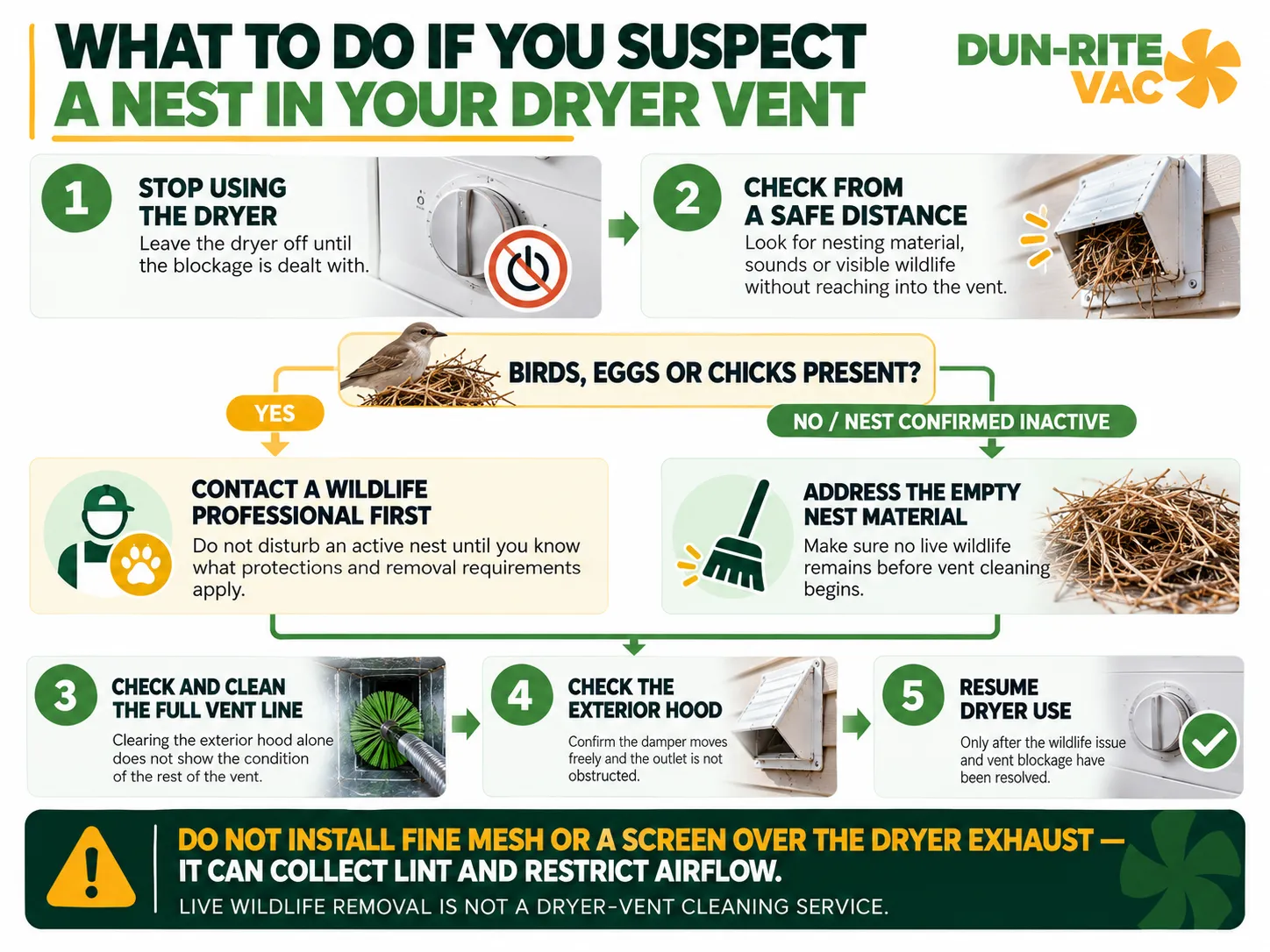
Quick Answer: If you suspect a nest is blocking your dryer vent, stop using the dryer and leave it off until the blockage is dealt with. The U.S. Consumer Product Safety Commission warns that lint buildup can restrict airflow, cause excessive heat buildup and contribute to dryer fires. If eggs, chicks or a live bird may be present, don’t disturb the nest until you know what protections apply. Once any wildlife issue is resolved, the vent line should be checked and cleaned as needed before the dryer goes back into service.
In This Post
- Spotting a Bird Nest in Your Dryer Vent Before the Dryer Gives Out
- Why a Blocked Exterior Dryer Vent Is More Than a Slow-Drying Problem
- Eggs, Chicks or Fur: When Wildlife Removal Has to Come First
- Pulling the Nest Out Is Only Half the Job
- Keeping Birds Out Without Choking the Airflow
- Frequently Asked Questions
Spotting a Bird Nest in Your Dryer Vent Before the Dryer Gives Out
A blocked vent is easy to mistake for a tired dryer: longer cycles, laundry that comes out hot but still damp, and the assumption that the machine is wearing out. Then someone looks at the exterior hood and finds straw and twigs. The dryer was fine. The exit was closed.
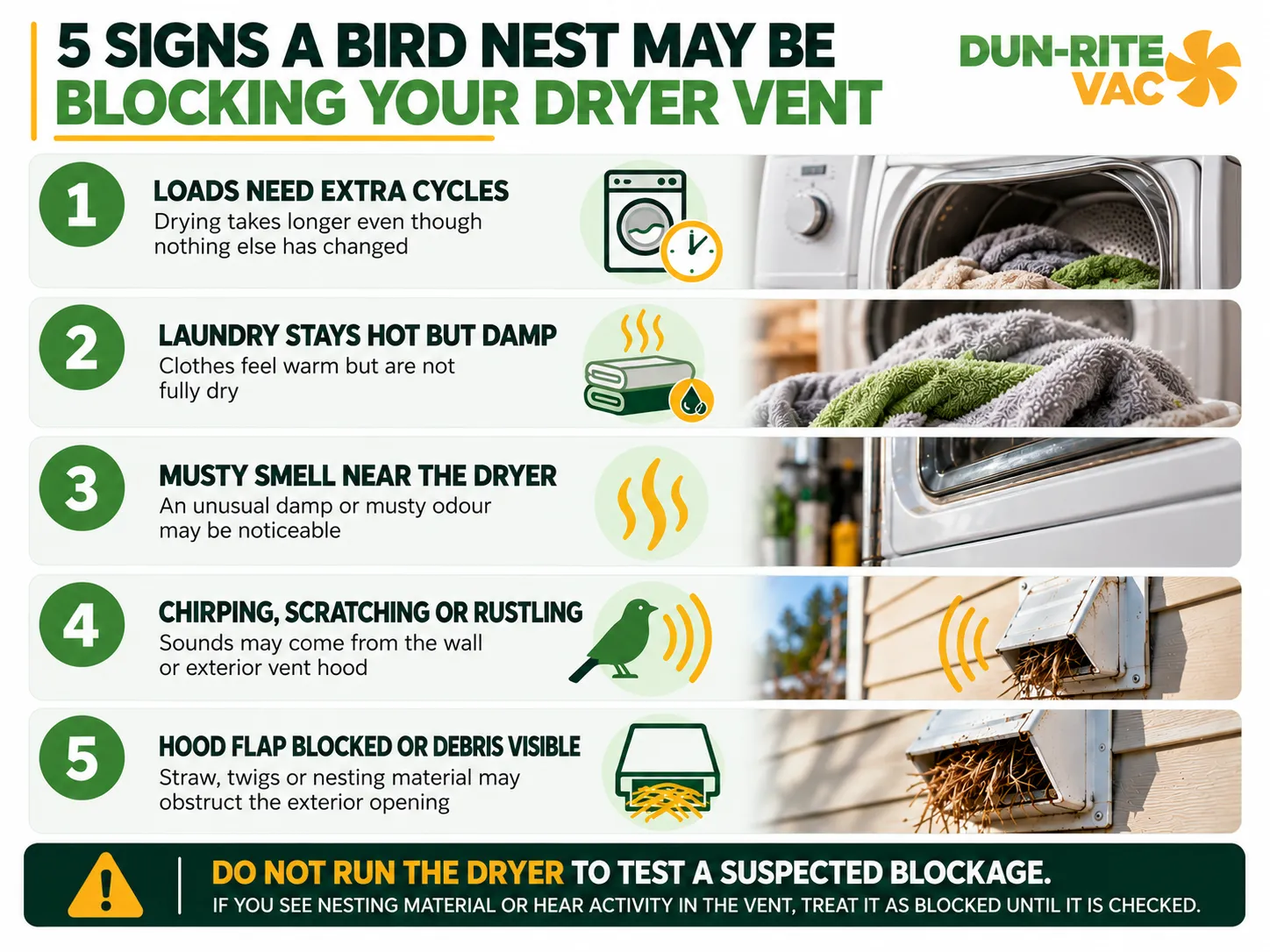
Birds in a dryer vent leave clues both inside and out. Check for these without running the machine:
- Loads that need two or more cycles when nothing else has changed.
- A damp or musty smell from the dryer drum or laundry room.
- Chirping, scratching or rustling in the wall or from the hood.
- A blocked dryer hood flap that is stuck open or jammed, pushed out of shape, or surrounded by straw and droppings.
- Visible debris in the opening of the exterior hood.
Don’t run the dryer to test it. If you can see material in the hood, or hear something in the line, treat it as blocked.
Why a Blocked Exterior Dryer Vent Is More Than a Slow-Drying Problem
A blocked dryer vent is more than a slow-drying problem. Dryers rely on the exhaust path to move heat and moisture outdoors, and restricted airflow can allow heat and lint to build up. The U.S. Consumer Product Safety Commission’s dryer-fire guidance warns that lint buildup in a dryer or exhaust duct can block airflow, cause excessive heat buildup and result in a fire.
A nest adds another physical obstruction to that exhaust path. That is why the dryer should stay off until the blockage has been removed and the vent has been checked before use resumes.
If you have a gas dryer, restricted venting also creates a carbon-monoxide concern. Technical Safety BC’s gas-dryer venting guidance explains that gas-dryer vents carry combustion by-products outdoors and that vent restrictions can allow exhaust containing carbon monoxide to leak. Health Canada notes that carbon monoxide cannot be seen or smelled and recommends working carbon-monoxide alarms in homes with combustion appliances. If a CO alarm sounds, move to fresh air and follow emergency guidance immediately.
That’s why the safest move is the simplest one: unplug the dryer (or switch off the gas supply for a gas dryer) and leave it off until the vent is cleared.
Eggs, Chicks or Fur: When Wildlife Removal Has to Come First
The right move depends on what’s actually in the vent. An animal nest in a dryer vent is not always a bird’s, and the answer changes with who, or what, is living there.
- Old, empty nest material: If you’re certain nothing is living in it, it can be removed and the line cleaned.
- Eggs or chicks: Don’t disturb the nest until you know what rules apply. Environment and Climate Change Canada’s guidance on migratory-bird nests explains that nests containing a live migratory bird or viable egg are protected from being damaged, destroyed, disturbed or removed, with additional protection applying to certain species. A wildlife professional can help determine the appropriate next step.
- Fur, droppings or noise suggesting a mammal: Don’t reach in. A frightened animal in a duct can bite or scratch, and may have young nearby.
What looks like a bird’s nest can sometimes be the work of a squirrel or another small animal, which is one more reason not to guess. We’re duct and vent cleaners, not wildlife removal specialists, so live animal or active nest removal must be handled by a wildlife professional before any vent cleaning. Once the vent is clear, we handle the cleaning.
Dryer struggling, and not sure why? If you can’t tell whether the cause is a nest or just lint, contact our vent cleaning team and we’ll talk through what you’re seeing. If wildlife turns out to be involved, that gets sorted out first, and we’ll take it from there.
Pulling the Nest Out Is Only Half the Job
With the hood cleared, it’s tempting to plug the dryer back in. Don’t yet. Nest material can get pushed into the line, droppings and moisture can be left behind, and the lint that built up while the vent was blocked is still sitting in the duct.
This is where certification matters. Our company is NADCA certified, our technicians are ASCS certified, and after 27+ years and over 50,000 completed jobs, our experience is that a clogged hood and lint further back in the duct often go together. That’s why a proper dryer vent cleaning covers the full run from the dryer to the outside, not just the opening. If we notice a damaged or warped hood flap while we’re there, we’ll let you know so you can get it repaired.
Keeping Birds Out Without Choking the Airflow
A bird-prevention fix should not create a new airflow restriction. GE Appliances’ dryer exhaust guidance advises against installing a screen or grid over the exhaust duct because it can contribute to lint buildup. For that reason, we don’t recommend fine mesh or homemade screens over a dryer exhaust outlet.
A few practical habits help:
- Once the vent is confirmed clear, check that the hood’s damper flap moves freely and closes fully when the dryer is off.
- If the hood is cracked, warped or the flap no longer seals, replace it with a standard damper-style hood. A flap that hangs open is an invitation.
- Look at the hood in early spring, when birds start looking for nesting spots, and again before the heating season.
No hood is bird-proof forever, and that’s okay. If you’ve never seen signs of nesting and your dryer runs normally, there’s no emergency here. A quick look at the exterior twice a year is usually enough.
Frequently Asked Questions
Can I just pull the nest out myself once the birds have left?
If you’re certain the nest is empty and inactive, you can clear what’s visible at the hood. Wear gloves and a dust mask, since old nesting material and droppings aren’t something to handle or breathe in bare, and take care on a ladder. The harder part is what’s gone further into the line, which you can’t see or reach from outside. That’s what a full vent cleaning is for.
Does a nest in the vent mean the rest of the duct is full of lint too?
Not necessarily, but clearing the hood alone doesn’t tell you what condition the rest of the vent is in. Technical Safety BC notes that not all lint reaches the outdoors and that lint can accumulate along the sides of a dryer vent until it creates a restriction. Once a nest or other blockage is removed, the rest of the vent should be checked and cleaned as needed.
My dryer vent already has a screen on it. Will that keep birds out?
It may, but screens clog with lint and restrict airflow, which creates its own blockage. If your vent has one and your dryer is slow to dry, check the screen first.
Think a nest is blocking your dryer vent? Once any wildlife has been dealt with, we’ll clear the full vent line and stand behind the work with our 100% Satisfaction Guarantee. Reach out for a free quote whenever you’re ready.