
Ask three companies for an air duct sanitizing cost and you can easily get three very different answers. Often the quotes aren’t describing the same job: one may cover the whole system, another only part of it, and a third may leave cleaning out. A single per-vent figure also can’t capture layout, scope and condition, which is why we scope sanitizing jobs rather than price them by the vent.
We don’t publish a generic dollar range for sanitizing, because any number we gave you would be a guess about a system we haven’t seen. What we can do is show you what moves the price, what to ask any contractor, and what details we need to give you a real quote.
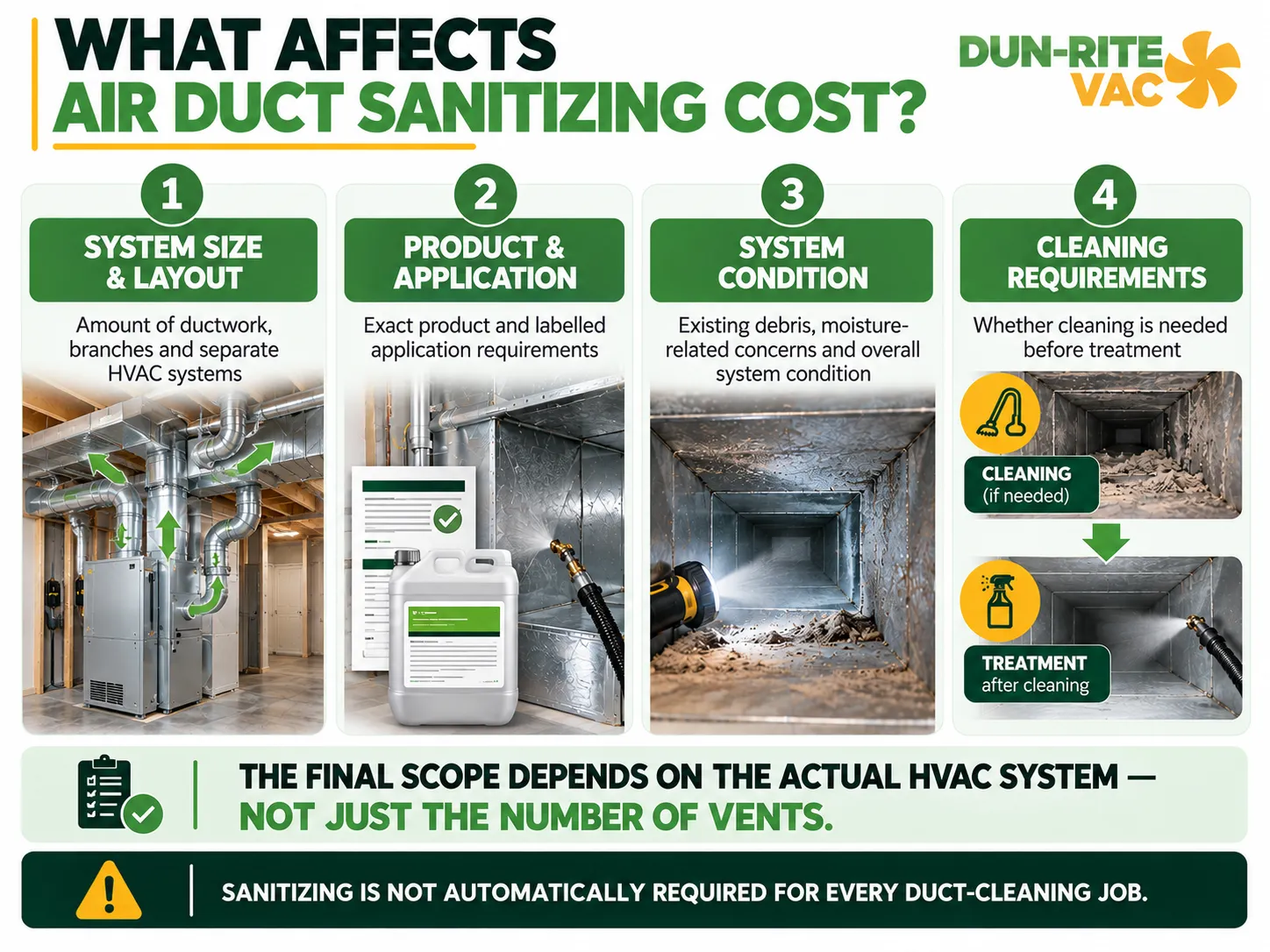
Quick Answer: Four major factors can affect sanitizing cost: the size and layout of your duct system, the product and application method, the condition of the system, and whether the ducts need cleaning first. Because those vary from building to building, we quote after learning about your system rather than publishing a one-size-fits-all price.
In this guide
- Why We Don’t Publish One Sanitizing Price
- System Size: Why Square Footage Alone Falls Short
- Product and Application Method: Questions to Ask Before You Compare Prices
- A Musty Smell Doesn’t Always Point to the Ducts
- Sanitizing Over Dirty Ducts: Why Cleaning May Come First
- Comparing HVAC Sanitization Cost Quotes Fairly
- Frequently Asked Questions
Why We Don’t Publish One Sanitizing Price
It’s tempting to treat sanitizing as a simple add-on with a fixed price, like adding a filter to an order. It’s closer to a custom job. The same service can mean treating a compact furnace and a handful of runs in one home, or a long branching system with several zones in another.
To give you an honest figure, these are the details that help us understand the likely scope:
- Home or building size, and how many floors or additions
- How many furnaces or separate systems you have
- Any past water damage, or odours you’ve noticed
- When the ducts were last cleaned
For what the service itself covers, see our HVAC sanitization service page.
System Size: Why Square Footage Alone Falls Short
Floor area is only one part of the picture. The amount of ductwork, number of branches, number of furnaces or separate systems, and accessibility of the system can all change the scope of the job. Acreage properties and larger two-storey homes can also have more extensive ductwork, including runs serving additions or finished basements and, in some cases, more than one furnace.
A small bungalow with a single furnace and short runs sits at the other end of the range. Commercial buildings add another layer, with multiple zones and mechanical equipment. If that’s your situation, our commercial duct cleaning page explains how those systems are approached.
Product and Application Method: Questions to Ask Before You Compare Prices
When two quotes for the same house differ, the product and application method can be part of the reason. Antimicrobial products are not interchangeable: Health Canada’s biocide labelling guidance requires product directions to address the intended use and application details, including where and how the product is used. That’s why the exact product and its labelled application matter when you compare quotes.
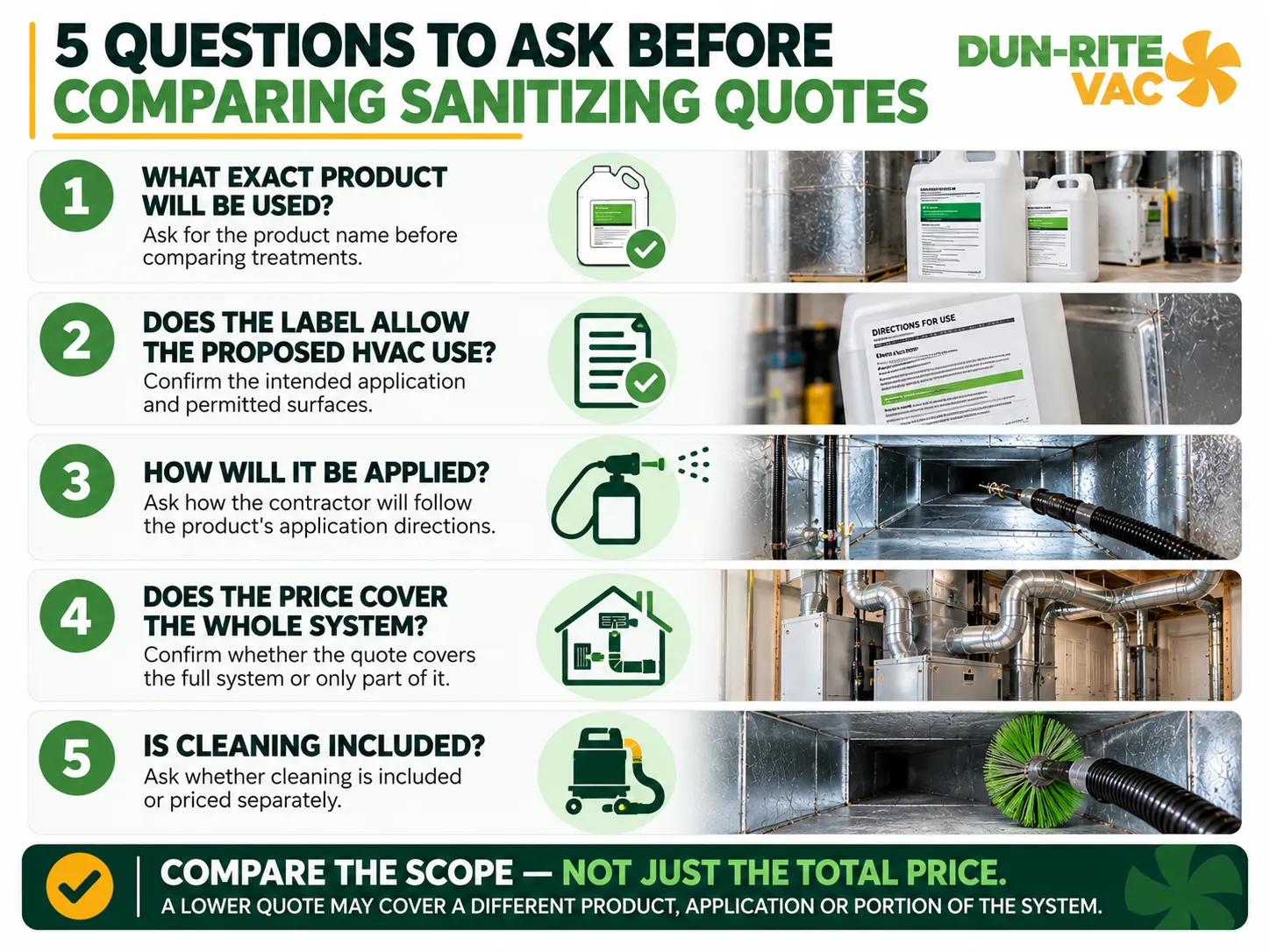
Whether any treatment is worth doing depends on the verified condition of your system and what the product’s label supports, not on a general sense that “more is better.” Five questions to put to any company before you compare totals:
- What is the exact product name you plan to use?
- Does its label permit the HVAC application you’re proposing, and which surfaces does it cover?
- How do you follow the label’s application directions on my system?
- Does the price cover the whole system or only part of it?
- Is cleaning included, or priced separately?
A vague answer to any of these is a reason to keep asking before you decide.
A Musty Smell Doesn’t Always Point to the Ducts
A musty smell shouldn’t automatically be blamed on the ductwork. Moisture, humidity and hidden damp areas elsewhere in the home can also contribute to musty odours, so the source needs to be identified before assuming the ducts need treatment.
If you suspect microbial growth or moisture-related contamination, Health Canada’s guidance on moisture and mould recommends identifying and correcting the underlying moisture problem. Sanitizing the ducts is not a substitute for fixing a separate moisture source, and where there is no relevant duct-system concern, treatment may not be necessary. If your home has an air exchanger, it’s a separate part of the system, and our air exchanger cleaning service covers it.
Sanitizing Over Dirty Ducts: Why Cleaning May Come First
Cleaning may need to come before an antimicrobial treatment when the duct surfaces contain significant dust or debris. The U.S. EPA’s guidance on air duct cleaning advises that biocides used in ductwork must be appropriate for the intended surface and used according to their label directions, with proper cleaning performed where needed. Whether cleaning is required first therefore depends on the condition of the system and the directions for the specific product being used.
That’s why a quote may combine cleaning and sanitizing when both are required, and why it matters to ask whether a quote includes both. A sanitizing-only price can look low until you learn the ducts needed cleaning first. Our furnace duct cleaning page explains that side of the work, and we cover standard cleaning pricing in our separate duct-cleaning cost guide rather than repeating it here.
Not sure whether your ducts need cleaning, sanitizing, or both? Tell us about your system and we’ll help you work out what’s actually worth paying for. No pressure either way.
Comparing HVAC Sanitization Cost Quotes Fairly
Credentials are one of the few things you can verify before you compare prices. Dun-Rite Vac has been family-run since 1998, with three generations in the business. We’re NADCA certified, our technicians hold ASCS certification, and we’ve completed more than 50,000 jobs.
When you line quotes up, check that each one states the scope (whole system or partial), whether cleaning is included, and the exact product being used. Without that, a duct disinfecting price may not be comparable to another company’s figure for what sounds like the same service. Our own sanitizing work is backed by a 100% Satisfaction Guarantee, and you can read what customers say on our reviews page.
Frequently Asked Questions
Why can two sanitizing quotes for the same house differ so much?
The scope may differ. One quote may cover the whole system and include cleaning, while another covers only part of it, uses a different product, or leaves cleaning out. Ask each company to spell out what’s included before you compare totals.
Do I need to sanitize every time I clean my ducts?
No. Cleaning removes dust and debris, while an antimicrobial treatment is a separate step that should only be considered when the system condition warrants it and the specific product’s label supports the intended HVAC application. If there is no relevant condition calling for treatment, cleaning alone may be all that’s needed.
What should I tell a company when I ask for a sanitizing quote?
Describe your home or building size, how many furnaces or zones you have, any water damage or odours, and when the ducts were last cleaned. Those details can help us understand the likely scope before quoting.
Is a sanitizing price different for a business than for a home?
It can be, because commercial systems may be larger, with more zones and equipment, which changes the scope. A quote should reflect the building’s actual layout rather than a residential rate.
Get a price that matches your system
Every Dun-Rite Vac job is covered by our 100% Satisfaction Guarantee, and quotes are free. Send us a few details about your home or building and we’ll tell you honestly what makes sense.