
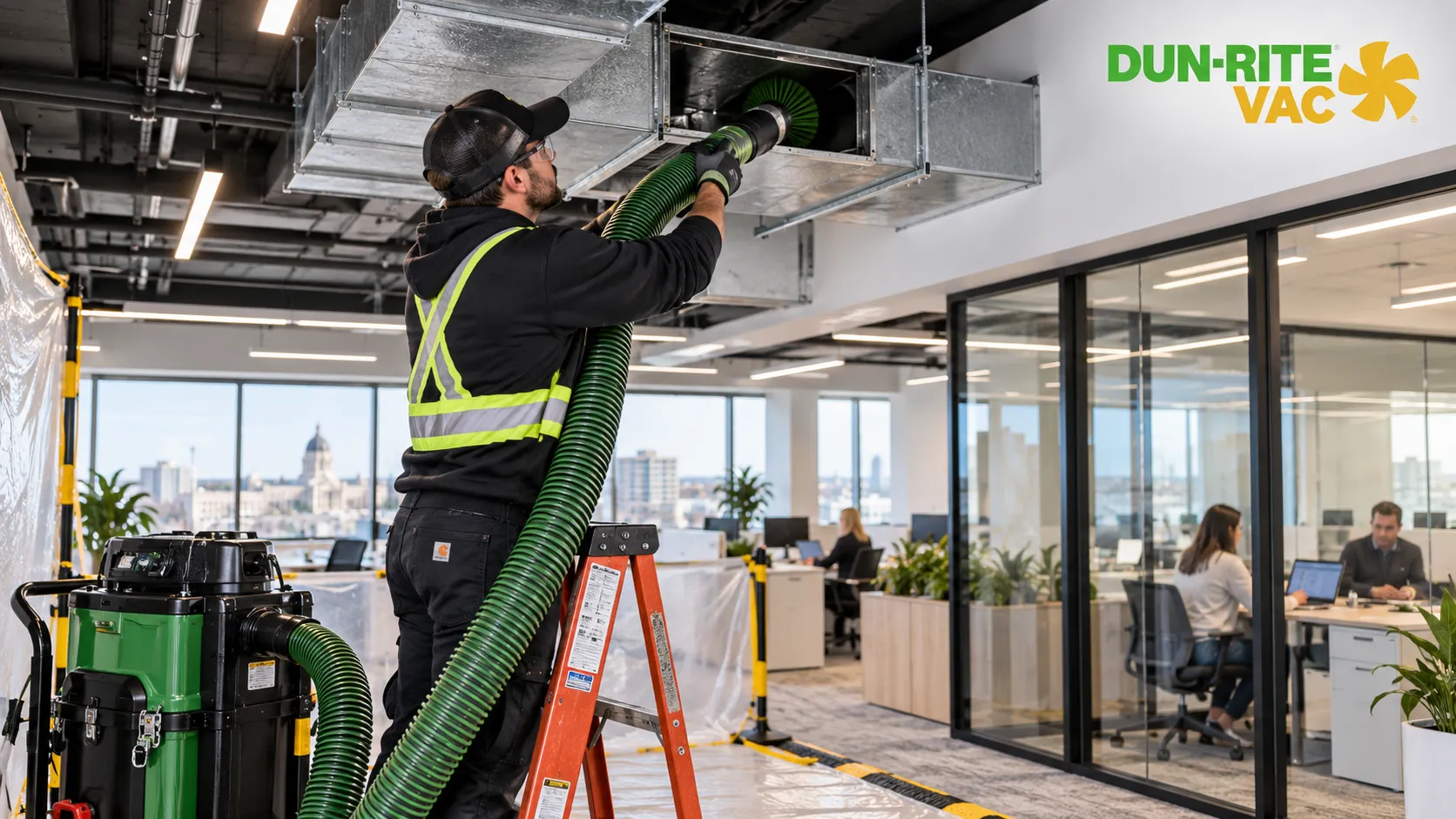
Nobody wants to explain to tenants why the air went quiet for a day, or tell a production supervisor that duct work stopped a line. Commercial HVAC cleaning without downtime isn’t achievable in every building, but disruption can sometimes be reduced through careful phasing when the system layout, access and operating schedule allow it. NADCA’s commercial HVAC standards and specifications emphasize project-specific coordination and adapting the cleaning scope to the building and HVAC system. Most of that planning happens before a technician opens an access panel.
Below is how a project gets built around business hours, tenant schedules and production requirements, and what a facility manager should expect at each step.
Quick Answer: It can be, in buildings where the HVAC layout, access and operating schedule allow it. The work is scheduled around business hours (after-hours or phased), the section being cleaned is isolated and held under negative pressure, and the plan is confirmed in a pre-job walkthrough. Crew presence and some temporary airflow changes are normal; the goal is keeping disruption within what your operation can tolerate.
In this post
- What Commercial HVAC Cleaning Without Downtime Actually Requires
- Walking the Building First: Where Access Planning Succeeds or Fails
- After-Hours Duct Cleaning vs. Phased Daytime Cleaning
- Commercial Air Duct Isolation and Containment: How Occupied Areas Stay Protected
- Keeping Tenants and Production Crews From Being Surprised
- The Paperwork You Should Have in Hand When the Crew Leaves
- FAQ
What Commercial HVAC Cleaning Without Downtime Actually Requires
A common assumption is that “no downtime” means invisible work: no noise, no crew, no change to airflow anywhere in the building. That isn’t realistic. A crew is on-site, equipment is running, and some temporary airflow changes can occur depending on the system.
What can be realistic is limiting disruption so heating and ventilation stay within what your operation can tolerate. Whether that’s achievable depends on the HVAC layout, how many air handlers serve the building, how well a work area can be isolated, and when the building operates. A no-downtime promise is only worth trusting after someone has reviewed the system, the access and your operating requirements.
For what a commercial cleaning covers overall, see our commercial furnace duct cleaning page, part of our wider furnace duct cleaning service. This post stays focused on logistics.
Walking the Building First: Where Access Planning Succeeds or Fails
Access planning can matter as much as the cleaning itself. Common sticking points in commercial buildings include a mechanical room only one person can unlock, equipment above a tenant’s secure space, or a return-air path through an area nobody mentioned.
A good pre-job walkthrough settles a short list of questions before a date goes on the calendar:
- Which air handlers and trunk lines serve which areas, and whether the building can realistically be split into zones.
- Who controls access to mechanical rooms, rooftops and tenant suites, and when they are reachable.
- Which areas are sensitive to dust, noise or temporary airflow changes, such as server rooms or any space with special operating requirements.
- Where equipment can be staged and where debris can leave the building without crossing occupied space.
Skipping this step can lead to avoidable delays, like an inaccessible mechanical room or tenant suite on the night of the job.
After-Hours Duct Cleaning vs. Phased Daytime Cleaning
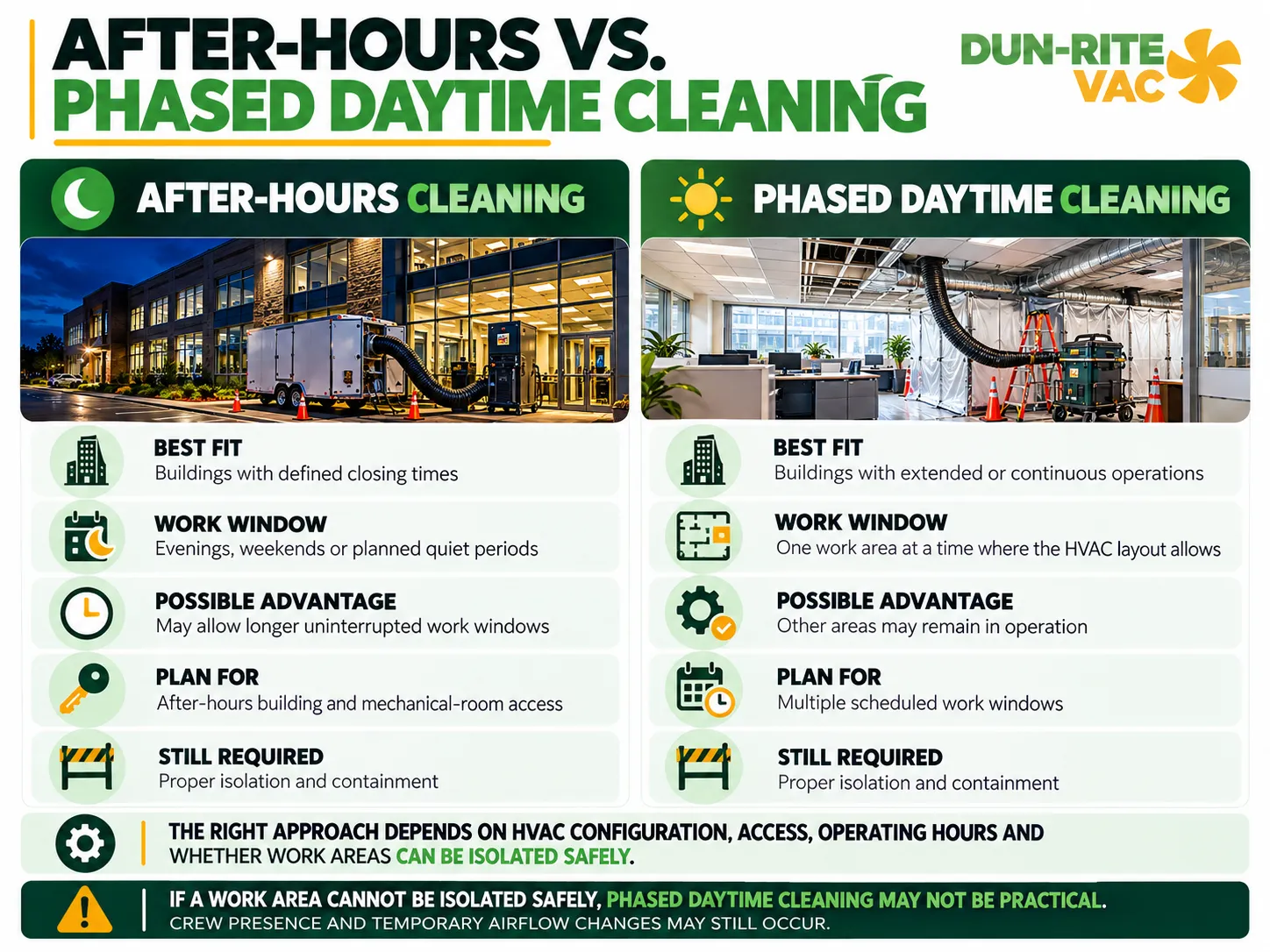
Commercial HVAC cleaning with minimal disruption can often be planned around two practical approaches: after-hours work or phased daytime cleaning. The right option depends on how your building operates, how the HVAC system is configured and whether work areas can be isolated safely.
After-hours duct cleaning suits offices, retail and other buildings with clear closing times. Most occupants won’t be present during the work, and depending on access and scope it may allow longer uninterrupted work windows. The tradeoffs are that someone must arrange building access outside normal hours, and it uses evenings or weekends. Isolation and containment are the same as in daytime work; an empty building doesn’t change how dust has to be controlled.
Phased daytime cleaning can suit buildings that never really close, such as multi-tenant properties or operations running extended shifts. Where the HVAC layout allows proper isolation, cleaning may focus on one work area at a time while other areas remain in operation. NADCA’s commercial cleaning guidance calls for negative pressure in the portion being cleaned and controls designed to limit contaminant migration into occupied spaces. The exact schedule still depends on how the individual building and HVAC system can be isolated.
If the HVAC system does not allow one work area to be isolated safely from another, phased daytime cleaning may not be practical. In that case, the better option may be a defined work window outside normal operating hours, with the cleaning sequenced around the building’s actual system layout.
Timing matters on the Prairies too. If cleaning is already due, shoulder seasons give more flexibility around heating demand than a January cold snap. Season alone isn’t a reason to clean, though.
Not sure which approach fits your building? Tell us how your site runs and when it’s quietest, and we’ll talk through a schedule that works. Reach out for a free quote and we’ll map out the options with you.
Commercial Air Duct Isolation and Containment: How Occupied Areas Stay Protected
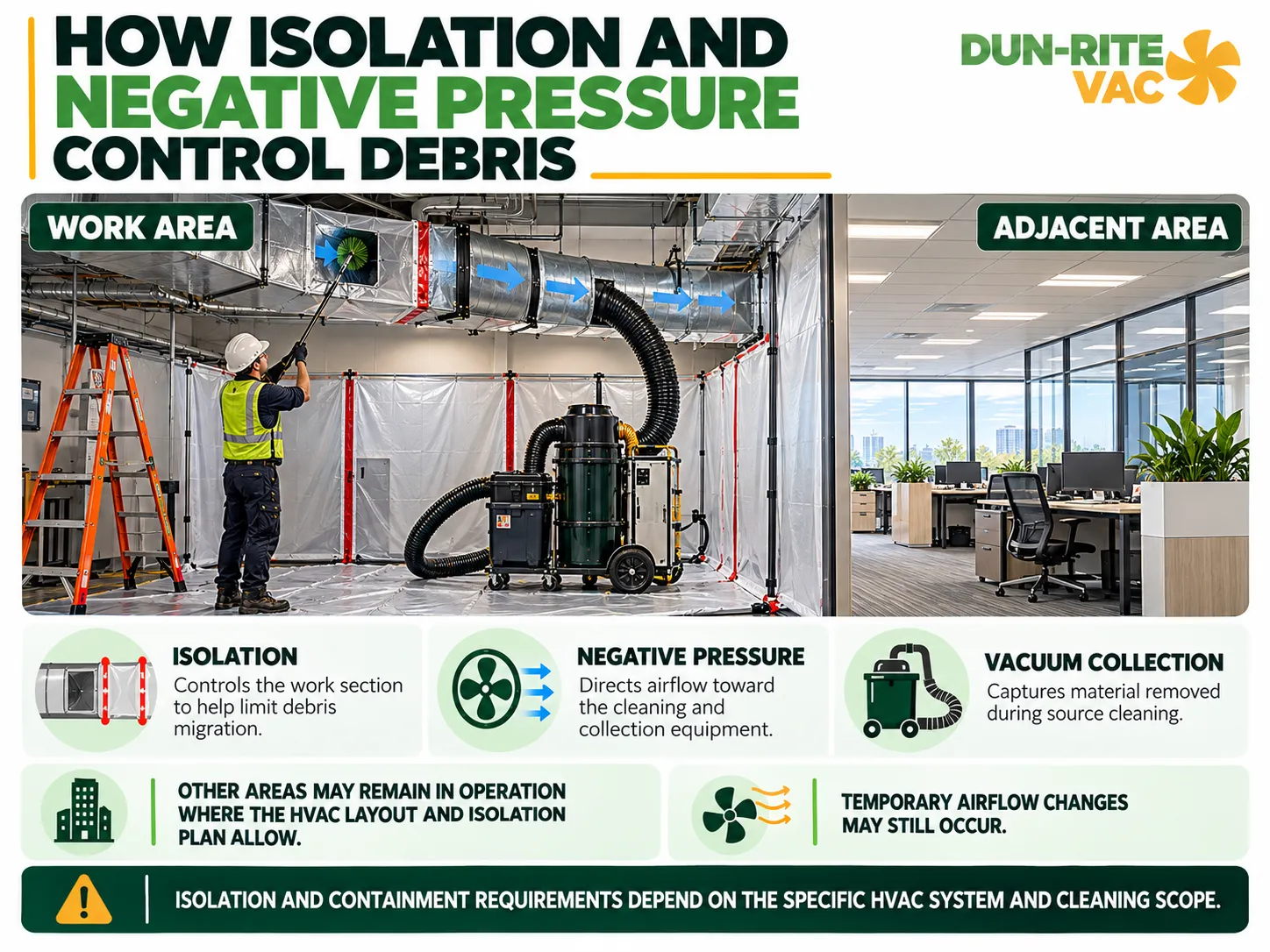
Dust control is where cleaning in an occupied building succeeds or fails. Without proper containment, debris loosened inside a duct can end up in the occupied space instead of the collection equipment, and complaints follow quickly.
Isolation means the section being cleaned is controlled so debris does not migrate into surrounding occupied areas. The NADCA ACR Standard for HVAC system assessment and cleaning addresses negative pressure, engineering controls, containment and vacuum collection during source-removal cleaning. These controls are used so dislodged material is captured by the collection equipment rather than released into occupied space.
Where the system layout allows, other zones may be able to stay in operation while this happens. Some temporary airflow changes are still possible, which is why the walkthrough flags sensitive areas ahead of time.
Dun-Rite Vac is NADCA certified and our technicians are ASCS certified. After 27+ years and 50,000+ completed jobs, we plan containment into commercial projects wherever the scope calls for it. When you’re comparing NADCA certified commercial duct cleaning providers, ask how containment will be handled in your specific building, not only whether the certification is held.
If your building has an HRV or ERV, air exchanger cleaning can be discussed alongside the duct work.
Keeping Tenants and Production Crews From Being Surprised
One communication problem that can occur is that the people most affected by a cleaning are the last to hear about it: tenants in a multi-unit building, a night-shift lead, or a front-desk team arriving to find vents covered.
Good communication is simple and specific:
- A written schedule showing which zone is being worked on which date and time.
- One named contact on both sides, so questions don’t bounce around the building.
- Advance notice drafted for tenants or staff, covering what to expect and who to call.
- A clear plan for delays, since an unexpected condition in a duct run can push a zone to the next window.
The Paperwork You Should Have in Hand When the Crew Leaves
“It’s done” isn’t enough for a building you’re accountable for. Facility managers answer to owners, tenants and sometimes insurers, and they need something they can file.
Dun-Rite provides formal post-service reporting for building management records. Whichever contractor you use, a useful report should state what was cleaned and when, note anything that couldn’t be accessed or completed in the planned window, and flag conditions the crew observed that your HVAC contractor or maintenance team may want to review.
That record also helps plan the next cycle, because you’ll know what was done, where access was tricky, and what to change.
FAQ
Can part of the building keep heating while another zone is being cleaned?
Sometimes. It depends on how the HVAC system is divided and whether the work area can be isolated safely. ASHRAE guidance for commercial and public buildings discusses using separate air-distribution systems where areas have different operating schedules or requirements, allowing those areas to operate more independently. In practice, that kind of system separation can make phased work more practical, but we confirm what is possible during the pre-job walkthrough. Some temporary airflow changes may still occur.
Does someone from our team need to be on-site during an after-hours job?
That’s decided in advance as part of the access plan. Some buildings arrange access for the crew, others assign a person to be present. What matters is that it’s settled before the scheduled date.
What affects how a commercial duct cleaning gets scheduled and quoted?
Building size, the number of air handlers and zones, access to mechanical rooms and rooftops, and your operating hours all play a part. That’s why we plan from a walkthrough rather than a guess. Send your building details through the contact form to start.
What happens if the crew finds a problem that isn’t a cleaning issue?
It’s noted in the post-service documentation so you can pass it to your HVAC contractor or maintenance team. We clean and report what we see.
Want to hear from other customers first? Our Google reviews are public.
Plan the cleaning around your building, not the other way around.
Request a free quote and we’ll work with you on a schedule that fits your building’s operating hours. Our completed work is backed by our 100% Satisfaction Guarantee.