
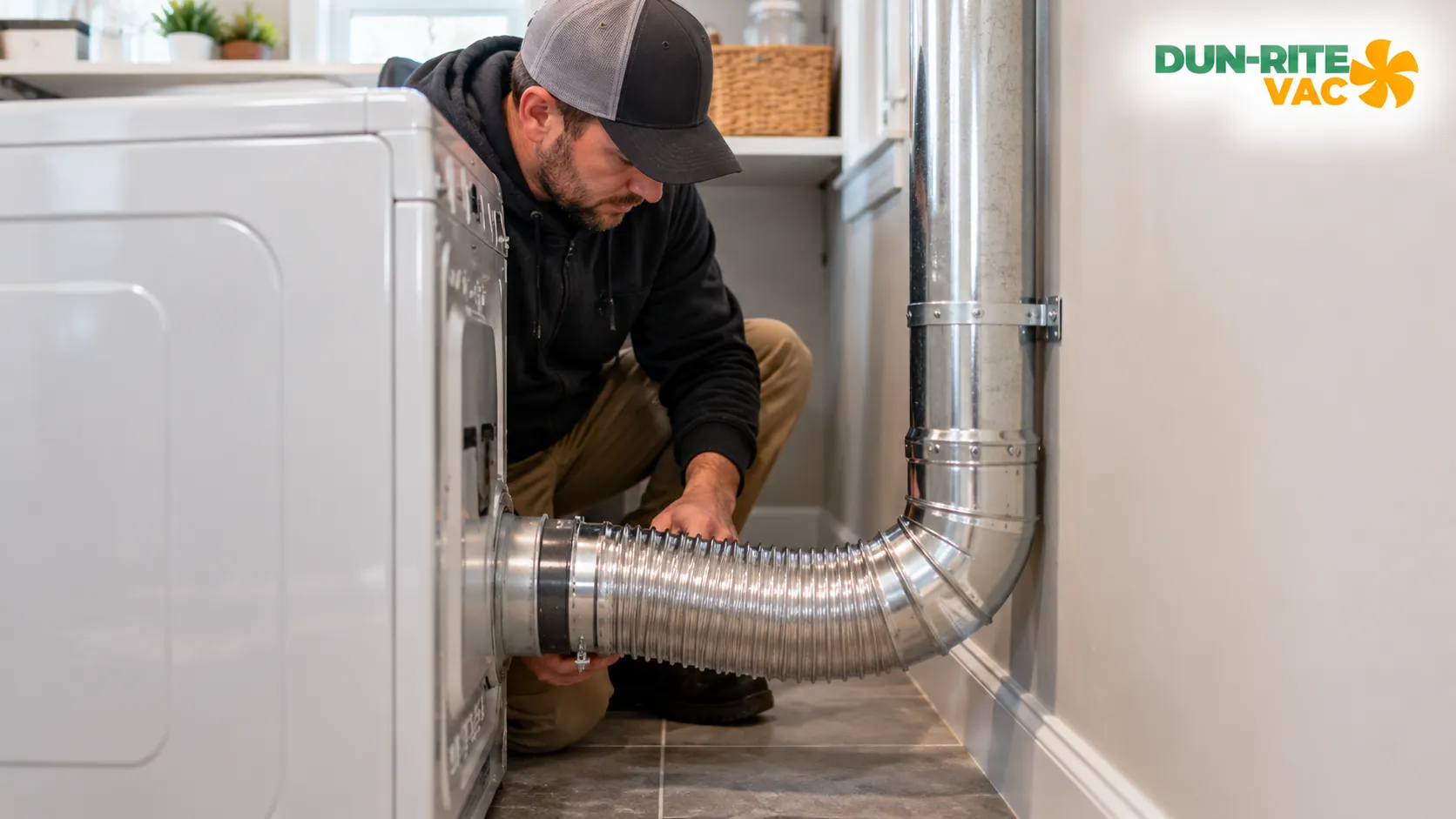
Slide your dryer away from the wall and you’ll find one of several dryer vent hose types linking it to the house: shiny foil, ribbed aluminum, white vinyl, or smooth metal pipe. Most homeowners treat it as one part. In reality there are two very different pieces of the vent path, and the material of each affects how well it can be cleaned and how readily lint collects.
Here’s how to tell them apart, what the materials mean for a cleaning visit, and why the final word on what’s allowed belongs to your dryer’s manufacturer rather than to us.
Quick Answer: The vent path has a short transition connector behind the dryer and a permanent exhaust duct in the wall, floor, or ceiling. The U.S. Consumer Product Safety Commission (CPSC) recommends rigid or corrugated semi-rigid metal duct instead of plastic or foil accordion-style duct, which can trap lint more easily and is more susceptible to kinking or crushing. What your dryer may actually use is set by its manual and local requirements.
In This Post
Dryer Vent Hose Types Fall Into Two Jobs, and Most Homeowners Only Think About One
When people say “the dryer hose,” they usually mean the accordion-style piece they can see and touch. That’s the transition connector: a short length that joins the dryer’s exhaust outlet to the duct in the wall. It gets bumped, bent, and pulled out every time the dryer moves.
The permanent exhaust duct is the pipe behind it. It runs through the wall, floor, or ceiling to an outside termination, and it carries nearly all of the air and lint. You mostly can’t see it, so it rarely gets a second thought.
The split matters because each piece faces different risks. The connector is handled whenever the dryer moves, so kinking and crushing are the usual concerns. The permanent duct is out of sight, so lint buildup, routing, and joint problems can go unnoticed. Either one can restrict airflow, though.
The Crushed Connector Behind the Dryer Is Where We Look First
Towels that are still damp after a full cycle, a laundry room that feels unusually warm or humid, or a dryer that feels unusually hot can all be reasons to check the venting. Maytag’s dryer troubleshooting guidance lists long drying times, heat and ventilation issues among the signs worth investigating. These symptoms can have other causes, but restricted airflow is one possibility, and the transition connector is a practical place to inspect first.
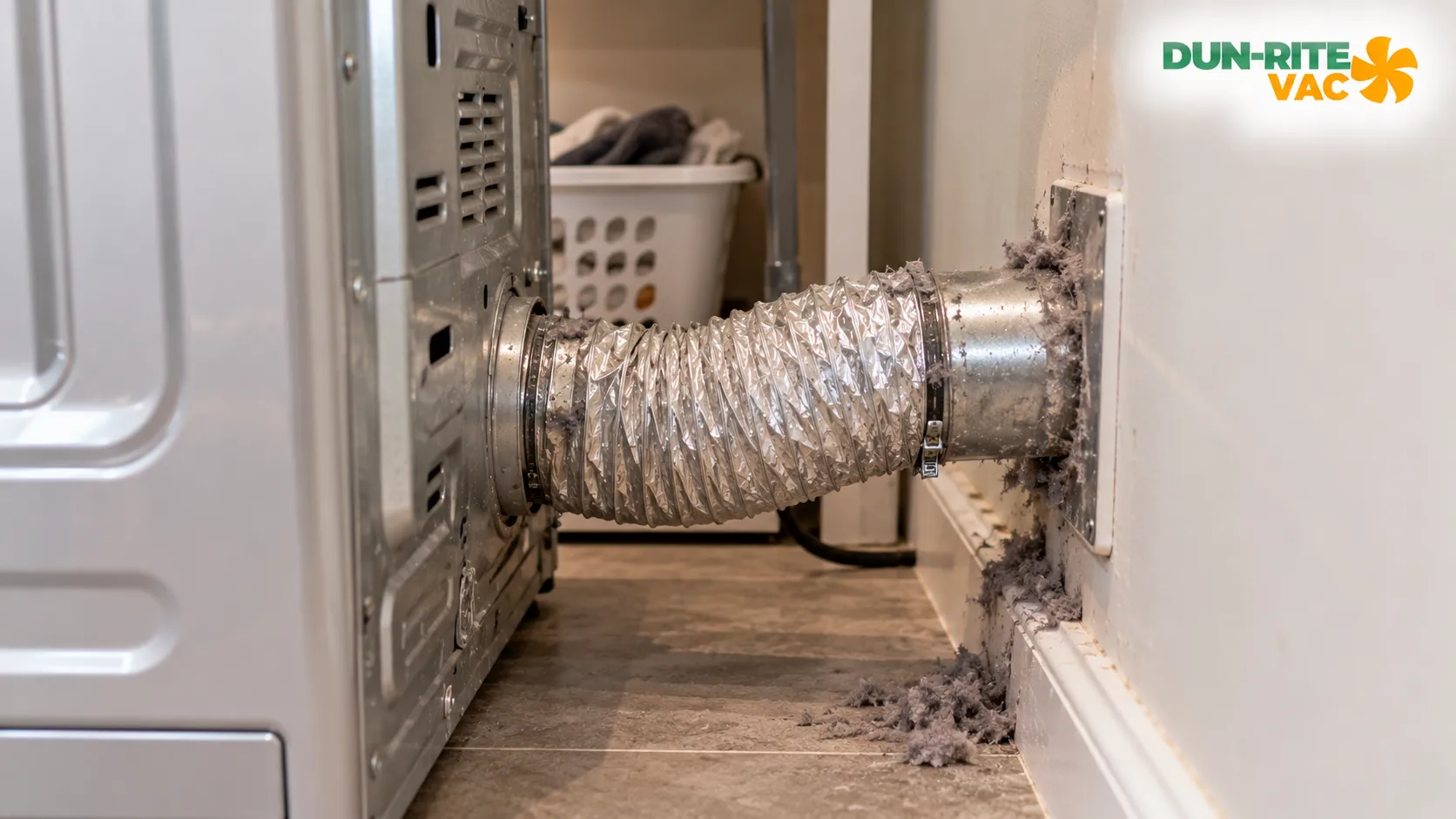
A common situation our technicians run into is a transition connector pinched into a tight bend behind a dryer that’s been pushed up against the wall. The bend narrows the passage, lint collects in the folds, and the dryer pushes air through a much smaller opening than it was designed for.
It’s a simple thing to check. If your connector looks kinked, flattened, or sharply bent, that’s worth addressing before you worry about the duct behind it.
Not sure what’s going on behind your dryer? A quick conversation with our team can help you work out whether you’re dealing with a bent connector or something deeper in the vent. Ask us a question, no commitment needed.
Rigid Metal vs. Flex Dryer Vent: How the Material Changes the Cleaning
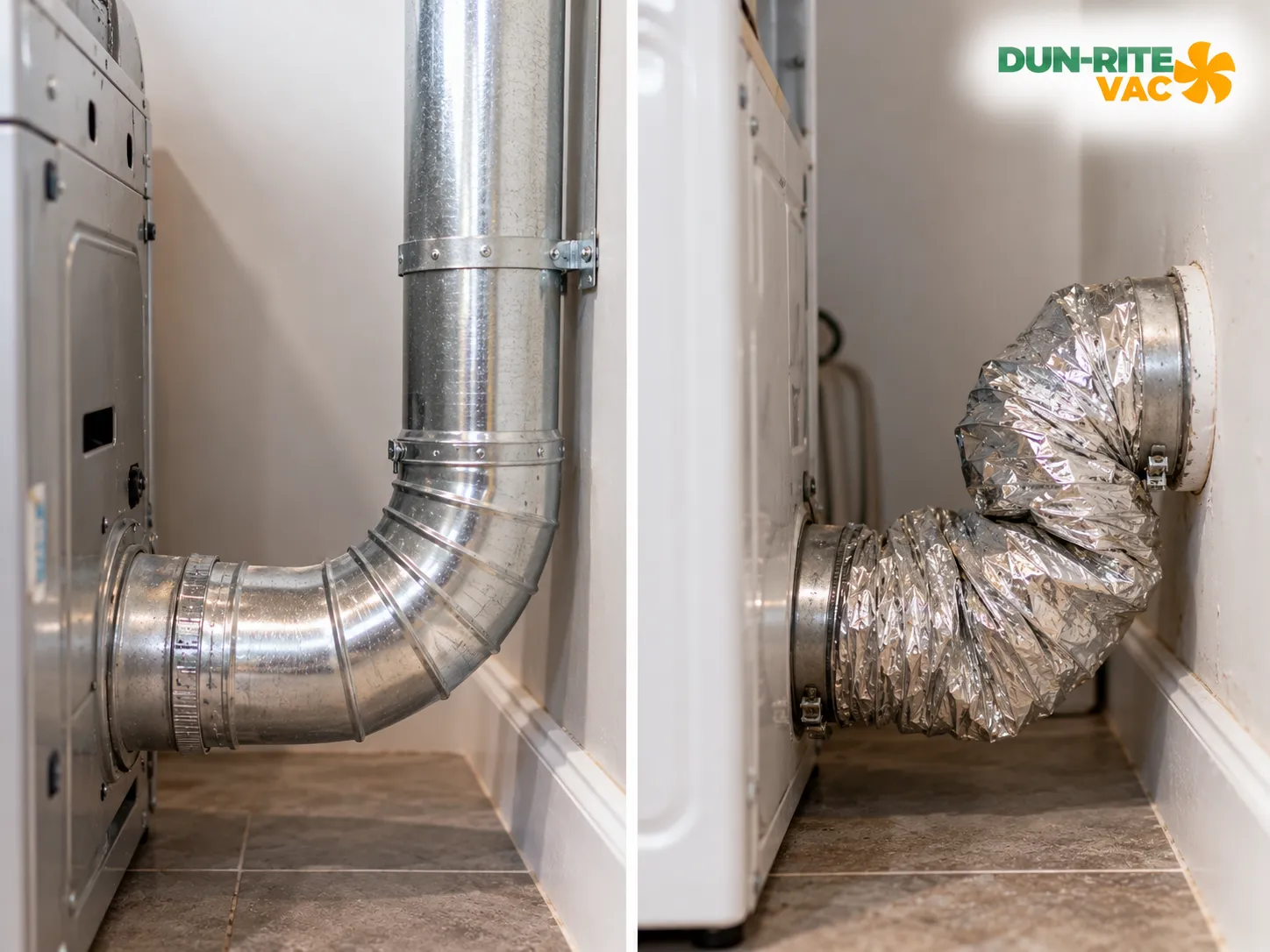
A rigid metal dryer vent has a smoother interior and holds its shape, while flexible accordion-style duct has more ridges where lint can collect and is more vulnerable to kinking or crushing. The CPSC’s clothes dryer maintenance guidance notes that most manufacturers specify rigid or corrugated semi-rigid metal duct for maximum airflow. Here’s how each material affects a cleaning:
| Material | What it means for cleaning |
|---|---|
| Rigid metal | Smooth walls give lint little to hold; joints and the exterior termination are the spots to check. |
| Semi-rigid aluminum | Often used as the short connector. Its ridges hold more lint than smooth pipe, and it can dent or kink if the dryer is pushed back carelessly. |
| Foil flex | Foil accordion-style duct can collect lint in its ridges and is more vulnerable to crushing or damage. Manufacturer rules also differ: some models prohibit foil, while others permit only specific listed transition ducts under defined conditions. Compare Whirlpool’s dryer installation instructions with GE Appliances’ exhaust duct guidance, and always check the instructions for your own dryer. |
| Vinyl or plastic flex | The CPSC recommends replacing flexible plastic or foil accordion-style duct with rigid or corrugated semi-rigid metal. If your dryer has plastic or vinyl venting, check the manufacturer’s instructions and applicable local requirements before deciding what should replace it. |
What we find when we open up the vent path on some homes is flexible material stretched across a long run and sagging between supports. The low points give lint a place to settle and stay. Some manufacturer instructions also say flexible metal duct should stay accessible rather than be concealed in walls, ceilings, or floors. Long runs are a topic of their own, so we’ve covered them in our guide to cleaning long dryer vent runs.
Is There a “Best Dryer Vent Hose”? Start With What Your Manual Allows
People search for the best dryer vent hose as if one product wins everywhere. It doesn’t work that way. Your dryer’s installation instructions should be the starting point for approved vent materials and model-specific length requirements. GE Appliances’ dryer exhaust guidance, for example, directs homeowners to model-specific installation instructions for permitted ducting and vent-length recommendations. Local requirements may add their own rules, so those sources outrank any general recommendation, including ours.
Dun-Rite’s job is cleaning, not selling or installing vent materials. If a connector needs replacing or your run needs changing, a qualified installer or appliance technician should handle it. What we can tell you from a cleaning visit is the condition of what’s there. Installation instructions commonly address clamps, kinking, support, and maximum length, so these make good checkpoints:
- Dents, crushed sections, or sharp bends
- Tears, holes, or brittle, discoloured material
- Loose or missing clamps at either end
- A run that’s longer than your dryer manual allows
Condition matters, but so does approval. An undamaged connector can be cleaned and kept only if its material, size, and installation are still permitted by your dryer’s manufacturer and local requirements. A torn, crushed, or non-approved one needs replacing by the right person, not more brushing. And if you notice moisture or frost in the vent during cold months, our post on dryer vent condensation in winter covers that separately.
When Your Hose Type Points Toward a Professional
A short, smooth, easily reached run with an intact, approved connector can be a reasonable candidate for a careful DIY clean, as long as you can disconnect and reconnect the dryer safely, won’t damage the duct, and are following your manufacturer’s instructions. We’d rather say so than oversell every situation as urgent. Our breakdown of brush kits versus professional cleaning explains where that line sits, so we won’t repeat it here.
The picture changes with flexible duct inside walls, runs you can’t see the end of, or any material you can’t identify. Dun-Rite Vac is a third-generation, family-run business operating since 1998, is a NADCA member company, and has technicians who hold ASCS certification. With more than 50,000 completed jobs, we have extensive experience assessing and cleaning dryer vent systems. When you’d like someone to take a look, our dryer vent cleaning service is built for exactly that.
Frequently Asked Questions
Can a flex connector be reused after the vent is cleaned?
Only if it’s intact and a type your dryer’s manual and local requirements permit. If it’s torn, brittle, permanently kinked, or not an approved material, replacement through a qualified provider is the better call.
Is it okay to clean a foil dryer vent connector?
First check whether your dryer’s manual allows foil at all, because some prohibit it and others permit only specific listed types. If it’s allowed and undamaged, cleaning needs to be gentle and thorough in the folds, since thin foil tears easily. If it isn’t allowed, replacement is the answer.
Should I keep using a vinyl or plastic dryer vent hose?
The CPSC recommends replacing plastic or foil accordion-type duct with rigid or semi-rigid metal, and plastic or vinyl is generally not approved by dryer manufacturers or building codes. Have a qualified provider replace it and confirm what’s right for your dryer and local requirements.
You Might Also Find This Helpful
- How long dryer vent runs are cleaned
- Dryer vent brush kits: DIY vs. professional
- Signs of a clogged dryer vent
Curious what’s behind your dryer? Every cleaning is backed by our 100% Satisfaction Guarantee, so asking for a free quote puts nothing at risk.