
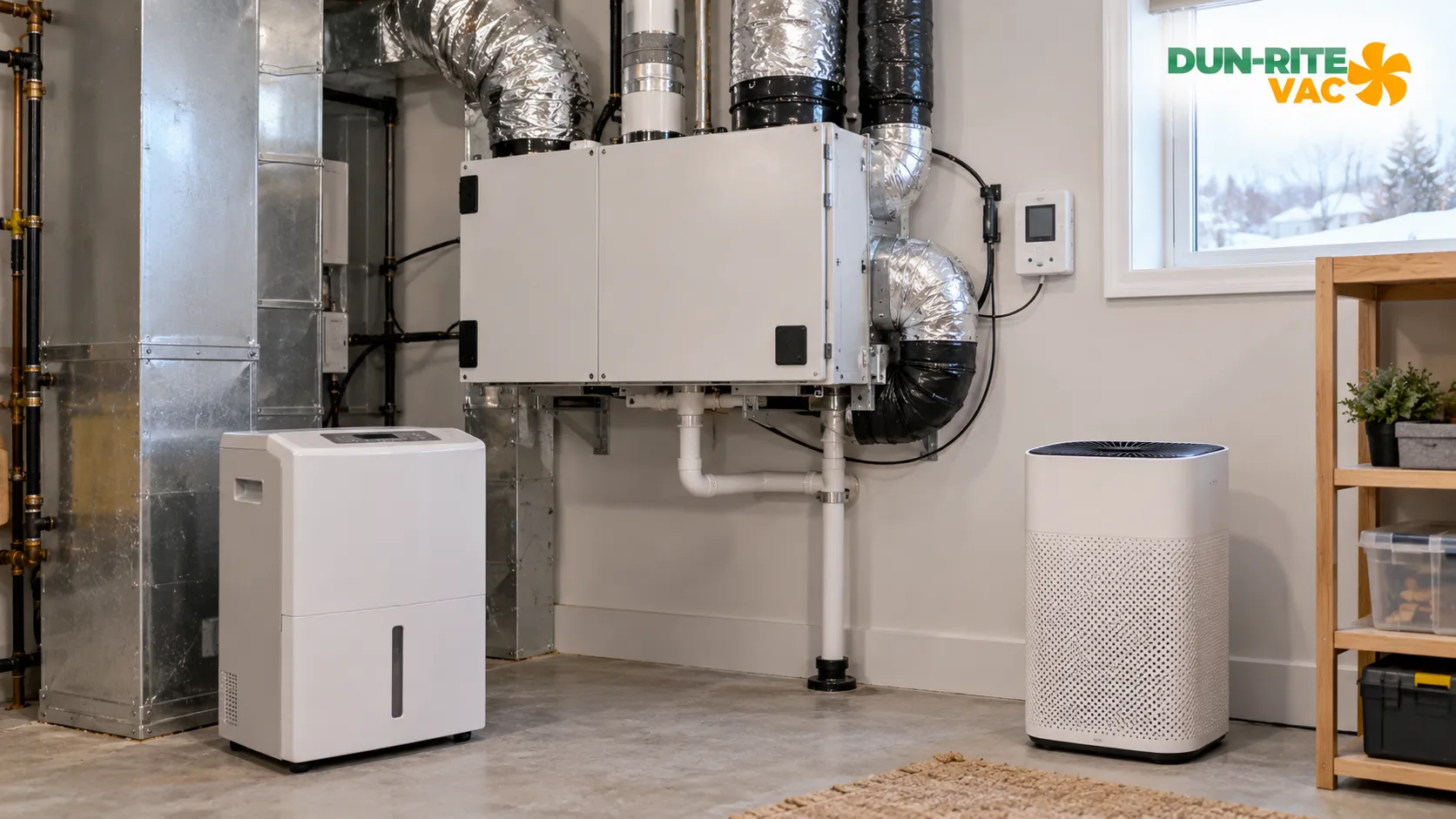
A stuffy bedroom, a clammy basement and a film of dust on every surface can all feel like “bad air,” so it’s tempting to buy one device and expect it to fix everything. The air exchanger vs dehumidifier question comes up a lot for exactly that reason: the two machines sound similar but solve different problems, and an air purifier solves a third.
Dun-Rite Vac cleans air exchangers for homes across Saskatchewan and Western Manitoba. This guide sorts out which device answers which question, so you can spend money and effort in the right place.
Quick Answer: An air exchanger swaps stale indoor air for fresh outdoor air, a dehumidifier pulls moisture out of the air, and an air purifier filters particles from the air already in the room. None of them does the others’ job, so the right one depends on whether your problem is stale air, excess moisture or airborne dust.
In this article
- Air Exchanger vs Dehumidifier vs Purifier: Three Different Jobs
- Why a Sealed Prairie Home Can Feel Stuffy and Damp at the Same Time
- What Saskatchewan and Western Manitoba Weather Does to Each Device
- Why Air Exchanger Maintenance Matters
- Matching the Symptom to the Device Before You Buy
- Frequently Asked Questions
Air Exchanger vs Dehumidifier vs Purifier: Three Different Jobs
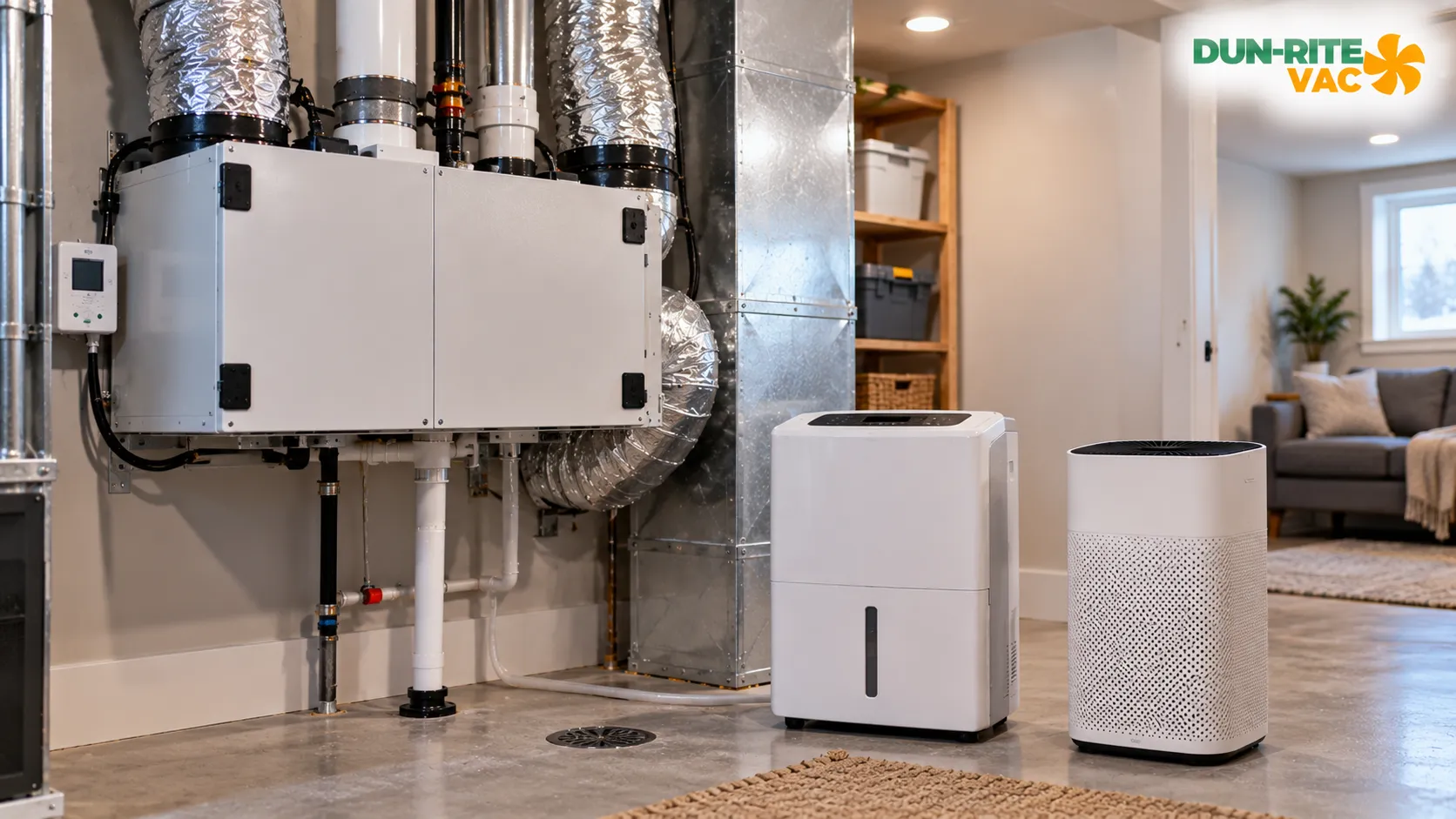
The common assumption is that these are three versions of the same appliance, just at different price points. They aren’t. Each one has a different primary job, and the table below shows how they split the work. “Air exchanger” here means a heat recovery ventilator (HRV) or an energy recovery ventilator (ERV). Both bring in outdoor air and exhaust indoor air, but they handle moisture differently. Health Canada’s ventilation guidance explains that HRVs and ERVs provide balanced mechanical ventilation, while ERVs also transfer some moisture between the outgoing and incoming air streams.
| Air exchanger (HRV or ERV) | Dehumidifier | Air purifier | |
|---|---|---|---|
| Primary job | Replace stale indoor air with fresh outdoor air | Remove excess moisture from the air | Capture particles in the air already in the room |
| What it does | Exhausts stale indoor air and brings in fresh outdoor air. An HRV transfers heat between the two air streams; an ERV transfers heat and some moisture | Condenses water out of the air and collects or drains it | Passes room air through a filter to catch dust and other particles |
| What it does not do | Filter fine particles to purifier standards, or replace a dehumidifier when direct moisture removal is needed (ventilation can still affect indoor humidity) | Bring in fresh air or remove dust | Bring in fresh air or remove moisture |
| Scope | Typically whole-home; may use dedicated ducts or connect to a forced-air system, depending on the installation | One room or area (portable and whole-home types exist) | Usually one room, depending on the model |
| Biggest caveat | Performance depends on the model, whether it’s an HRV or ERV, and on how cold or humid it is outside | Works best when the air is actually damp; capacity varies by model | Filter type and room-size rating vary widely between models |
One note on scope: Dun-Rite cleans air exchangers, we don’t sell or install any of these devices. This comparison exists so you know what you’re dealing with before you decide what to buy or what to have maintained.
Why a Sealed Prairie Home Can Feel Stuffy and Damp at the Same Time
Start with the symptom instead of the gadget. Say a house feels stuffy, windows fog in the morning, and the basement smells close. The instinct is to buy a dehumidifier, and it may well help with the damp part.
Cold-climate houses are built tight to hold heat, which also means moisture, cooking smells and everyday indoor air have fewer places to go. A dehumidifier treats the moisture. It doesn’t replace stale indoor air with fresh air, which is the job of mechanical ventilation. So a tightly sealed home can end up with a dehumidifier running in the basement while the ventilation question goes unanswered.
The reverse mistake is also possible. A home with well-functioning ventilation can still have a damp corner for reasons unrelated to air exchange, such as a poorly drained area or a room that doesn’t get much airflow. That calls for localized moisture control and, if the dampness persists, a look at where the moisture is coming from.
What Saskatchewan and Western Manitoba Weather Does to Each Device
None of these devices works in a vacuum, and Prairie weather changes how each one behaves through the year. Saskatchewan’s winters include some of the province’s coldest and driest months, as described in the Government of Saskatchewan’s climate overview. During cold, dry conditions, bringing outdoor air indoors through an HRV can lower indoor humidity. An ERV transfers some moisture between the outgoing and incoming air streams, which can reduce that drying effect. Health Canada’s ventilation guidance explains these differences between HRV and ERV operation. How much either system changes indoor humidity depends on the model and conditions.
In humid summer weather, the picture changes. Ventilating with moist outdoor air can raise indoor humidity, and the effect differs by system type and by indoor and outdoor conditions. Health Canada notes that summer ventilation can affect indoor humidity and that an ERV or separate dehumidifier may be appropriate depending on the conditions. A dehumidifier is designed specifically to remove excess moisture from the air, and ENERGY STAR’s dehumidifier guidance explains how capacity should be matched to the space and moisture conditions.
A portable air purifier recirculates and filters the air in a room. It can reduce airborne particles, but it doesn’t provide ventilation, so it can’t refresh that air. The U.S. EPA’s guide to air cleaners in the home explains that portable air cleaners are designed for individual rooms or areas, and that effectiveness depends on factors such as the filter, airflow and whether the unit is appropriately sized for the room. Air cleaning supplements rather than replaces ventilation and source control. Operating schedules and seasonal settings for HRVs are a separate topic, so we’ll leave those aside here.
Why Air Exchanger Maintenance Matters
Whatever else you add to the house, a ventilation system you already own should be kept in good working order. HRVs and ERVs rely on filters, grilles and a core that need regular maintenance. Health Canada recommends regular HRV/ERV maintenance, including cleaning or replacing filters, keeping intake and exhaust openings clear, and maintaining the heat-exchange core. Dirty filters or obstructed components can affect airflow and ventilation-system performance.
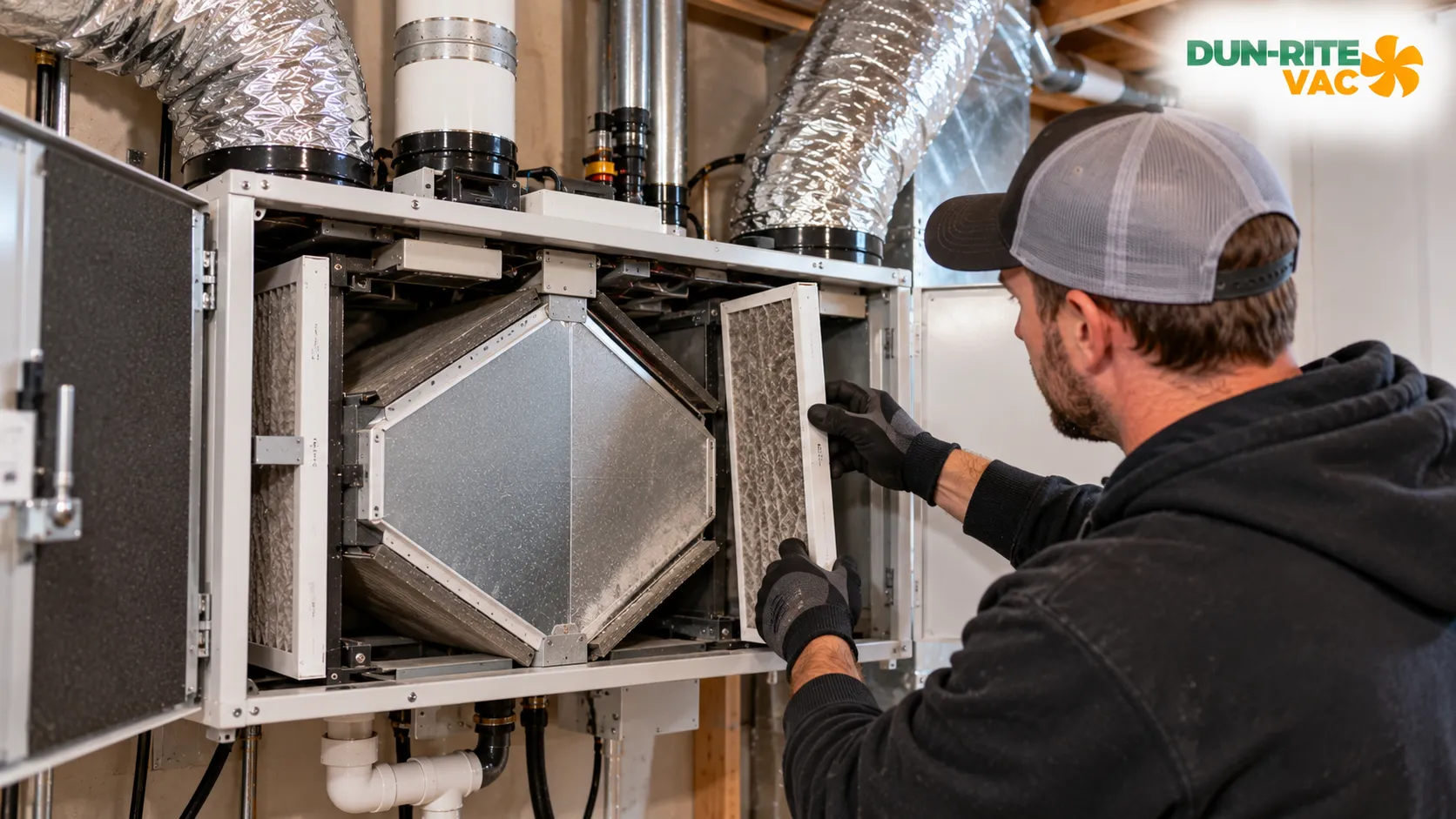
If you notice stale air or persistent stuffiness, checking your air exchanger’s condition is one sensible step, alongside looking at humidity and filtration. In homes that rely on an HRV or ERV for balanced mechanical ventilation, maintaining that system is important.
This is the work our air exchanger cleaning service covers. Dun-Rite Vac is a NADCA member company, and our technicians hold ASCS certification. As a third-generation family business with 50,000+ completed jobs since 1998, we focus on getting air exchangers clean and working the way they were designed to.
Not sure whether your air exchanger is due for cleaning? Send us a note through our contact page and we’ll talk through what you’re noticing. A quote is free, and there’s no pressure to book anything.
Matching the Symptom to the Device Before You Buy
A useful way to decide is to ask which of three things you can actually observe, rather than which product sounds best.
- The air feels stale, with lingering cooking smells or foggy windows: look at ventilation, which includes checking your air exchanger’s condition and maintenance.
- A specific area feels clammy or damp: a dehumidifier (portable or whole-home) targets the moisture in the air. If the dampness is persistent and localized, also check for an underlying moisture source such as a leak.
- Dust or particles are the main complaint: a portable air purifier can reduce airborne particles when it’s properly sized for the room, though it doesn’t remove every pollutant.
Be realistic about what any of them promises. Filtration supplements, rather than replaces, source control and ventilation. None of these devices is a cure for illness or a guaranteed fix for mold, and a good seller will say so. If you have a mold concern, that calls for finding and addressing its source, which is outside what these appliances do. If you’re curious how HVAC cleaning treatments differ from filtration, our HVAC sanitization page explains that separately.
Many homes need only one or two of these tools, and which ones depends on what you’re actually seeing: stale air, excess moisture or airborne particles.
Frequently Asked Questions
Can an air purifier replace an air exchanger in a tightly sealed house?
No. A purifier filters the air already in the room, but it doesn’t bring in outdoor air or push stale air out of the house. In a sealed home, that fresh-air exchange is the part ventilation exists to provide.
Will my air exchanger lower indoor humidity in winter?
It can, because cold winter air is very dry, but the effect varies by model and by outdoor conditions. An HRV tends to dry a home more in winter, while an ERV transfers some moisture between air streams. Check which type you have before expecting a specific result.
If my basement feels damp, should I run the air exchanger harder instead of buying a dehumidifier?
Not necessarily. In humid summer weather, bringing in more outdoor air can add moisture rather than remove it, depending on your system type and conditions. A damp area is usually better handled by a dehumidifier sized for that space, and persistent dampness is worth investigating for its source. Keep the air exchanger maintained either way.
Wondering about your air exchanger? If it hasn’t been cleaned in a while, we’ll get it cleaned and working the way it should, backed by our 100% Satisfaction Guarantee.