

If you’re comparing air duct sanitizing vs mold remediation, the key difference is the scope of the problem. HVAC cleaning and sanitizing deal with conditions inside appropriate parts of the heating and cooling system. Mold remediation addresses a broader moisture and contamination problem that may involve building materials, hidden areas, or materials that cannot be adequately cleaned.
The right service depends on what material is affected, how extensive the problem is, whether moisture is still present, and whether the affected material can actually be cleaned. Sanitizing should not be used as a substitute for removing mould or correcting the conditions that allowed it to grow.
Quick Answer: HVAC sanitizing and mold remediation are not interchangeable. If mould or suspected microbial growth is present, the moisture source should be identified and corrected, contaminated material should be physically cleaned or removed as appropriate, and the HVAC system should be evaluated based on the materials involved. An antimicrobial treatment may be considered in some HVAC applications after proper cleaning, but it should not be presented as a substitute for mold removal or moisture correction.
In this post:
When Air Duct Sanitizing Isn’t the Right Solution for Mold
Sanitizing is sometimes mistaken for a stronger version of duct cleaning or a way to solve any mould concern inside an HVAC system. That’s not how the services should be approached.
Professional duct cleaning physically removes accumulated material from appropriate HVAC surfaces. HVAC sanitization is a separate treatment that may be considered afterward when there is a justified reason for its use and the specific product is approved for the intended application.
If mould is growing on building materials outside the duct system, an HVAC treatment does not address the full problem. Drywall, insulation, ceiling materials, flooring, framing, and other components may require different cleaning, removal, drying, or repair methods depending on the material and extent of contamination.
The EPA also cautions that simply killing mould is not enough. Mould must be physically removed, and the moisture problem that allowed it to grow must be corrected.
Air Duct Sanitizing vs. Mold Remediation: Where the Line Falls
One important factor is the type of material affected.
Hard, non-porous surfaces can often be physically cleaned when mould is present. EPA guidance recommends scrubbing mould from hard surfaces and drying them completely. An additional antimicrobial treatment is a separate decision and should not automatically be assumed necessary simply because the surface is non-porous.
Porous or absorbent materials can be more difficult to restore. The EPA notes that some mould-contaminated porous materials may need to be discarded because mould can grow into spaces that are difficult or impossible to clean completely.
HVAC duct materials require particular care. If substantial mould is present inside hard-surface ductwork, professional cleaning may be considered. However, EPA states that wet or mould-contaminated fiberglass duct liner or fiberglass duct board cannot be effectively cleaned and recommends removal and replacement of affected material. :contentReference[oaicite:2]{index=2}
If you’re trying to determine whether duct cleaning removes mold in your situation, the decision depends on the affected material, the extent of the contamination, and whether the underlying moisture source has been corrected.
Why Fixing the Moisture Source Comes First
Mould growth requires moisture. Cleaning or treating a surface without correcting the moisture problem can allow the condition to return.
Health Canada advises identifying and correcting the underlying moisture source when dealing with indoor mould. If mould returns after cleaning, Health Canada says that is usually an indication that the moisture source has not been eliminated. :contentReference[oaicite:3]{index=3}
Possible causes can include leaks, condensation, excess indoor humidity, inadequate ventilation, drainage problems, or water intrusion. The appropriate repair depends on what is actually causing the moisture.
A properly maintained air exchanger can be one part of a home’s ventilation system, but an air exchanger should not be presented as a universal mould-prevention solution. Moisture problems need to be diagnosed based on the specific home and source.
If you’ve already had the HVAC system cleaned or treated and a musty odour or moisture problem continues, repeating the same service may not address the cause. Contact Dun-Rite Vac for a free quote if you need help determining whether the HVAC system itself requires cleaning or whether the issue falls outside that scope.
How Cleaning, Sanitizing, and Remediation Sequence
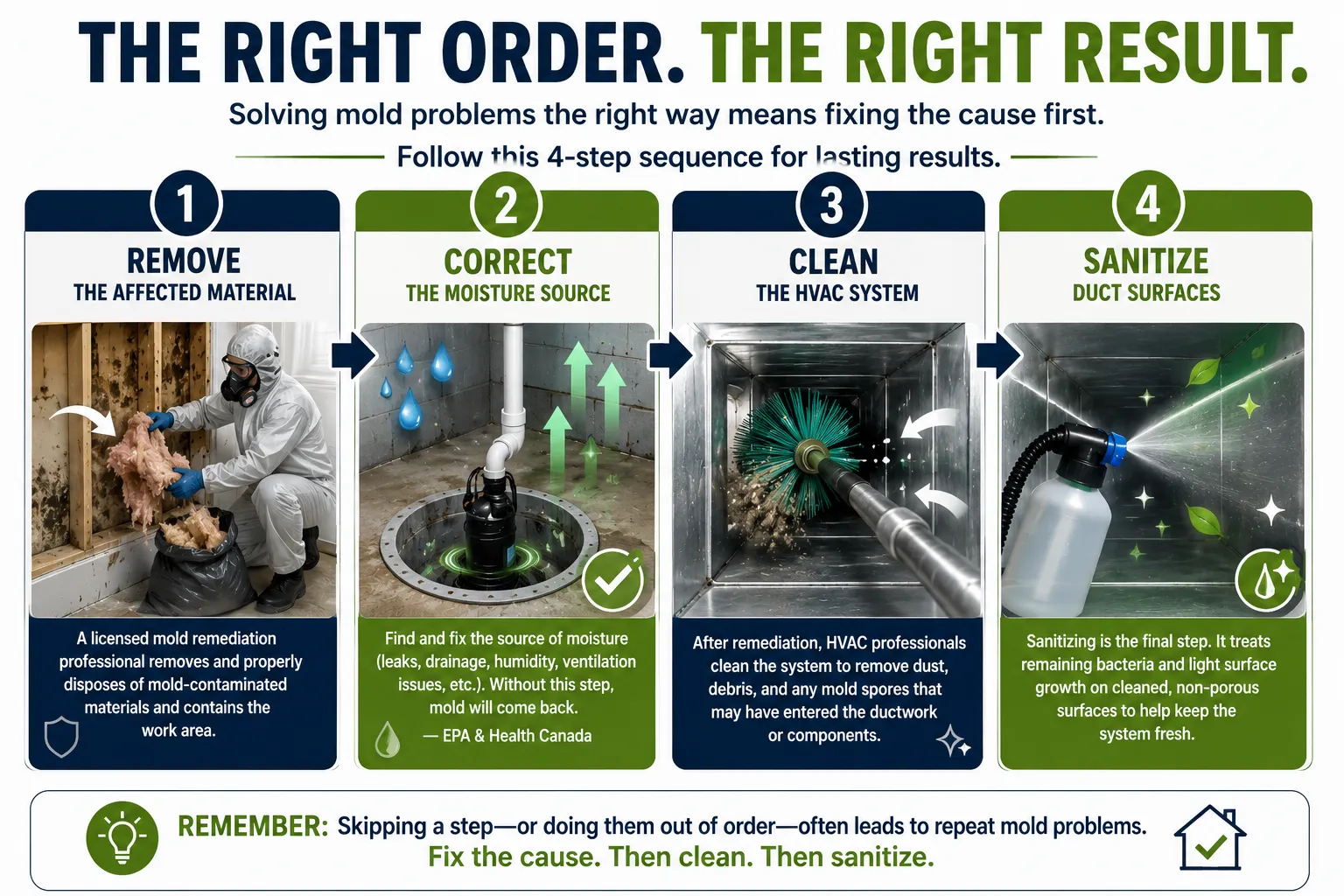
There is no single sequence that fits every mould problem, but the underlying principles are consistent: identify the moisture source, correct it, physically remove or clean contaminated material using methods appropriate for that material, and address affected HVAC components where necessary.
When a mould problem extends beyond normal HVAC cleaning, a qualified professional with experience in moisture assessment and mould remediation may be appropriate. Health Canada recommends considering professional help when there is a large amount of mould, the problem keeps returning, or the underlying moisture issue requires further investigation. :contentReference[oaicite:4]{index=4}
Professional remediation guidance such as the ANSI/IICRC S520 Standard for Professional Mold Remediation provides procedures and methodologies for professional remediation projects.
Dun-Rite Vac’s role is focused on HVAC cleaning and related services rather than whole-building mould remediation. Dun-Rite Vac is listed with NADCA and has ASCS-certified personnel. If conditions discovered around the HVAC system appear to require a broader mould or moisture assessment, the appropriate next step may be to involve a qualified professional before proceeding with additional HVAC treatment.
Why Every Property Needs an Individual Assessment
Moisture problems can occur in older homes, newer homes, acreages, commercial buildings, and multi-unit properties. Property type alone does not tell you whether mould is present or what caused it.
An older building may have a history of leaks or previous renovations, while a newer building can still develop condensation, ventilation, drainage, or envelope problems. Rural or urban location by itself does not establish greater mould risk inside the HVAC system.
Commercial buildings can add complexity because HVAC systems, drainage systems, occupied areas, and moisture sources may span multiple zones. In those situations, determining where the moisture originates and how far the problem extends can be more important than immediately choosing between duct cleaning and sanitizing.
The practical rule is the same for every property: determine what is affected, find and correct the moisture source, and choose cleaning, replacement, remediation, or HVAC treatment based on what the assessment shows.
FAQ
Can Duct Sanitizing Get Rid of Mold on Its Own?
It should not be relied on as a stand-alone mould solution. EPA notes that simply killing mould is not enough because dead mould still needs to be removed. Moisture control and physical cleaning or removal of affected material are fundamental parts of addressing the problem. Any antimicrobial treatment is an additional step whose appropriate use depends on the material, circumstances, and product label. :contentReference[oaicite:5]{index=5}
How Do I Know if I Need Mold Remediation or HVAC Cleaning?
It depends on where the contamination is located, how extensive it is, what material is affected, and whether moisture is still present. Substantial or recurring mould, hidden moisture problems, and contamination extending into building materials may justify assessment by a qualified mould or moisture professional. If the concern is limited to cleanable HVAC components, professional HVAC cleaning may be part of the solution.
If Mold Is on Metal Ductwork, Does It Automatically Need Sanitizing?
No. Hard surfaces can often be physically cleaned, but an antimicrobial treatment should not automatically be added. EPA recommends asking why biological growth cannot be physically removed and future growth prevented through moisture control before permitting a chemical biocide inside ductwork. :contentReference[oaicite:6]{index=6}
Will Dun-Rite Vac Tell Me if the Problem Is Outside Its HVAC-Cleaning Scope?
If the conditions around the HVAC system indicate that broader moisture or mould remediation may be needed, the appropriate next step may be an assessment by a qualified professional rather than proceeding with an HVAC treatment that does not address the underlying problem.
Does Fixing a Moisture Problem Always Mean a Major Renovation?
No. The solution depends on the cause. Some problems involve condensation, ventilation, drainage, humidification equipment, or another maintenance issue. Others involve leaks, water damage, or building materials that require repair or replacement. The source needs to be identified before the appropriate solution can be determined.
Should I Use an Antimicrobial Product After Mold Remediation?
Not automatically. EPA does not recommend biocides as a routine part of mould cleanup, and their use does not replace physical removal or moisture correction. For HVAC applications, any treatment should have a justified purpose and the specific product must be suitable for the intended application and used according to its label. :contentReference[oaicite:7]{index=7}
Still weighing air duct sanitizing vs mold remediation for your home or building? Dun-Rite Vac can help determine whether the HVAC system needs professional cleaning or whether the conditions point to a broader moisture or mould problem that should be assessed first.