
Central vacuum cleaning vs repair depends on what is causing the loss of suction. Your system may simply need a canister, filter or piping check, while air leaks and power-unit problems may require repair. Before replacing anything, a few basic checks can help narrow down the cause.
Weak suction has several possible causes, and they call for very different fixes. Some cost nothing, some need a cleaning, and a few need a repair technician. Here is how to tell which one you have.
Quick Answer: If weak suction shows up across several inlets, start with the canister, bag or filter before assuming the power unit is failing. Cana-Vac’s troubleshooting guidance lists a full dirt receptacle or bag and piping obstructions among possible causes of decreased suction. If only one inlet is weak, comparing it with the others can help narrow the issue to that outlet or branch. Cleaning can address debris-related restrictions, but it will not repair an air leak or a failing power unit.
In this post
- The Free Checks to Run Before You Blame the Motor
- Weak Suction at One Inlet or Every Inlet? What the Pattern Tells You
- When the Pipes Are the Problem: Gradual Buildup vs. a Lodged Blockage
- The Hiss and the Loose Inlet: Leaks That Cleaning Won’t Fix
- Central Vacuum Motor Problem: What a Tired Power Unit Looks and Sounds Like
- Central Vacuum Cleaning vs Repair: Matching the Symptom to the Fix
- Frequently Asked Questions
The Free Checks to Run Before You Blame the Motor
When a central vacuum starts losing suction, it is easy to assume the motor is failing. But simple maintenance issues can cause the same symptom, and they are much cheaper to fix.
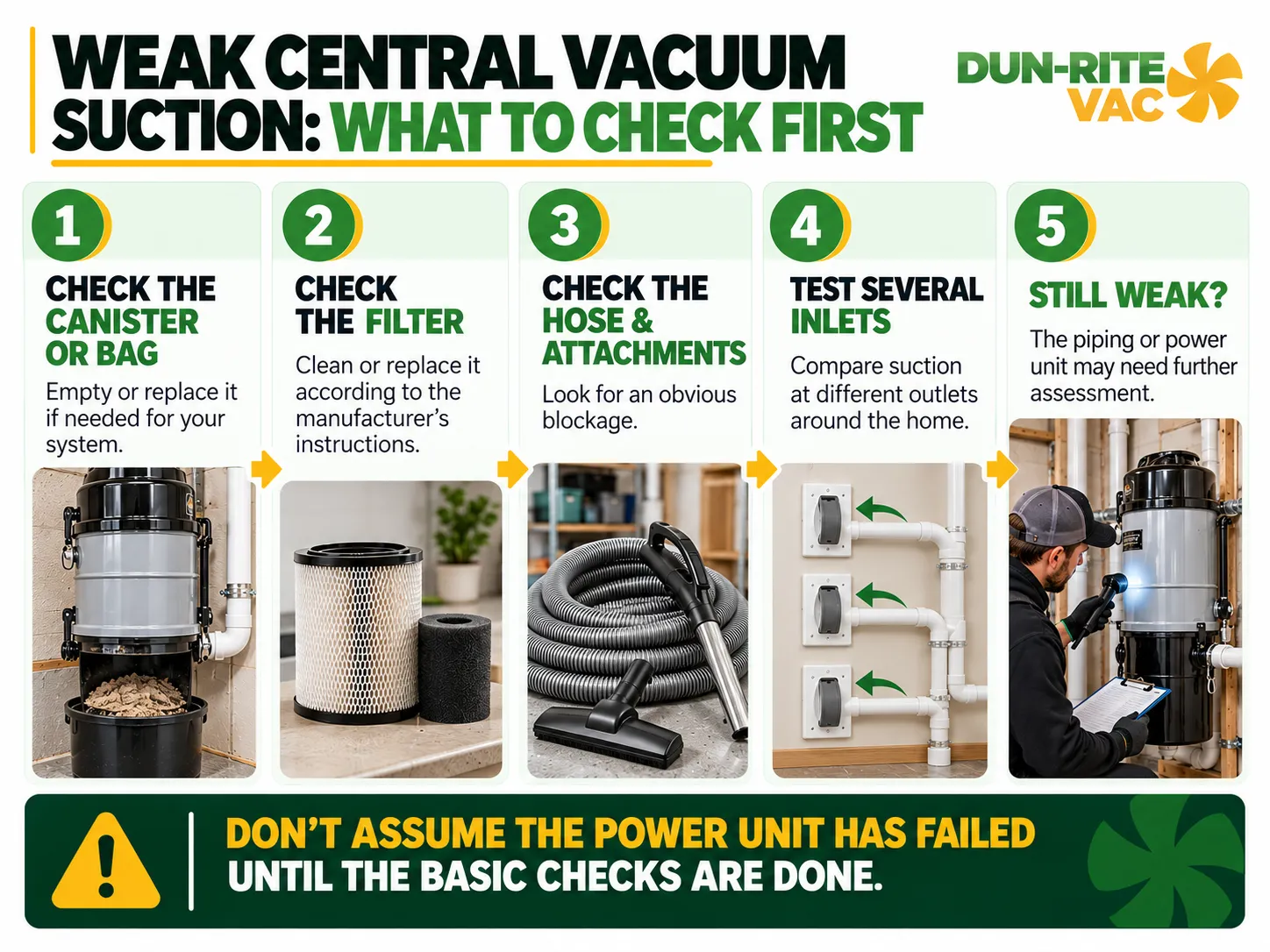
A full dirt receptacle, bag or dirty filter can contribute to decreased suction, so these are worth checking before you assume the power unit is failing. Cana-Vac’s troubleshooting guidance lists a full dirt receptacle or bag among the possible causes of reduced suction. Work through these checks in order:
- Empty the canister completely, and check the bag if your unit uses one.
- Clean or replace the filter according to your manufacturer’s instructions.
- Check the hose and attachments for a blockage.
- Retest suction at the inlet closest to the power unit.
If suction comes back, you have saved yourself a service call.
Weak Suction at One Inlet or Every Inlet? What the Pattern Tells You
If the free checks did not help, the next step is also free. Plug your hose into several inlets, starting with the one closest to the power unit, and compare. With the unit running, you can also feel the pull at an open inlet with your hand and compare it from inlet to inlet.
- Weak across several inlets: check the dirt canister or bag, filter, piping and power unit before assuming the cause.
- Weak at one inlet: the problem may be closer to that outlet or branch. Drainvac’s troubleshooting guidance recommends testing each outlet and notes that a clog may be near an outlet with no suction.
- Weak farther from the power unit: compare the outlets progressively rather than treating distance alone as a diagnosis. A restriction or piping issue may still need to be ruled out.
This comparison helps narrow down where to look next before anyone assumes the problem is the motor or starts opening up the system. If one inlet performs differently from the others, it makes sense to investigate that outlet or branch first.
When Central Vacuum Cleaning May Help With Pipe Blockages
Central vacuum piping can develop restrictions in places where debris accumulates. Drainvac’s piping guidance notes that certain short 90-degree elbows are more likely to create areas where debris can collect. That is one reason fittings and bends are worth considering when suction drops in part of the system.
A lodged blockage looks different. Something bulky gets stuck in the line, and suction at an inlet drops suddenly, sometimes after you hear a rattle or vacuum up something unusual. Heavy dust from a renovation, such as drywall dust, can also fill the filter and add to buildup in the pipes.
When the problem is debris or a blockage in the installed piping, professional central vac cleaning may be the appropriate next step. We do not recommend improvising with rods, wire or coat hangers inside concealed piping. Manufacturer-recommended blockage-removal methods vary by system, so follow the instructions for your equipment or have the line assessed if the basic checks do not solve the problem.
If your checks point to debris in the pipes, you can request a free quote for central vacuum cleaning. If they point to a leak or the motor, a repair specialist is the better first call.
The Hiss and the Loose Inlet: Leaks That Cleaning Won’t Fix
Cleaning and leak repair get confused because both show up as lost suction, but they are different problems. A clog restricts the air path. A leak lets outside air in along the way, so less suction reaches the hose even though the pipe itself is clear.
Telltale signs include a whistling or hissing sound at a wall inlet, an inlet door that no longer seats firmly, or suction that is fine in one part of the house and poor in another with no pattern to the debris. A separated pipe joint inside a wall is also possible. None of these is solved by cleaning the pipes, so a repair specialist is the right call.
Central Vacuum Motor Problem: What a Tired Power Unit Looks and Sounds Like
Motor trouble looks different from a clog. The clues are usually sensory:
- A burning smell from the power unit
- A grinding, rattling or high whine that was not there before
- The unit shutting off or cutting out partway through use
- Weak suction at every inlet even with an empty canister and a clean filter
If the power unit repeatedly shuts off or shows signs of an unresolved electrical or motor problem, stop troubleshooting and have it serviced. Cana-Vac’s owner’s manual directs users to authorized service when the unit restarts and then shuts off again. Motor maintenance and internal power-unit repairs are better left to qualified service personnel.
If the last point on that list describes your home and the other checks are clear, the motor or power unit is the likely cause. Cleaning the pipes will not repair a worn motor. That is a job for a vacuum repair specialist or a replacement unit, and the money is better spent there.
Central Vacuum Cleaning vs Repair: Matching the Symptom to the Fix
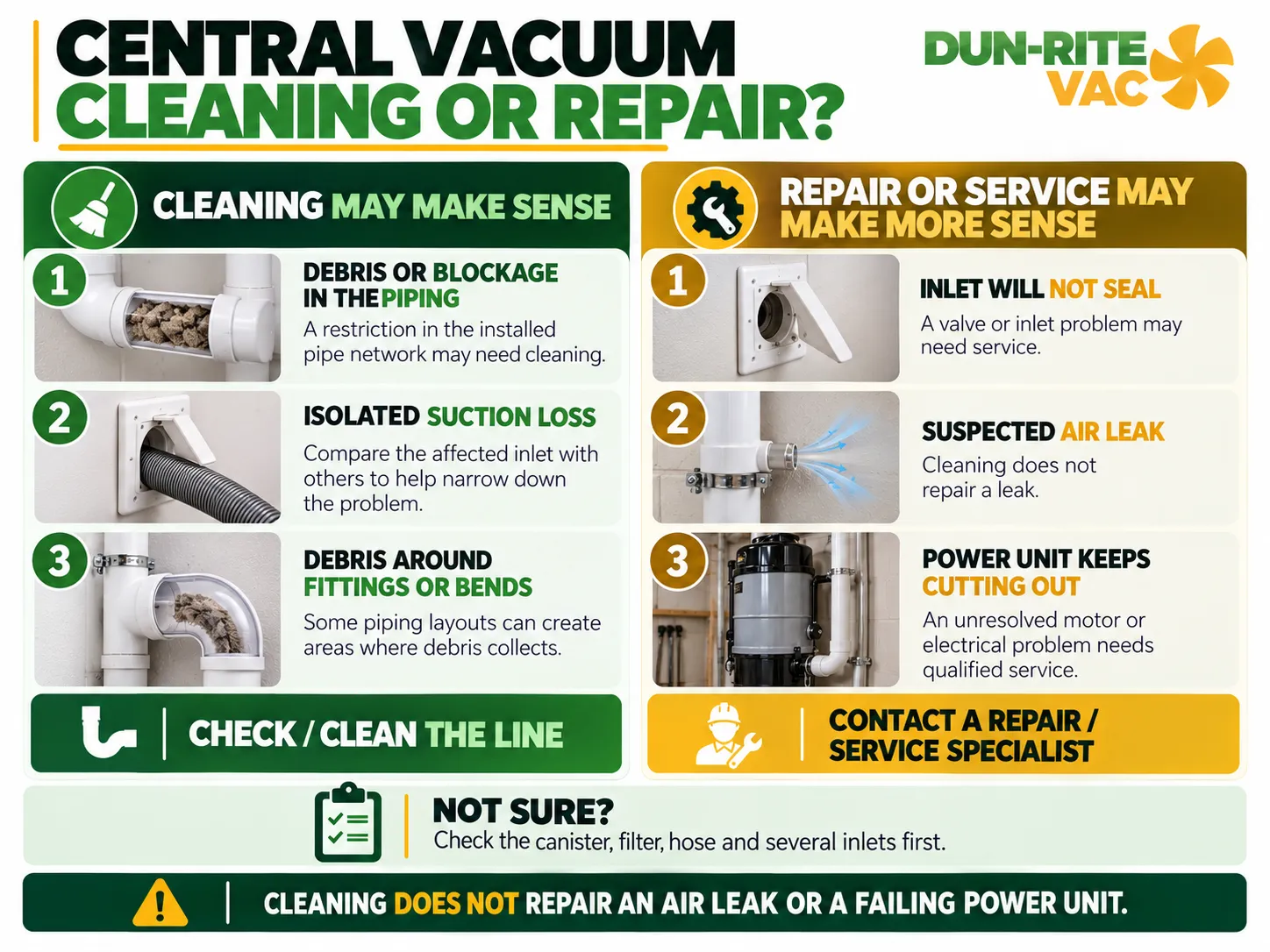
Put the clues together and the right call is usually clear:
| What you notice | Most likely cause | Right next step |
|---|---|---|
| Weak at every inlet, and the canister was full or the filter dirty | Full canister, bag or filter | Empty, clean or replace it yourself, then retest |
| Weak with one hose or attachment only | Blocked hose or attachment | Try another one; clear or replace the blocked one |
| One inlet fading gradually | Debris buildup in that branch | Professional line cleaning |
| One inlet lost suction suddenly, perhaps after a rattle | Lodged blockage in that branch | Stop forcing objects into the line; request a cleaning quote |
| Hissing, or a loose or ill-fitting inlet door | Air leak | Repair; cleaning will not help |
| Weak everywhere, with a clean canister and filter | Main line restriction or the power unit | Check for motor symptoms first. If none, a line cleaning quote is reasonable; if present, see a repair specialist |
| Burning smell, grinding, cutting out | Motor or power unit | Turn it off; repair or replace the unit |
Central vacuum pipes and furnace ducts are separate systems, and cleaning one will not improve the other. If your heating ductwork is also due for attention, our furnace duct cleaning page explains that service.
Frequently Asked Questions
My central vacuum has weak suction since a renovation. Is that the motor?
Not necessarily. Construction dust, especially from drywall, can fill the filter and settle in the pipes. Empty the canister and clean the filter first, then see whether suction returns evenly at every inlet.
Is it safe to keep using a central vacuum that smells hot or cuts out?
If the power unit is repeatedly cutting out or showing signs of an electrical or motor problem, stop using it and have it checked rather than continuing to run it. Internal motor or power-unit repairs are separate from pipe cleaning and should be handled by qualified service personnel.
How can I tell a clog from a leak?
A clog tends to reduce suction at specific inlets with no other sign, either gradually or suddenly. A leak often makes noise, such as a hiss at an inlet or a door that will not seal. If you hear outside air being pulled in, repair is the better bet than cleaning.
About Dun-Rite Vac: a third-generation, family-run business operating since 1998, with more than 50,000 completed jobs, NADCA certification and ASCS-certified technicians.
If the signs point to buildup in the lines, we’re happy to quote the cleaning.
Dun-Rite Vac offers a 100% Satisfaction Guarantee. Reach out for a free quote on central vacuum cleaning.