
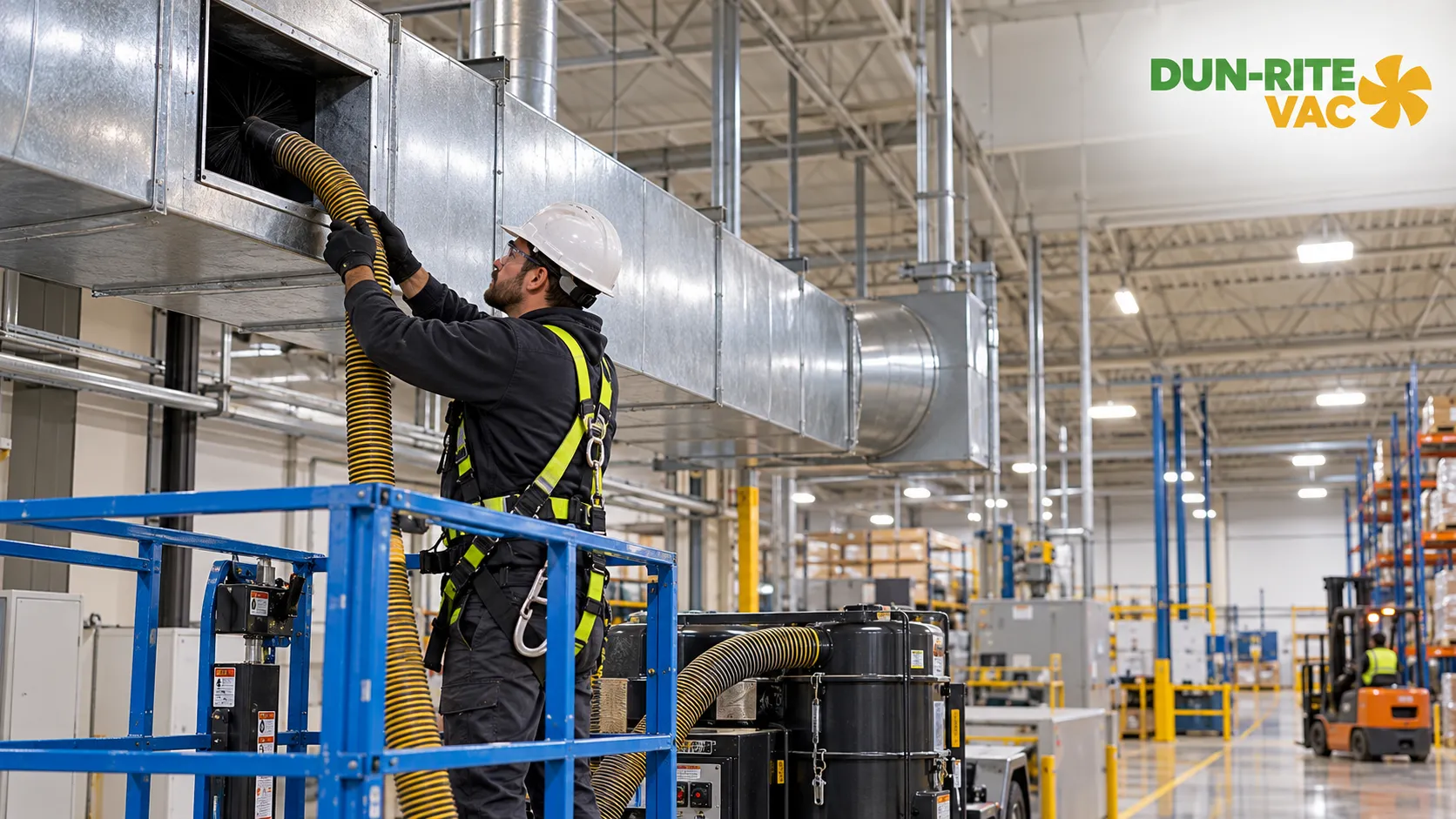
A warehouse office, a workshop and a production floor can all share one heating system while asking very different things of it. Industrial HVAC cleaning is a different job from cleaning a home or a retail unit: the buildings are bigger, the debris depends on what the facility produces, and the work has to fit around production schedules.
This guide covers what changes when the ductwork serves a warehouse, workshop or industrial facility, and why the first step is understanding the system before the heavy work begins.
Quick Answer: Industrial duct cleaning often involves heavier debris, harder access and tighter scheduling than a typical commercial building. The work goes best when the system is assessed at the start of the cleaning visit and the job is planned around your operating hours, not the other way around.
In this article
- What Collects in Industrial Ductwork Depends on What the Facility Produces
- What a Long Saskatchewan Heating Season Means for a Large Open Building
- Getting to the Ductwork When Equipment Is in the Way
- Scheduling Around Production, Not Around Us
- Why Scope Gets Confirmed Before Industrial HVAC Cleaning Starts
- Frequently Asked Questions
What Collects in Industrial Ductwork Depends on What the Facility Produces
Dust that keeps returning to shelving, machinery or finished product, even after the floor is swept, has many possible sources: production processes, material handling, outdoor air coming in through doors, filtration and housekeeping routines. The ventilation system can be one of them, which is why it is worth assessing rather than assuming.
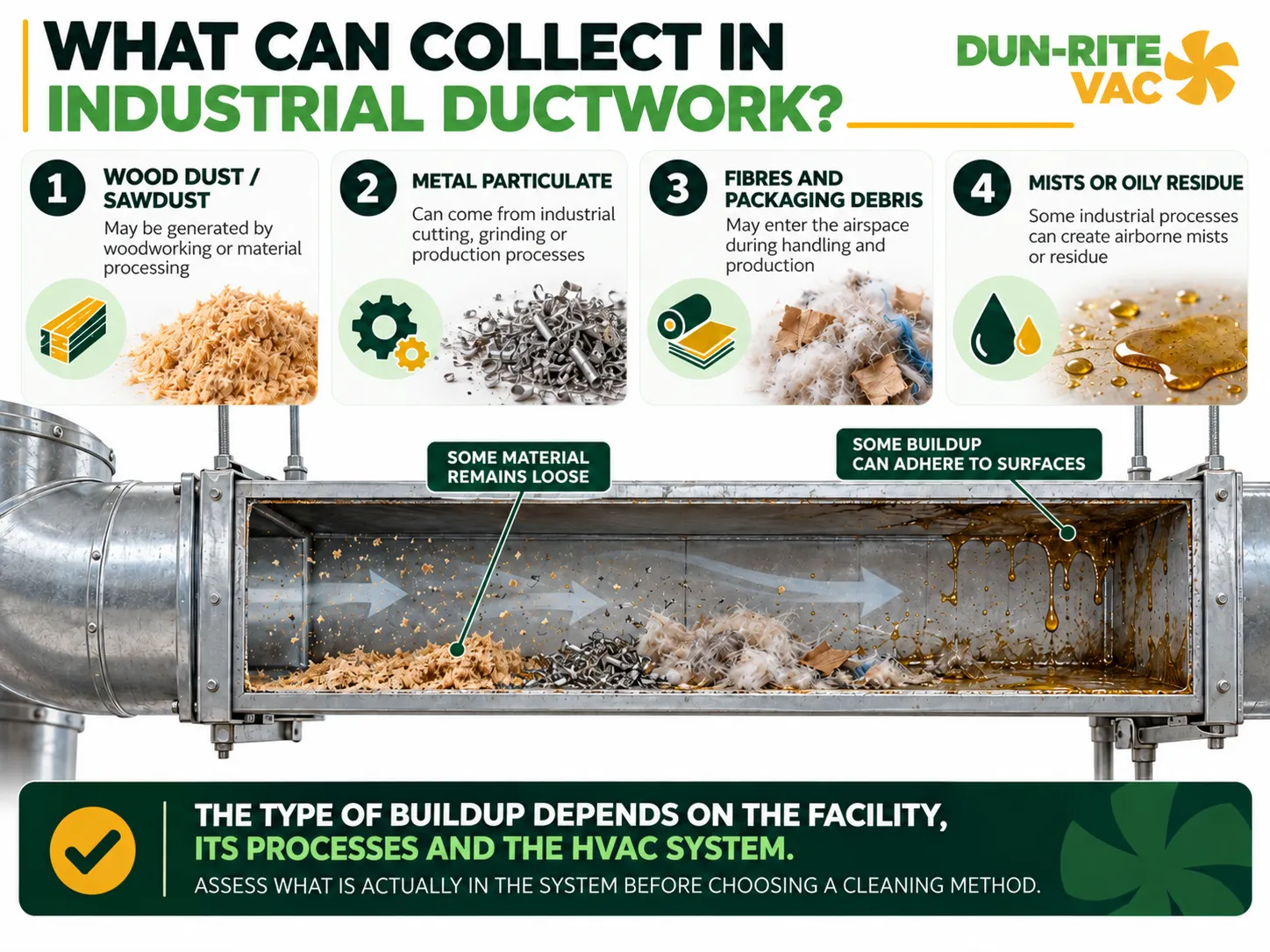
What we find when we open up the ductwork in shops and production spaces depends heavily on the work done inside. OSHA’s industrial hygiene guidance explains that industrial processes can generate airborne contaminants such as dusts, fibres and mists, while CCOHS guidance on industrial ventilation notes that particles can settle and mists can accumulate in ventilation ductwork when transport conditions are inadequate. Depending on the facility, materials encountered may include sawdust, metal particulate, packaging fibre or oily residue, and some buildup may adhere to duct surfaces rather than remain loose. A system serving a mostly clean storage area may look very different.
That difference shapes the method. Heavier or more adhered buildup may require more time and a different cleaning approach. The NADCA ACR Standard for HVAC system assessment and cleaning addresses project-specific assessment, containment, negative pressure and vacuum collection so dislodged debris is controlled during cleaning. Industrial duct cleaning that is scoped without understanding the system condition and facility processes can miss those requirements.
What a Long Saskatchewan Heating Season Means for a Large Open Building
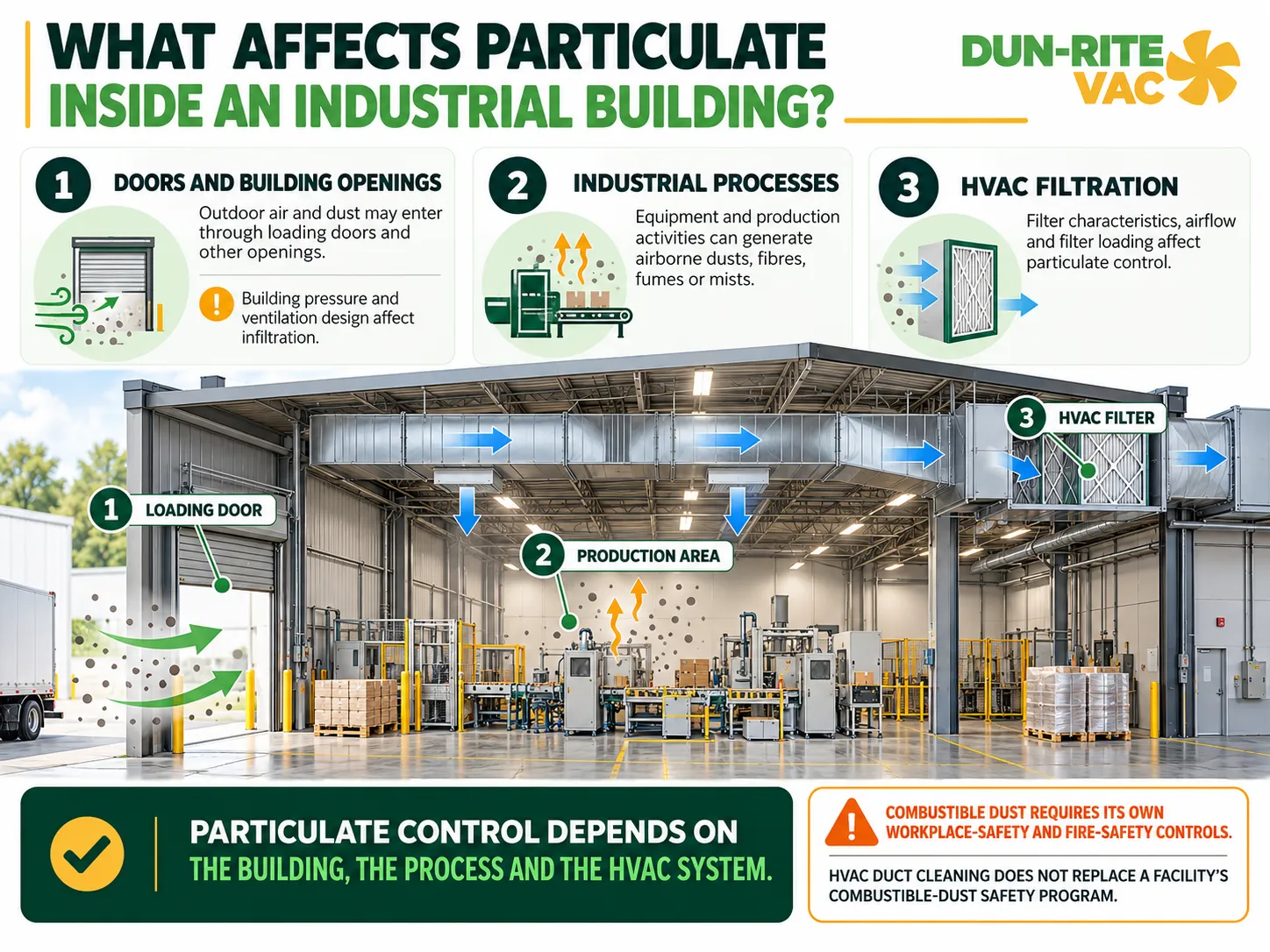
Large buildings in Saskatchewan and Western Manitoba run their heating for a long part of the year, so the ventilation system moves a lot of air over many months. In facilities with frequent loading-door traffic, outdoor air and particulate can enter through doors and other openings depending on building pressure and ventilation design. NIOSH guidance on controlling surrounding dust sources discusses uncontrolled outdoor air entering industrial buildings through openings and bringing particulate or other contaminants indoors.
A few factors can add up over a heating season:
- Frequent door opening may increase the outdoor dust entering the building.
- Industrial processes can generate airborne dusts, fibres, fumes and mists that add particulate or other contaminants to the surrounding airspace.
- ASHRAE guidance on particulate air cleaners explains that filtration performance depends on filter characteristics, airflow and filter loading, making filter condition and maintenance part of particulate control.
If your facility handles combustible dust, it needs to be managed under the applicable workplace-safety and fire-safety requirements rather than treated as a routine duct-cleaning issue. CCOHS guidance on combustible dust outlines the fire and explosion hazards and the need for dedicated dust-control measures, while the Government of Saskatchewan’s fire and explosive hazards guidance covers applicable workplace requirements. HVAC duct cleaning may support ventilation-system maintenance, but it does not replace a facility’s combustible-dust safety program or applicable code requirements.
Getting to the Ductwork When Equipment Is in the Way
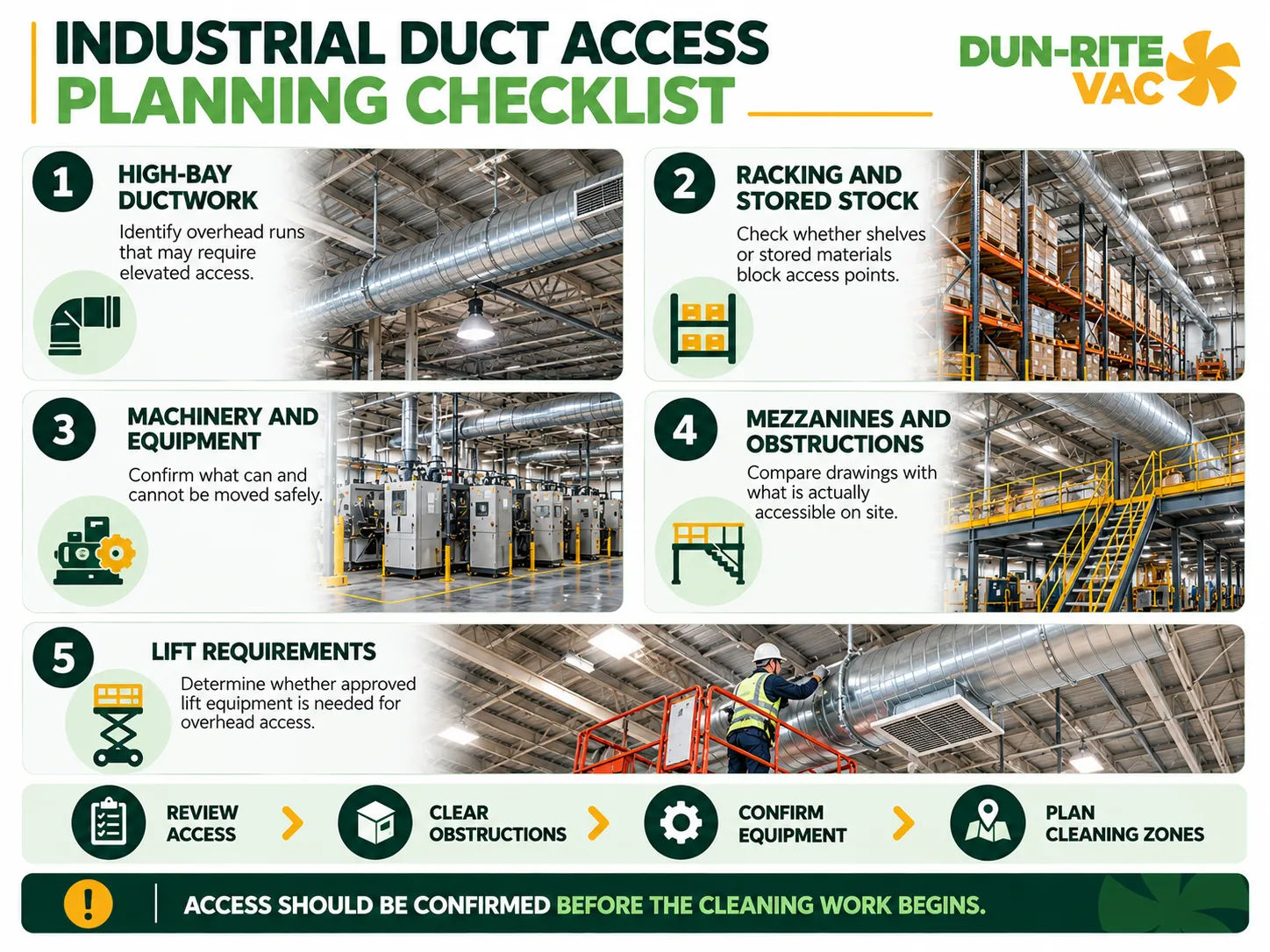
Access can be one of the main constraints in an industrial building. Ducts may run overhead in high-bay spaces, above racking, over machinery that cannot be moved, or through mechanical areas that were never designed with a cleaning crew in mind.
One situation our technicians can run into in larger buildings is an access point that looks fine on a drawing but is blocked in practice by stored stock, a mezzanine or a piece of equipment. Sorting that out before the cleaning day is far cheaper than discovering it with a crew on site.
Those conversations tend to come down to a few practical decisions:
- Which areas need clearing, and who on your team can do it.
- Whether lift equipment is needed to reach overhead runs safely.
- Which zones can be cleaned while neighbouring ones stay in use.
Scheduling Around Production, Not Around Us
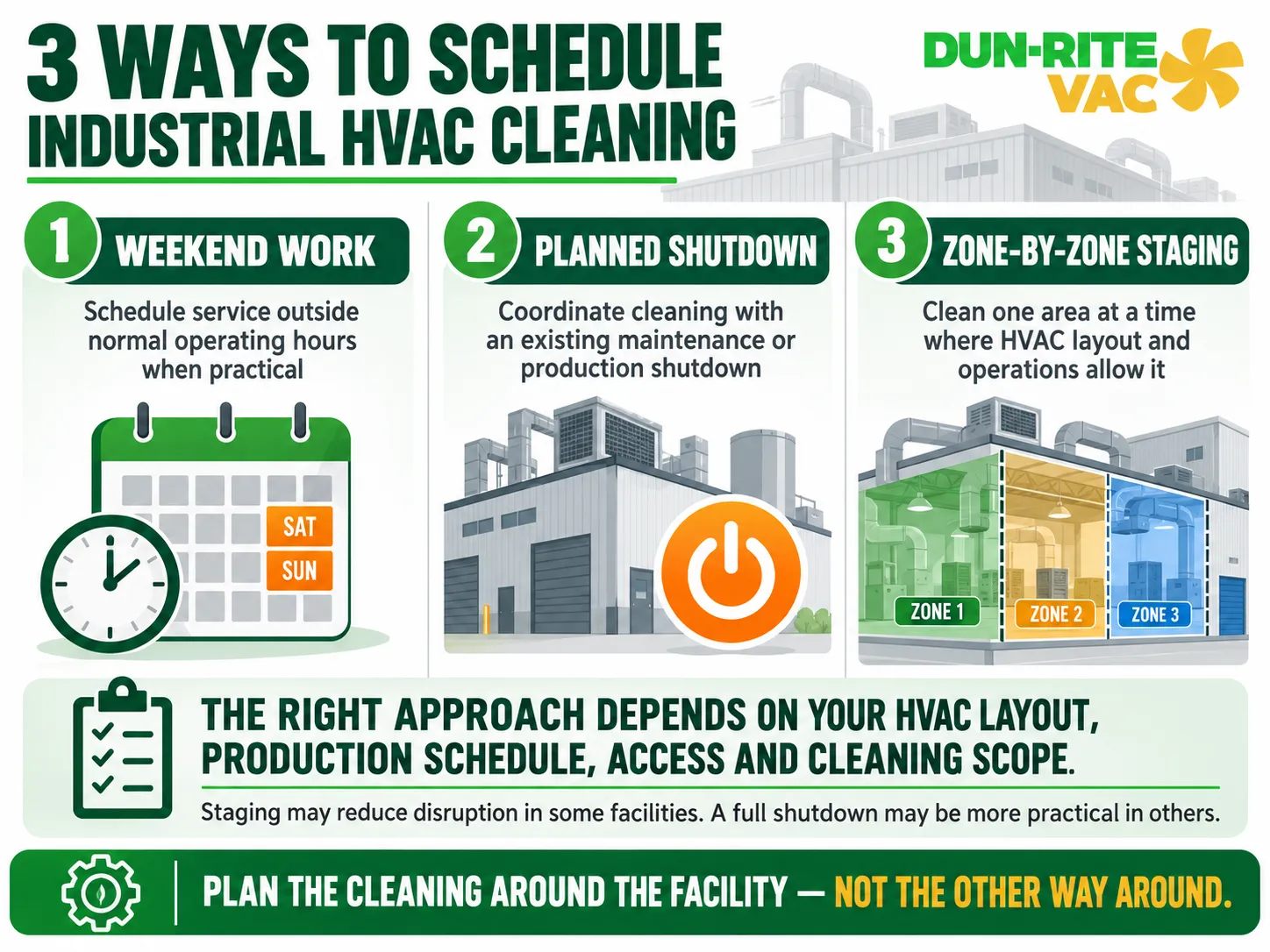
A facility manager asking when the work can happen is really asking what it will cost in lost output. Options can include weekend work, a planned shutdown, or a zone-by-zone approach where one section is cleaned at a time.
Staging by zone may reduce disruption where the HVAC layout and operations allow it. In some facilities, whole-building work during a shutdown may be the more efficient route. The right choice depends on how your operation runs, how the system is zoned and how heavy the buildup is.
Seasonal timing is a practical consideration too. If a facility is already due for cleaning, scheduling it before the fall heating season means the work doesn’t land in the middle of the cold months. A change of season isn’t a reason to clean on its own.
If you’re trying to fit a cleaning around shifts or a planned shutdown, tell us how your facility runs and we’ll work out a schedule that fits. You can reach out here for a free quote, no pressure.
Why Scope Gets Confirmed Before Industrial HVAC Cleaning Starts
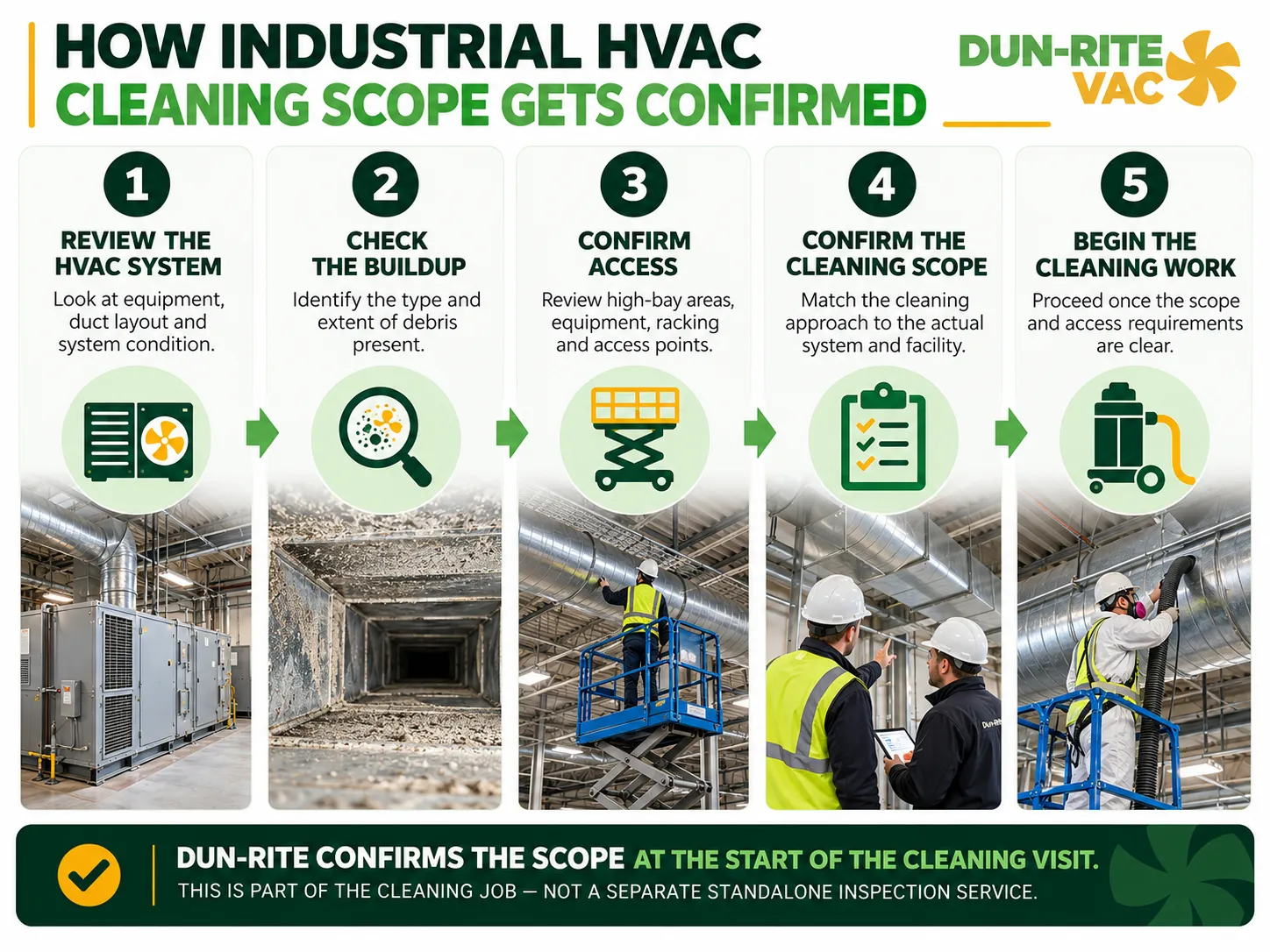
Two industrial buildings of similar floor area can need very different work. One may have lighter buildup that cleans quickly, while another has heavier or more adhered buildup that calls for a slower, more methodical approach. Quoting without looking at the system is how a job ends up under-scoped or over-priced.
For that reason, we look over the system at the start of the cleaning visit and confirm the scope before the heavy work begins. This is part of the cleaning job itself, not a separate inspection service, and it is how facility ventilation cleaning gets matched to what is actually in the ductwork.
Credentials matter when you compare providers for a larger system. Dun-Rite is listed in the NADCA professional directory, and our technicians hold Air Systems Cleaning Specialist credentials. NADCA describes the ASCS certification as a credential covering knowledge of HVAC system hygiene, cleaning principles, standards and safety practices. Dun-Rite is also a family-run business with more than 50,000 completed jobs since 1998, so credentials and experience are both worth comparing when choosing a provider.
For smaller commercial spaces, our commercial furnace duct cleaning page covers what applies to offices and storefronts. The broader furnace duct cleaning overview explains the standard process. If mould or bacteria are a concern in your system, HVAC sanitization is a separate service.
Frequently Asked Questions
Can our facility stay open while the ducts are cleaned?
Sometimes. Whether parts of the facility can keep operating depends on the layout, HVAC configuration, nearby processes, access and cleaning scope. We plan this with you in advance rather than deciding on the day.
Does a warehouse with no office space need its ductwork cleaned?
Any ductwork that moves air can accumulate particulate over time, depending on the facility, its filtration, the processes inside and the condition of the system. Warehouse duct cleaning comes down to how much dust and particulate your operation generates, not whether the space looks like an office.
Do you serve facilities outside the main cities?
Our service area covers Saskatoon, Yorkton, Regina and Weyburn, plus the broader Saskatchewan and Western Manitoba region. See our Saskatoon, Yorkton, Regina and Weyburn pages, or contact us with your location.
Ready to talk through your facility? Send us a few details about the building and how it operates, and we’ll get back to you with a free, no-pressure quote. Our completed work is backed by our 100% Satisfaction Guarantee.