
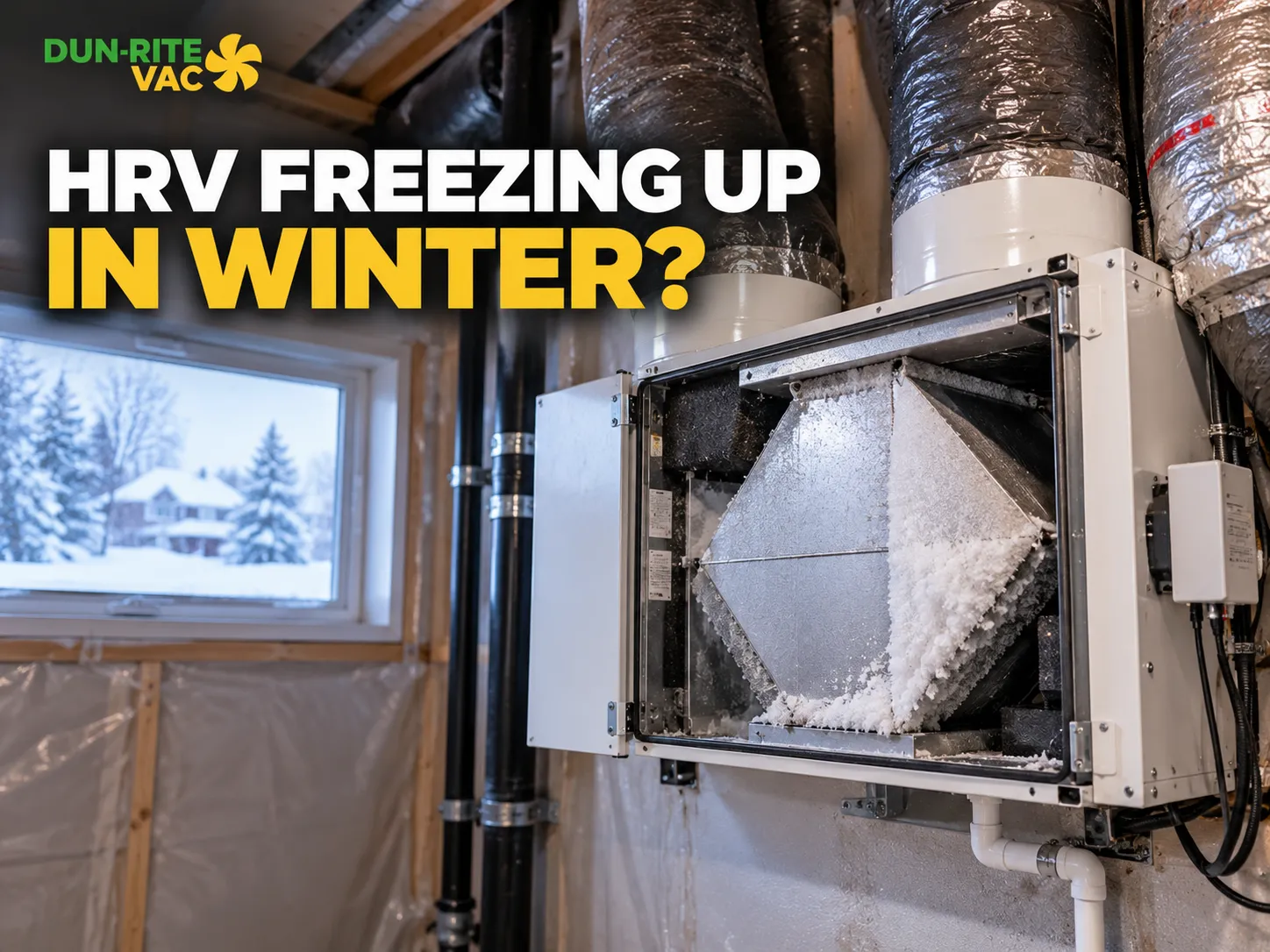
It usually starts with a small clue: a puddle under the unit in January, a fan that sounds strained, or a fresh-air hood outside that looks like it’s wearing a fur coat. If you’ve noticed an HRV freezing up in winter, the first question is whether you’re looking at normal cold-weather behaviour or the beginning of a real problem.
The answer depends on how much ice, where it’s forming, and whether it clears. Here’s how to tell the difference, what tends to cause the bad kind, and when cleaning is the right fix versus when it isn’t.
Quick Answer: If you notice your HRV freezing up in winter, light frost during a cold snap can be normal, since many units run a defrost cycle to clear it. Ice that keeps building or blocks airflow is worth investigating. A dirty filter or restricted core is one of the first things to check, and cleaning may help if buildup is limiting airflow. If icing continues after the unit is clean, the cause may be airflow balance, drainage, controls, or indoor humidity.
In this post
- Frost Isn’t Always a Fault: What a Normal Defrost Cycle Looks Like
- When a Clogged Filter or Core Starves the Unit of Airflow
- Unbalanced Airflow: The Quiet Reason One Side Keeps Icing
- Frozen Drain Lines and Sagging Condensate Hoses
- Why a Tight, Humid Prairie House Pushes Your HRV Harder
- Cleaning or a Different Kind of Call? Deciding What Your Unit Needs
- Frequently Asked Questions
HRV Freezing Up in Winter: When Frost Is Normal
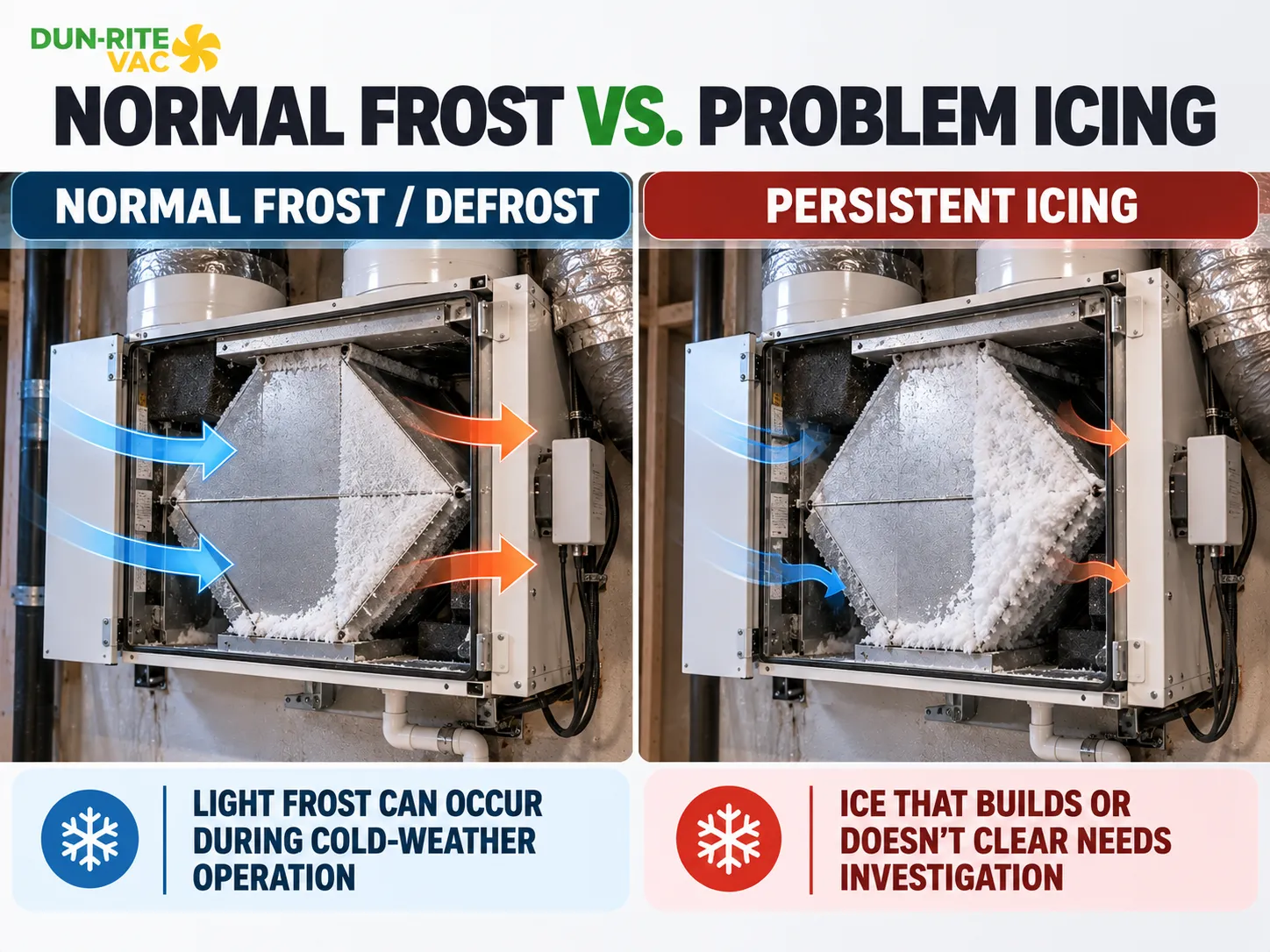
Many homeowners assume any ice inside the unit means something is broken. That’s a wrong assumption. An HRV passes warm, moist stale air past cold incoming air, and in deep cold the moisture in that outgoing air can freeze on the core. Many units are designed to handle this with a defrost cycle. Natural Resources Canada explains that frost can form on an HRV core in cold weather and that defrost mechanisms are used to manage this buildup.
During defrost, the unit may temporarily change how it moves air so the core can warm up and clear frost. How it does this, and how often, varies by manufacturer and model, so your manual is the best reference for what’s normal on your unit. For example, Lifebreath documents temperature-controlled defrost operation in which certain models temporarily close the outdoor supply while indoor air recirculates through the core.
Where ice in an HRV becomes a concern is when it doesn’t clear between cycles. Thick ice that builds, stays, or starts blocking the core suggests something is stopping the unit from keeping up. The rest of this post covers those causes.
When a Clogged Filter or Core Starves the Unit of Airflow
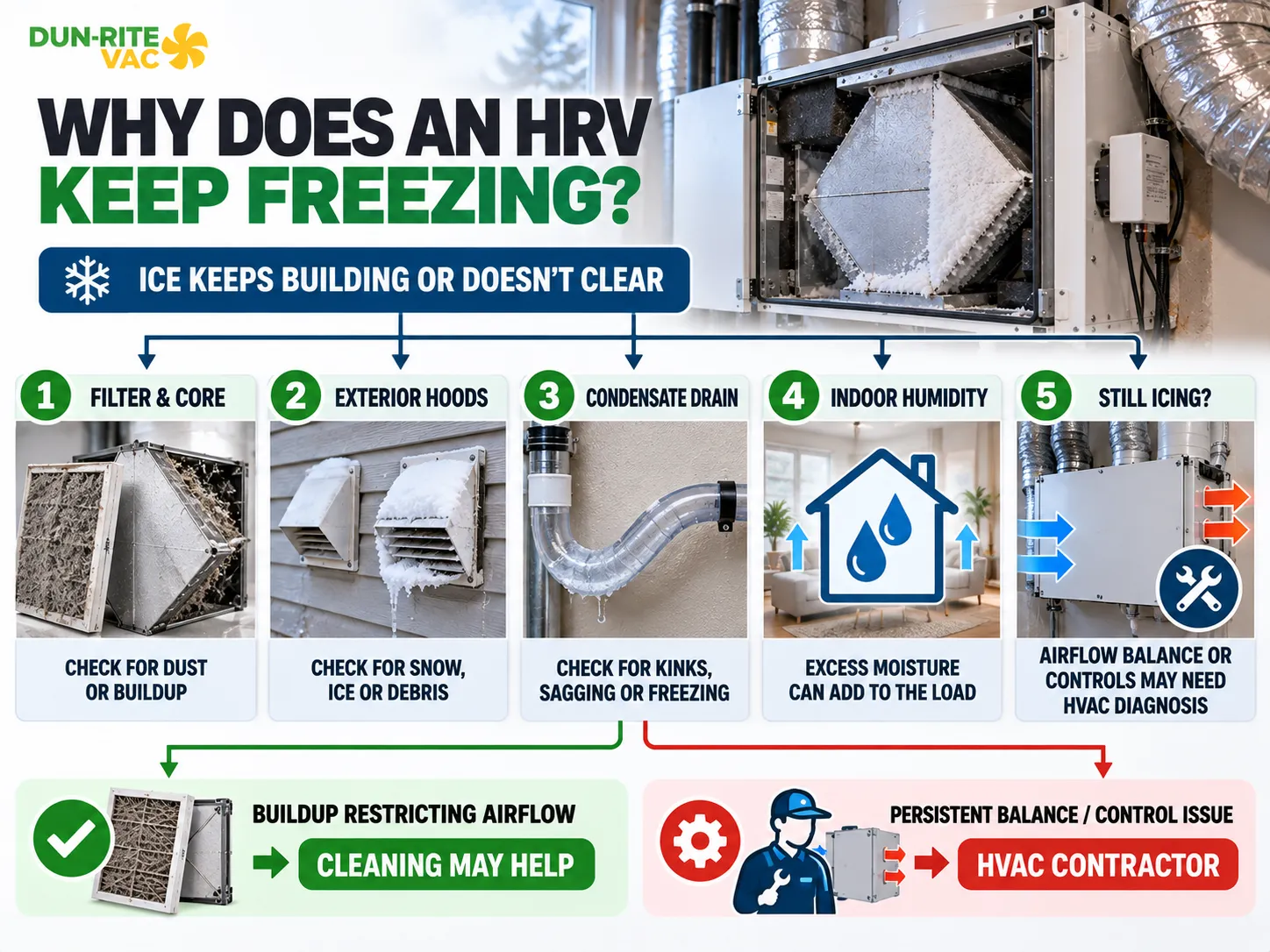
Start with one of the easiest conditions to check. A filter loaded with dust and lint can restrict airflow through the unit, so the filters and core are worth inspecting when you’re dealing with an HRV freezing up in winter or recurring air exchanger frosting. Cleaning may help when buildup is limiting airflow, but persistent icing after the unit is clean can point to another issue.
When we open up an air exchanger that has been struggling, the intake face of the core is often where fine dust, lint, or pet hair has collected. The core passages are narrow, so once they’re partly coated the unit has to work harder to move the same air.
Blocked exterior hoods are the other half of this. Drifted snow, heavy frost, or debris around an intake or exhaust hood can cut airflow as effectively as a dirty filter. Checking the hoods from outside takes a minute and rules out a cause that has nothing to do with the unit itself.
This is where cleaning fits. Dun-Rite Vac has been family-run since 1998, is a NADCA member, has ASCS-certified technicians, and has completed more than 50,000 jobs. Our air exchanger cleaning covers the filters, core, and accessible internal surfaces so the unit can move air the way it was designed to.
Unbalanced Airflow: The Quiet Reason One Side Keeps Icing
Consider two homes with identical, clean HRVs. One keeps frosting and the other doesn’t. The difference can be the balance between the air pulled out of the house and the air brought in. When those two streams aren’t well matched, the core can end up operating in conditions where it freezes repeatedly, even though nothing is dirty or broken.
Imbalance can come from how the system was set up, or from changes made afterward: ducting altered during a renovation, a damper knocked out of position, or a restriction somewhere in the runs. Cleaning can remove a restriction that contributes to imbalance, but re-balancing is a commissioning task for the installer or an HVAC contractor. It isn’t something a cleaning visit replaces.
A useful clue: if ice keeps returning even after the filter and core are clean and the hoods are clear, imbalance moves up the suspect list.
Frozen Drain Lines and Sagging Condensate Hoses
Defrosting can produce condensate that needs a clear drainage path. If the drain pan, hose, or line can’t carry that water away, drainage problems can contribute to pooling or refreezing around the unit. Lifebreath’s HRV installation guidance calls for proper condensate drainage, including correctly sloped drain tubing without kinks and protection from freezing conditions. That makes the drain path worth checking when troubleshooting HRV condensation in winter.
One thing our technicians check for is a condensate hose that has sagged over time, creating a low spot where water collects. On a unit in a cold mechanical area or unheated space, that pooled water can freeze and back up into the pan. The unit looks like it has an ice problem, but the actual fault is the drain path.
Drain lines that run through cold spaces, hoses with kinks, and pans with buildup all belong on the checklist. Dripping in the middle of winter is not automatically a failing core. It may be meltwater with nowhere to go.
If your unit is icing and you’re not sure whether it’s the filter, core, or drain, we’re happy to look at it as part of a cleaning visit and tell you plainly what we find. Reach out for a free quote and we’ll take it from there.
Why a Tight, Humid Prairie House Pushes Your HRV Harder
Saskatchewan and Western Manitoba homeowners regularly deal with very cold winter conditions, which can make frost management more important for an HRV. Natural Resources Canada explains that frost can form on an HRV core as moisture in outgoing air freezes and that defrost cycles increase in duration as outdoor temperatures become colder. Indoor moisture levels can add to the amount of moisture the ventilation system has to manage.
Households that run humidifiers for dry skin and static can add to that load, as can cooking, showers, and laundry dried indoors. If frost appears a few cold snaps after the humidifier setting goes up, the fix may not be a repair at all. It may be bringing indoor humidity down to a level your ventilation can handle. Your manual or an HVAC contractor can help you find the right target for your home.
Cleaning or a Different Kind of Call? Deciding What Your Unit Needs
If you’re dealing with an HRV freezing up in winter, it doesn’t automatically mean you need a service call. We’d rather tell you that than oversell. Here’s a rough way to sort what you’re seeing:
- Clears on its own, briefly: likely normal defrost. Keep an eye on it.
- Filter looks loaded, or the core is visibly dusty: cleaning is a reasonable next step, following your manufacturer’s guidance.
- Ice persists after a clean filter and clear hoods: could point to imbalance or a defrost control issue. That’s a job for your installer or an HVAC contractor.
- Water pooling or refreezing near the drain: check the hose and line, and have it looked at if you can’t resolve it.
If cleaning is what’s needed, that’s where our air exchanger cleaning service fits. And if what we see during the visit looks like something beyond cleaning, we’ll tell you so you know who to call next.
Frequently Asked Questions
Can I chip the ice off my HRV core myself?
We’d advise against it. The core is delicate, and scraping or using heat tools can damage it. Check your manual for whether the unit should be switched off while it thaws, then let the ice melt at room temperature and put towels or a tray underneath to catch the meltwater. Once it’s clear, deal with the underlying cause so the ice doesn’t come back.
Is frost on the outside intake or exhaust hood a problem?
Some frosting around the exhaust hood is common, since the outgoing air is warm and moist. What matters is that the hoods stay open and clear. If snow, ice, or debris is blocking either one, clear it and see whether the unit’s behaviour changes.
Does water dripping under my HRV mean the core has failed?
Not necessarily. Meltwater from a defrost cycle that can’t drain properly is a more likely explanation than a failed core. Check the drain hose and pan first, and look for kinks, sagging, or ice in the line.
If you’re dealing with an HRV freezing up in winter more than it should, you don’t have to work out the cause alone. We stand behind our work with a 100% Satisfaction Guarantee, and a free quote costs you nothing. Get in touch and we’ll help you figure out what your unit needs.