
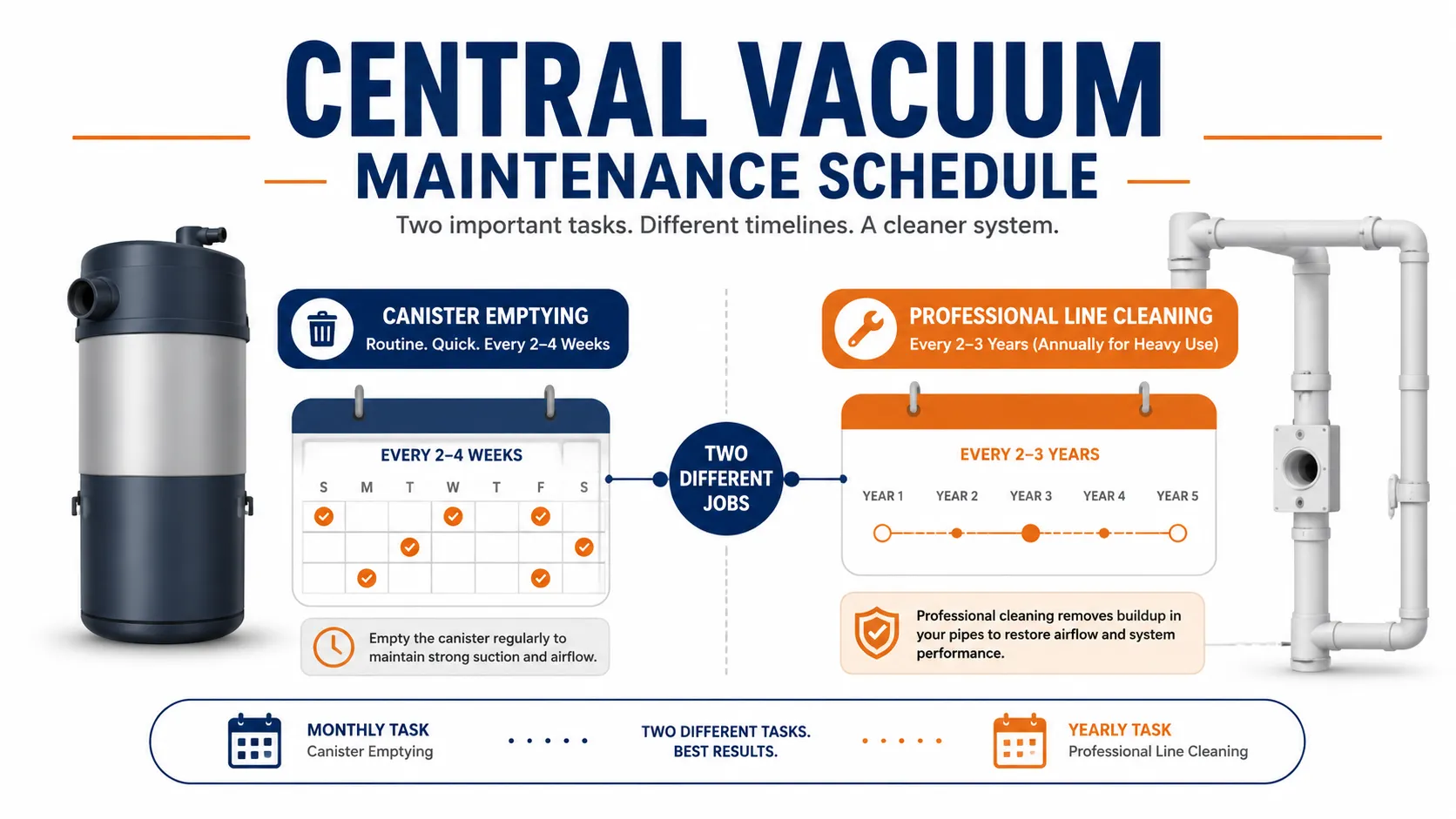
Quick Answer: As a general guideline, plan to empty the canister every 2–4 weeks for an average household (sooner with pets or heavy use). Professional line cleaning is a separate service — many homes go 2–3 years between visits, though pets, a previous clog, or noticeably weaker suction are good reasons to have it looked at closer to once a year.
In this article:
- The Variables That Set Your Central Vacuum Maintenance Schedule
- Canister Emptying and Line Cleaning Aren’t the Same Job
- What a Sudden Suction Drop Is Actually Telling You
- How Often to Clean a Central Vacuum, by Household Type
- The Wrinkle Saskatchewan and Manitoba Homes Add to the Equation
- Frequently Asked Questions
How Often to Clean a Central Vacuum: What Sets Your Maintenance Schedule
There’s no single number that applies to every home, because central vacuum systems don’t wear evenly. A retired couple in a two-bedroom bungalow and a family of five with a shedding dog are working the same equipment under completely different loads.
Household size, pets, and how often you vacuum have the biggest impact on your maintenance schedule. A system that runs twice a week handles debris differently than one used every day to keep up with kids and a large dog. Previous clogs also matter. Once debris packs into a section of pipe, future debris is more likely to catch there, even after you clear the blockage.
Central Vacuum Maintenance Schedule: Canister Emptying vs. Line Cleaning
Most homeowners think of “cleaning the central vac” as one job, but it actually involves two separate tasks. Emptying the canister is routine maintenance that most homeowners can handle. Cleaning the pipe network is different because the piping runs inside the walls and isn’t accessible for routine inspection.
We often meet homeowners across Yorkton and Saskatoon who have emptied the canister faithfully for years. Many have never had the line itself checked.
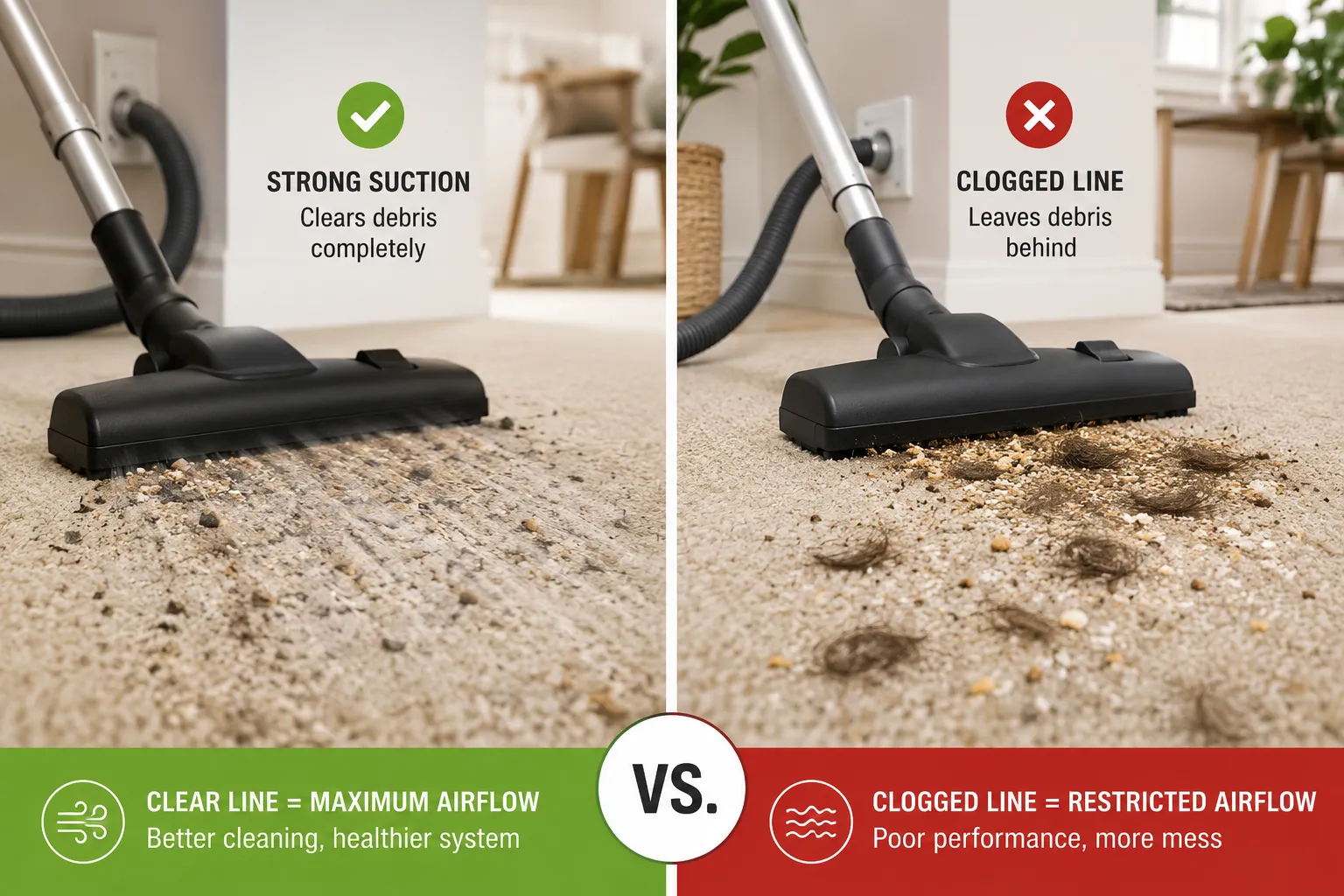
The canister may look fine, but the rest of the system can tell a different story. Fine dust, hair, and debris can collect over time. Our technicians commonly find it around elbow joints, low points, and other high-friction areas. That buildup gradually restricts airflow without being visible from the canister.
That buildup doesn’t always show up as a clog. Often it just shows up as a system that’s quietly losing suction, year over year, until it’s noticeably weaker than when it was installed.
A gradual decline in suction usually points to normal wear over time. A sudden drop is different. If a system worked well last week but suddenly struggles to pick anything up, a full or partial blockage is often the cause. This Old House notes that a sudden loss of suction in a central vacuum system commonly points to a clog in the hose or piping.
Our technicians often see acreage homes with half-empty canisters but noticeably weaker suction. Grain dust, gravel road dust, and dried well-water mineral dust tracked in from outside behave differently than typical household debris. In these homes, the canister level isn’t always the best indicator. Pay closer attention to suction performance instead.
If your suction has dropped off and you’re not sure whether it’s a quick fix or a sign the lines need attention, it’s easier to have it checked than to guess. Reach out for a free quote and we’ll tell you straight whether it’s worth a service call yet.
How Often to Clean a Central Vacuum, by Household Type
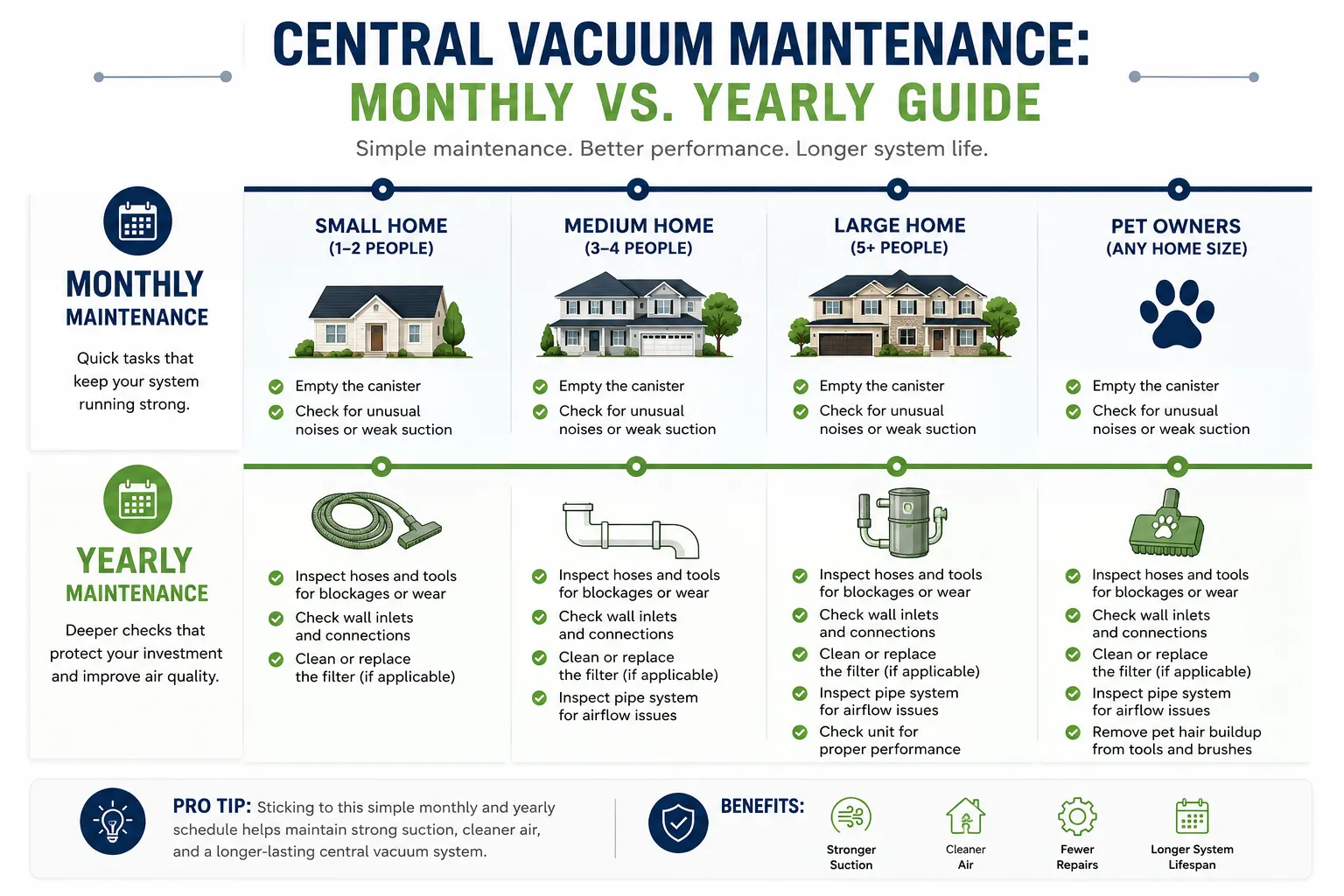
There’s no single schedule that fits every home. Here’s the general guideline we use in the field, based on household type:
- ✅ Small household, no pets, moderate use: empty the canister roughly monthly; professional line cleaning every 2–3 years.
- ✅ Family household, occasional pet shedding: empty the canister every 2–3 weeks; line cleaning every 1–2 years.
- ✅ Large household or multiple pets, daily use: empty the canister weekly to biweekly; line cleaning yearly.
- ✅ Any household with a prior clog or noticeable suction loss: line cleaning is worth doing now, regardless of when the last one was, since a cleared clog doesn’t mean the rest of the line is clear.
These are starting points, not fixed rules. If suction remains strong and you’ve never had a clog, you can usually wait. There’s no need to schedule service just because a date on the calendar arrives.
Central Vac Cleaning Frequency for Saskatchewan and Manitoba Homes
The long, dry heating season across Saskatchewan and Western Manitoba affects what moves through these systems for much of the year. Winter conditions create drier, dustier homes. Whether you live in Regina, Weyburn, Yorkton, or Saskatoon, your lines may have gone decades without professional cleaning. That’s true even if you’ve emptied the canister regularly.
Rural and acreage properties face different conditions. Dried well-water mineral dust, grain dust, gravel-road dust, and heavier overall dust loads all affect what moves through the system. That doesn’t mean these homes need constant service. It simply means they often benefit from following the more frequent end of the schedule.
Why Professional Central Vacuum Line Cleaning Matters
Most homeowners can empty the canister themselves. Cleaning the pipe network requires different equipment and experience. Our technicians are NADCA-certified and ASCS-trained through the same standards we apply to our air-system cleaning work. We bring more than 27 years of experience across Saskatchewan and Western Manitoba to our central vacuum cleaning service, giving every system the same careful attention.
Frequently Asked Questions
Can I clean central vacuum lines myself?
You can safely empty the canister and wipe down accessible inlets yourself. However, the pipe network runs through the walls. Cleaning those lines properly requires specialized equipment.
Does a HEPA filter change your central vacuum maintenance schedule?
A HEPA filter affects filtration quality more than it changes how often the canister needs emptying or the lines need clearing — those schedules are driven mainly by household size, pets, and usage rather than filter type. This Old House recommends treating filter maintenance as its own task and replacing or servicing filters according to the manufacturer’s instructions.
Will skipping your central vacuum maintenance schedule damage the system?
Not immediately — a system running a bit past schedule with no suction issues isn’t in danger. The risk builds gradually as buildup narrows the pipe over time, which is why a suction drop or a history of clogs is a better trigger than a strict calendar date.
How long does professional central vacuum line cleaning take?
Most residential systems can be cleared in a single visit, though the exact time depends on how many inlets and how much pipe run the home has.
You Might Also Find This Helpful
Not sure where your system falls on this schedule?
We’ll take a straightforward look at your setup and let you know what it actually needs — backed by our 100% Satisfaction Guarantee. No pressure, no upsell.