

Your furnace and air conditioner often share more than a blower. In many forced-air systems with central air, the evaporator coil sits in the same airflow path that carries heated air through the house all winter. Understanding heating and AC coil cleaning matters more than most homeowners realize, because a coated coil can quietly work against your system in every season.
Here’s what coils actually do, what dirt can do to them, and where coil buildup ends and duct buildup begins.
Quick Answer: Coils exchange heat with the air passing over them, and a layer of dust and grime can reduce that exchange and restrict airflow. That may mean weaker comfort, longer run times and, on the cooling side, a higher chance of icing. Coil cleaning is a different job from duct cleaning: coils are delicate heat-transfer surfaces, while ducts are the passages that carry the air.
In this article
Why a Furnace Doesn’t Have a “Heating Coil” (and What Does)
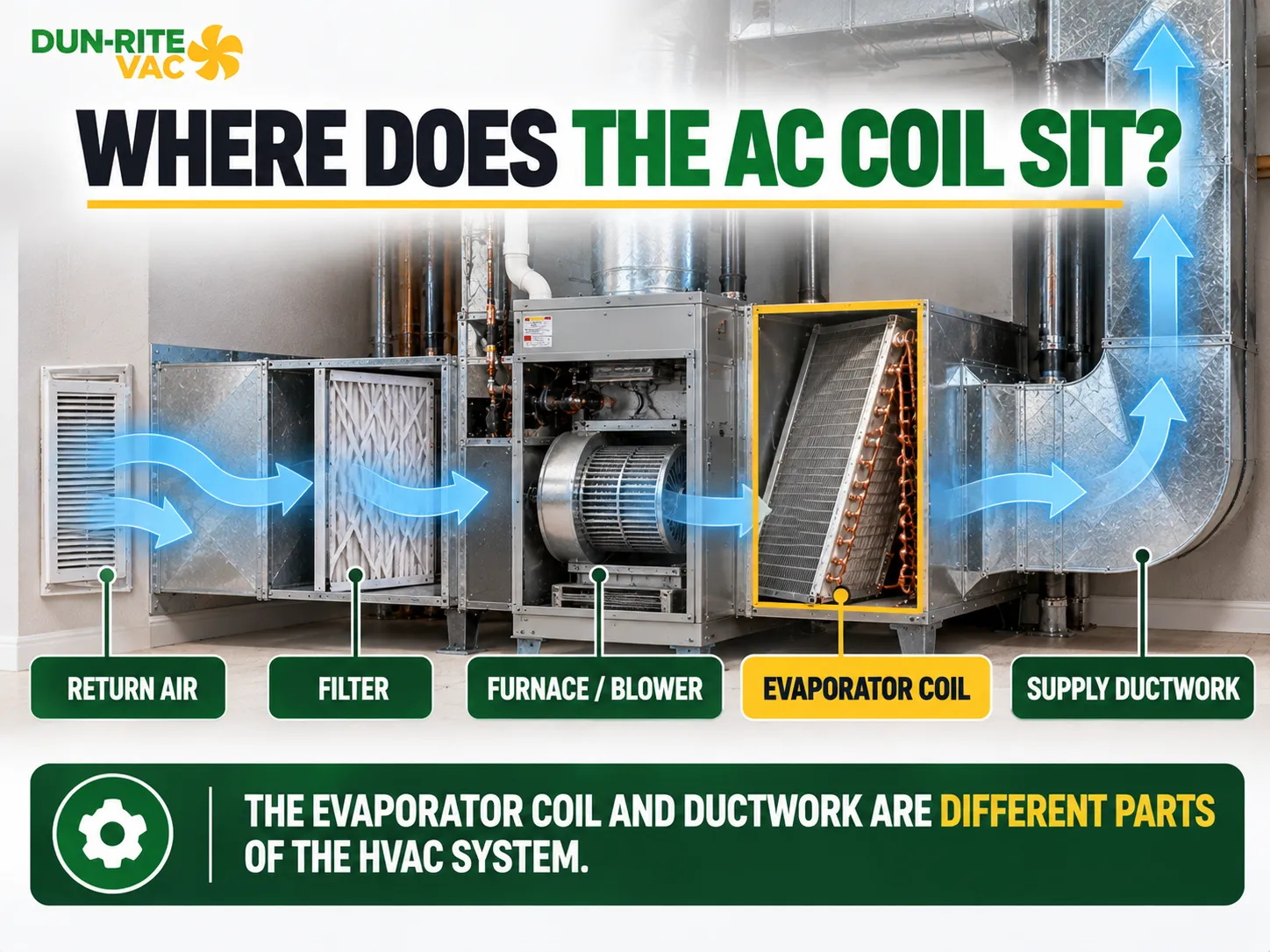
Searches for “furnace coil cleaning” usually mix up two different parts. A gas furnace heats air across a heat exchanger, a sealed metal chamber, rather than a coil. The part that is actually a coil is the evaporator coil, the cooling component mounted on top of or beside the furnace in homes with central air.
Some systems do have a true heating coil, such as hot-water coils in certain air handlers and electric heating elements. If you’re not sure which setup your home has, check the furnace label or ask your HVAC contractor. The rest of this post applies to any coil sitting in your airflow path.
The wrinkle is that the evaporator coil sits idle for much of a Saskatchewan year, but the blower still moves air past it whenever the furnace runs. Particles that get past the filter can continue through the system and may accumulate on downstream components, including the coil.
How a Thin Film of Dirt Steals Heat Transfer and Airflow
A coil works by passing air across a large, finned surface so heat can move into or out of the air. Dirt can interfere with that in two ways at once: it acts as a layer between the air and the metal, and it can fill the narrow gaps between the fins so less air gets through. The U.S. Department of Energy notes that dirt on air-conditioning coils can reduce airflow, insulate the coil, and reduce system efficiency.
A layer of dust on the coil face can look harmless, but reduced heat transfer or airflow can make the system work harder. ENERGY STAR notes that dirty air-conditioning coils can reduce cooling ability, cause equipment to run longer, increase energy costs, and reduce equipment life.
Dust and debris on an evaporator coil can interfere with airflow and cooling performance. If airflow becomes restricted enough, icing can be one of the symptoms that appears.
Dirty HVAC Coil Symptoms Worth Acting On
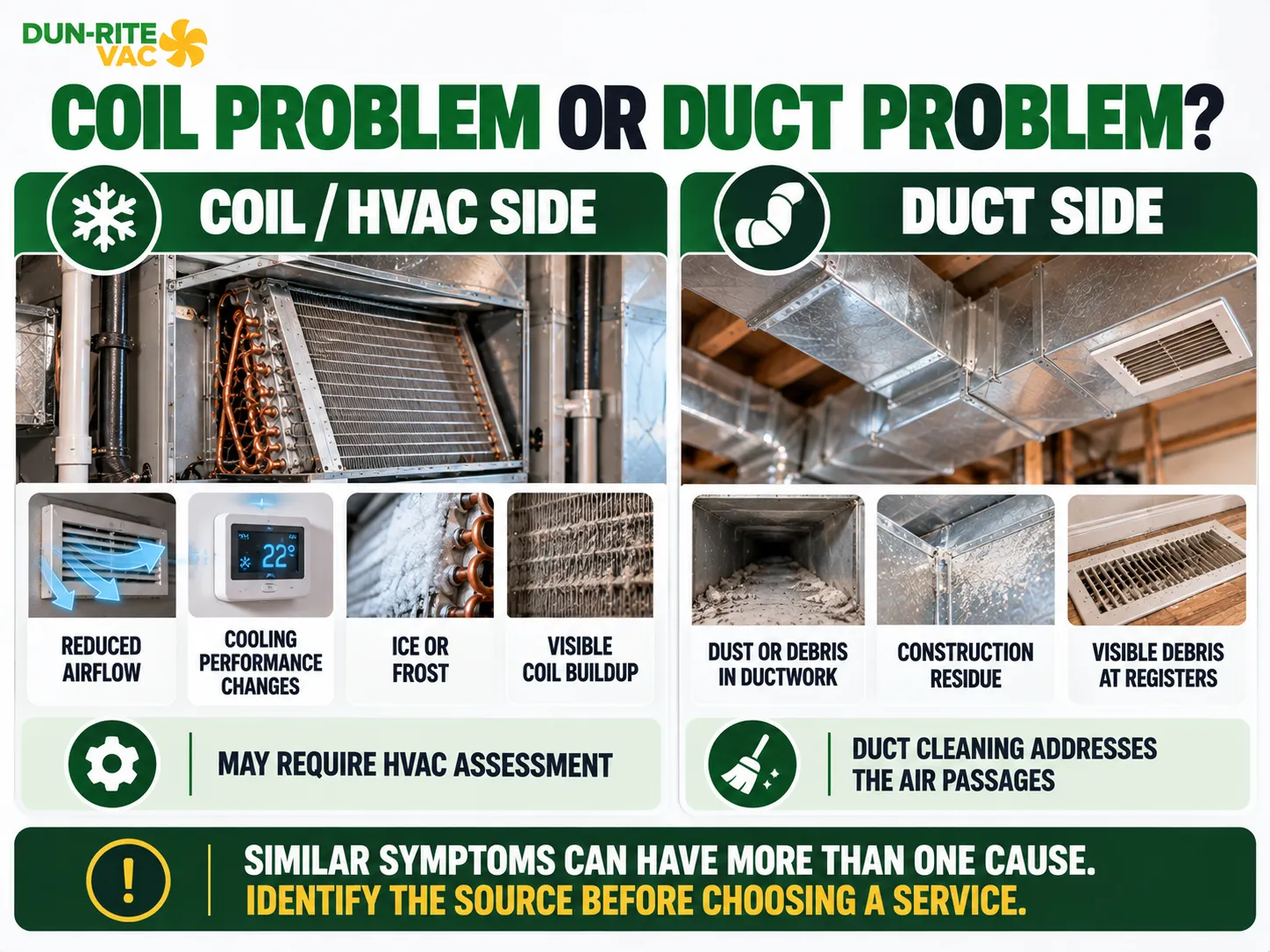
Dust on a coil is normal. The question is whether it’s affecting performance. These signs can show up when a coil is dirty or airflow is restricted, but they also have other HVAC causes, including a plugged filter or low refrigerant:
- Weak airflow from vents even after you’ve swapped the filter.
- Cooling that takes far longer to bring a room down, or a system that never quite catches up on hot days.
- Ice or frost on the refrigerant line or coil area.
- Musty smells when the A/C first kicks on for the season.
- Rising energy bills with no change in how you use the system.
A common situation our technicians run into on older homes with original ductwork is a family blaming the ducts for weak airflow when the restriction may actually be at the coil. Cleaning the ducts won’t fix a restriction at the coil, so it’s worth working out where the problem sits before deciding what needs doing.
Not sure whether your airflow problem is in the coils or the ducts? Get in touch and describe what you’re noticing. We’ll help you work out whether duct cleaning is relevant, and if the problem falls outside what we do, we’ll say so and suggest an HVAC contractor.
Heating and AC Coil Cleaning vs. Duct Cleaning: Where the Line Falls
Ducts are large passages that carry air, and their buildup is dust, debris and sometimes construction residue. Coils are precision heat-transfer surfaces with thin, easily bent fins and, on the cooling side, refrigerant lines. Treating a coil like a duct with a rough cleaning can do real damage.
Dun-Rite doesn’t offer coil cleaning as a standalone service. What we do is furnace duct cleaning, and our technicians are ASCS-certified and work to NADCA standards. After 27+ years and over 50,000 completed jobs, we know a cleaning visit is often where people first learn what shape their coils are in. If a coil looks heavily fouled or damaged, or needs specialized coil servicing or refrigerant handling, we’ll say so and refer you to an HVAC contractor.
Two related notes: if a persistent musty odour is your main concern, our HVAC sanitization page explains a separate service. And if you have an HRV or ERV, its filter and core can also affect airflow, which we cover on our air exchanger cleaning page.
Frequently Asked Questions
Can a dirty evaporator coil cause my A/C to freeze up?
It can. Restricted airflow from a dirty coil is one possible contributor to icing, but low refrigerant and other HVAC problems can cause similar symptoms. Trane’s frozen evaporator coil guidance identifies restricted airflow, a dirty evaporator coil, clogged filters, low refrigerant, and other HVAC issues as possible causes. A frozen coil is worth having checked by an HVAC professional.
Can dust build up on the AC coil?
Yes. When filtration is inadequate or a filter becomes clogged, excess dust and dirt can reach and accumulate on the evaporator coil. Trane recommends regular filter replacement as part of helping prevent excess dust and dirt from collecting on the coil.
Will duct cleaning fix weak airflow if the coil is the problem?
Not by itself. Duct cleaning removes buildup from the passages, but a coated coil would still restrict air at its own location. Identifying which part is restricting flow is the first step.
How can I tell if dust on my coil is normal?
Light dust with no change in airflow, cooling time or energy use is typically not a concern. It becomes worth looking into when you notice the symptoms above, such as reduced airflow, icing or a musty odour.
Want a clearer picture of what’s going on inside your system? If your home isn’t heating or cooling the way it used to, request a free quote and we’ll talk through your options. Every job is backed by our 100% Satisfaction Guarantee.