
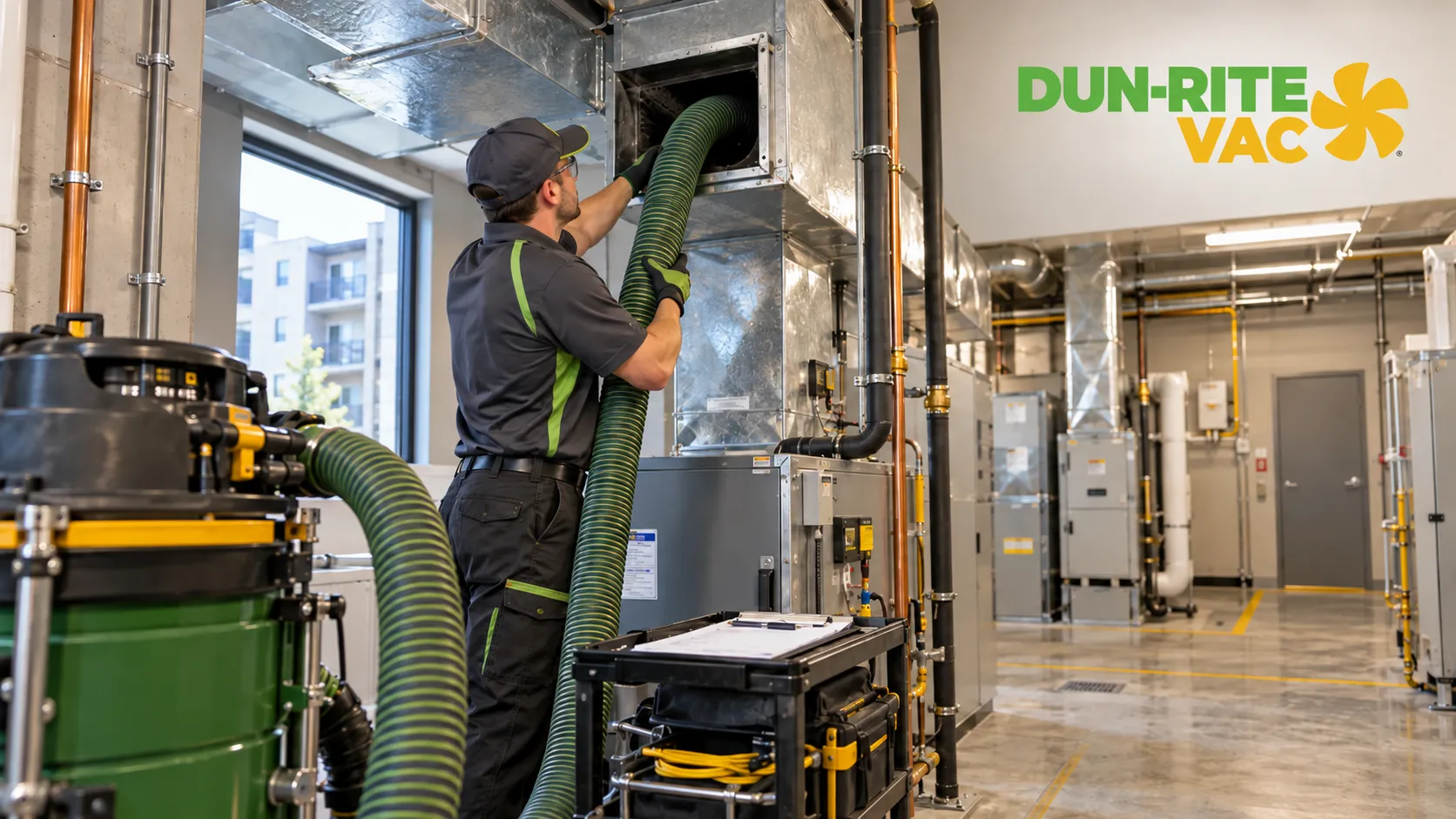
A single furnace in a house is one job. A building with forty suites can be forty furnaces, one central system, or something in between, and that difference decides almost everything about apartment air duct cleaning in multi-unit buildings: how long it takes, who needs to be home, and what the invoice looks like.
This guide is written for property managers, condo boards, and owners planning multi-residential duct cleaning without a flood of tenant questions. It covers how to scope the system, handle suite access, give residents proper notice, and fit the work around a building full of people.
Quick Answer: Condo HVAC cleaning and apartment work go smoothly when you confirm early whether the building runs shared or in-suite systems, line up suite access and written tenant notices before the crew arrives, and choose a NADCA-certified company that plans around occupied units. Entry notice also has to meet the applicable provincial rules, so timing the notices matters as much as timing the crew.
In This Guide
- Why Apartment Building Air Duct Cleaning Starts With Mapping the System
- Suite Access: Where Multi-Unit Jobs Usually Stall
- What a Tenant Notice Needs to Say, and When It Needs to Go Out
- Scheduling Around a Building Full of People
- Which Buildings Need Cleaning Now and Which Can Wait
- Frequently Asked Questions
Why Apartment Building Air Duct Cleaning Starts With Mapping the System
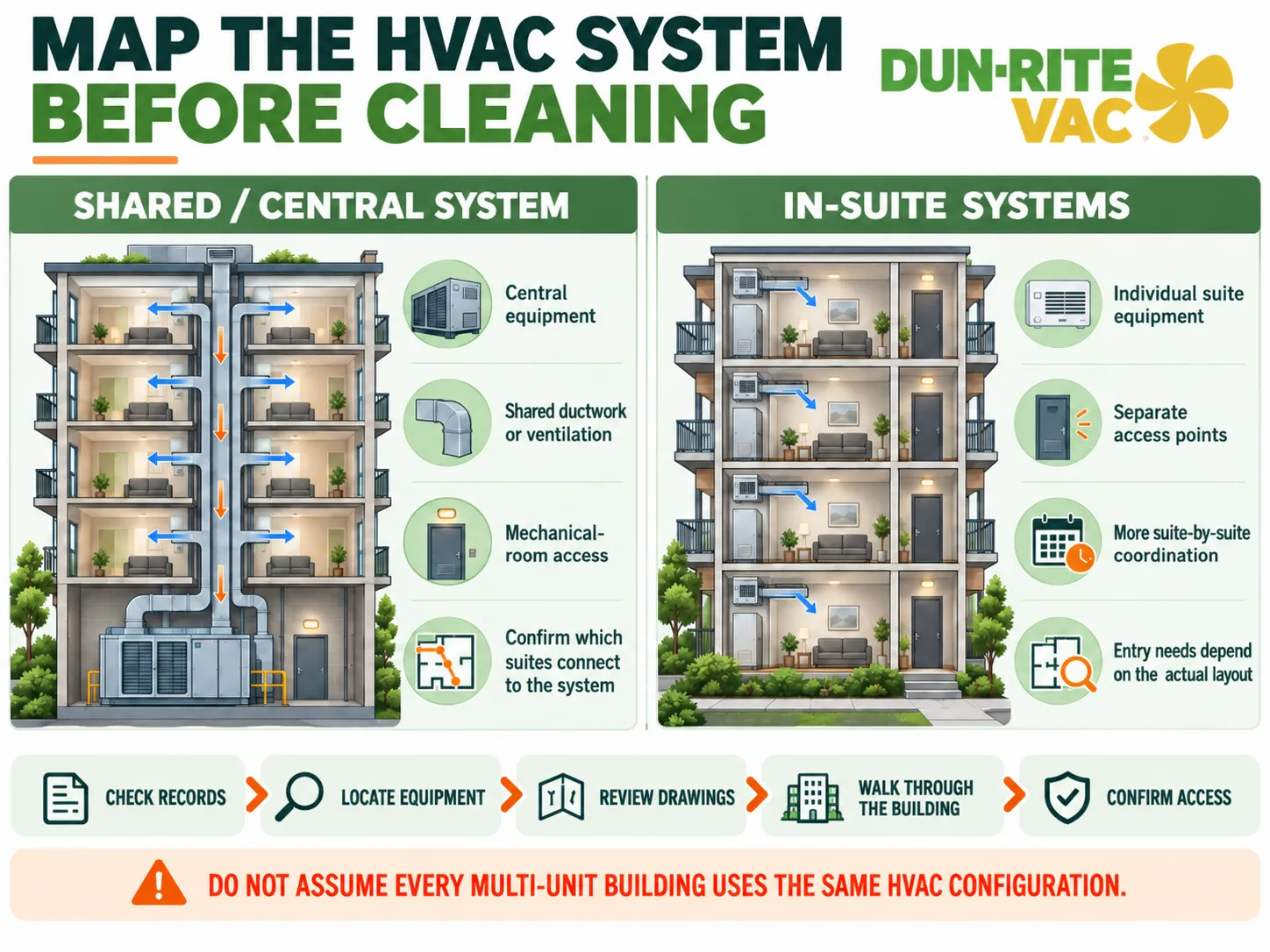
Most quoting problems begin with a wrong assumption: that a multi-residential building has one HVAC setup. In practice, an older walk-up might have a furnace in every suite, while a newer condo building may feed several floors from shared equipment, and some properties mix both. A quote built on the wrong assumption will be wrong in either direction.
On some multi-unit jobs, records of which suites share ductwork and which are independent may be incomplete or spread across owners and past contractors. Before pricing, gather what you do have: equipment locations, mechanical room access, mechanical drawings if they exist, and a suite list showing which units have their own furnace. A contractor walkthrough can help clarify the layout, though in a mixed building you may still need drawings or access to additional suites to be sure.
Multi-unit buildings can use central ventilation equipment serving multiple suites, individual systems located within suites, or a combination of approaches. The Canada Mortgage and Housing Corporation’s guide to ventilation systems in multi-unit residential buildings illustrates why system configuration matters before access is planned. In practice, shared systems may concentrate more of the work around common equipment and main ductwork, while in-suite systems can require access to individual units. Which suites need to be entered still depends on the building’s actual configuration and access points, so confirm that during system mapping rather than assuming it. For the broader picture of how commercial properties are handled, see our commercial furnace duct cleaning page.
Suite Access: Where Multi-Unit Jobs Usually Stall
Picture a cleaning day where the crew arrives on schedule and half the doors stay closed. Nobody is home, a tenant missed the notice, or a key is with someone off site. Ducts that can’t be reached can’t be cleaned, and the gap may require a return visit, which could affect scheduling or cost depending on your quote.
A situation technicians can run into on multi-unit jobs is common-area work wrapping up while several suites still remain. The fix is rarely about the cleaning. It’s about knowing, before the day starts, who holds keys, which tenants want to be present, and which suites have a pet, a night-shift sleeper, or a locked storage area in the way of vents and returns.
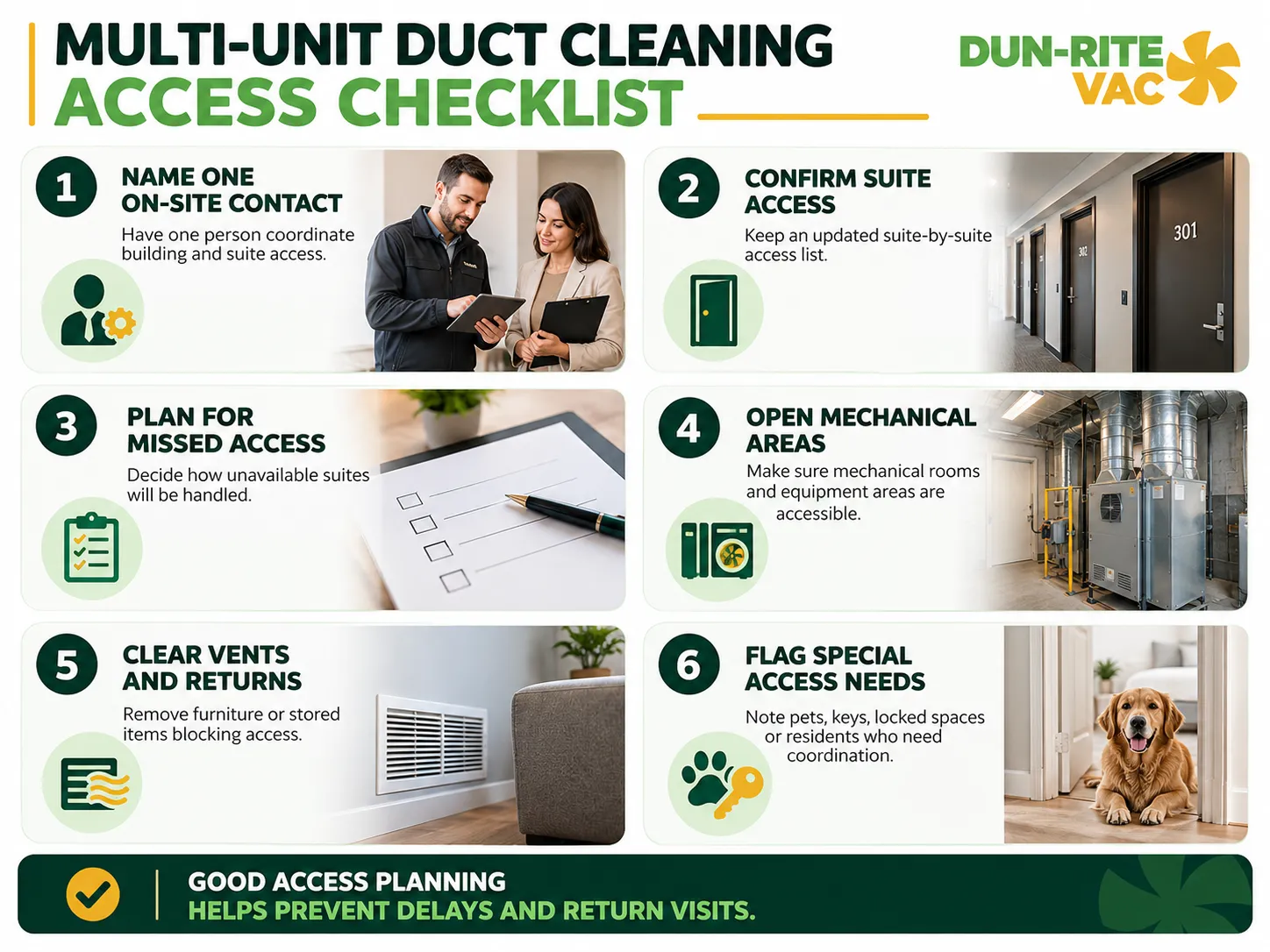
A short checklist keeps this manageable:
- One named on-site contact who can authorize entry to suites.
- A suite-by-suite access list, updated a few days before the visit.
- A plan for no-shows, whether that’s a make-up window or a second pass.
- Clear access to mechanical rooms, panels, and return-air locations.
What a Tenant Notice Needs to Say, and When It Needs to Go Out
Clear notice reduces confusion, questions, and last-minute access problems. For property manager duct cleaning in rental buildings, entry notice is also governed by provincial tenancy rules. The Government of Saskatchewan’s landlord-entry guidance generally requires at least 24 hours’ written notice and no more than seven days’ advance notice. The Manitoba Residential Tenancies Branch’s entry guidance uses a minimum of 24 hours and a maximum of two weeks. Both provinces also set requirements around the reason for entry, notice details, and permitted entry times.
Those are legal minimums and limits for the owner or manager to meet, not a recommendation on how early to notify. As a practical matter, giving tenants a few days’ lead time leaves room to arrange access. On multi-day jobs, plan notices so each suite’s entry falls inside the permitted window. This isn’t legal advice, so confirm current rules and entry hours with Saskatchewan’s Office of Residential Tenancies or Manitoba’s Residential Tenancies Branch. Owner-occupied condominium access is a separate issue from landlord-tenant entry and can involve provincial condominium legislation as well as the corporation’s bylaws. Saskatchewan’s standard condominium bylaws include provisions dealing with corporation access, while Manitoba’s Condominium Act contains its own access and notice provisions.
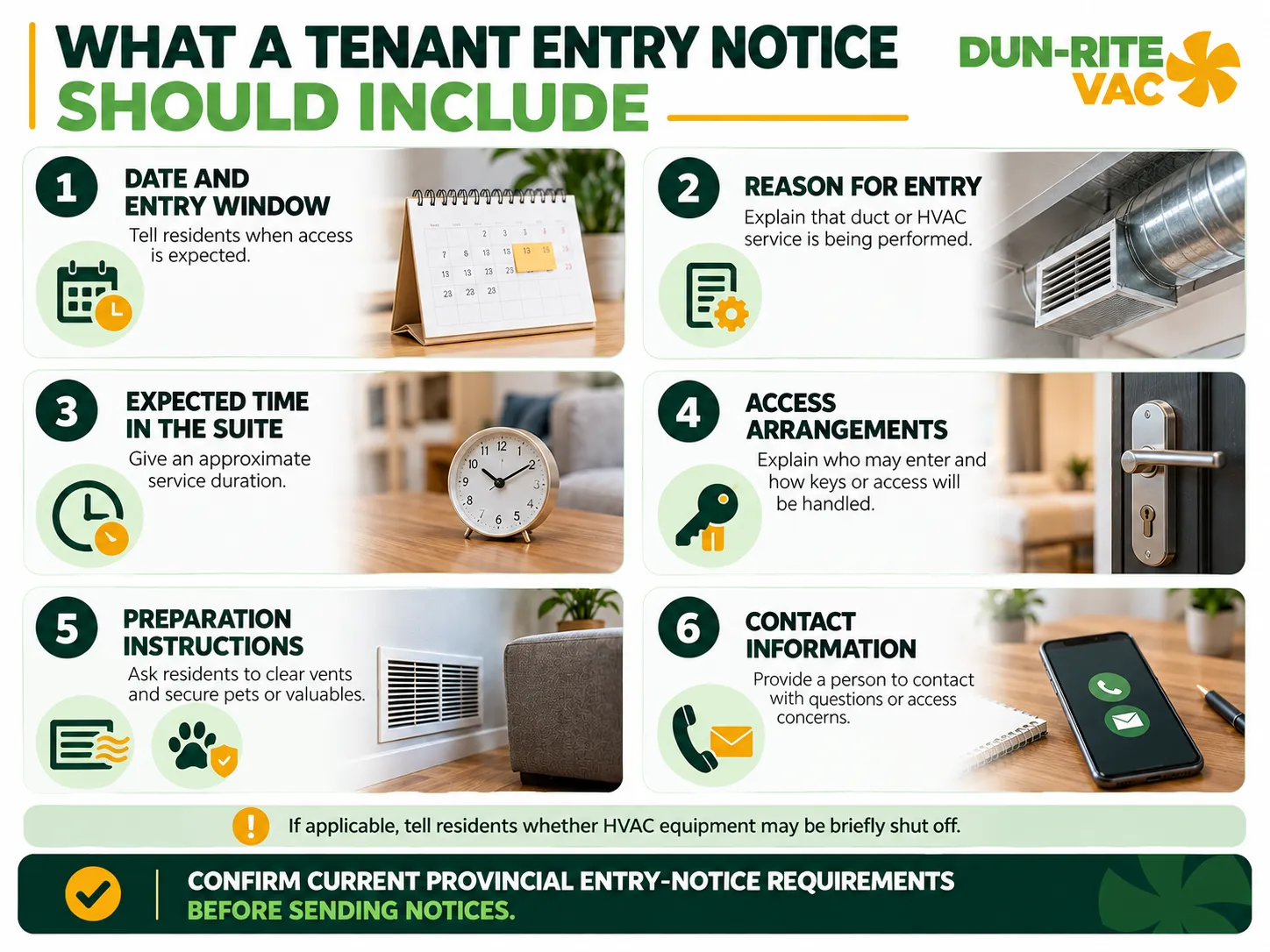
A complete notice covers:
- The date, entry window, and the reason for entry.
- Roughly how long the crew will be in each suite.
- Who is authorized to enter and how keys or access will be handled.
- Instructions on clearing space around vents and registers, and securing pets or valuables.
- Whether the furnace will be briefly shut off, if that applies to your system.
- A contact person for questions and rescheduling.
Planning a multi-unit job and not sure how to handle access or scheduling? Send us a few details about the building and we’ll talk through the options, no obligation. You can reach us here for a free quote.
Scheduling Around a Building Full of People
Saskatchewan’s long heating season shapes the calendar. Two practical windows are early fall, before furnaces are running steadily, and spring, once the heating season eases. Briefly shutting off a furnace in the middle of winter is a bigger ask for tenants, so those windows tend to be easier to manage.
Grouping the work can limit disruption. Floors or wings can be done in sequence so tenants know roughly when their turn comes, and visits can be set for hours when most residents are out. If dryer vent cleaning is already due, it may be practical to include dryer vent cleaning in the planned scope so tenants aren’t disturbed twice. Any air exchanger serving the building should be considered separately, based on the unit’s own condition and maintenance needs; see air exchanger cleaning for what that involves.
Which Buildings Need Cleaning Now and Which Can Wait
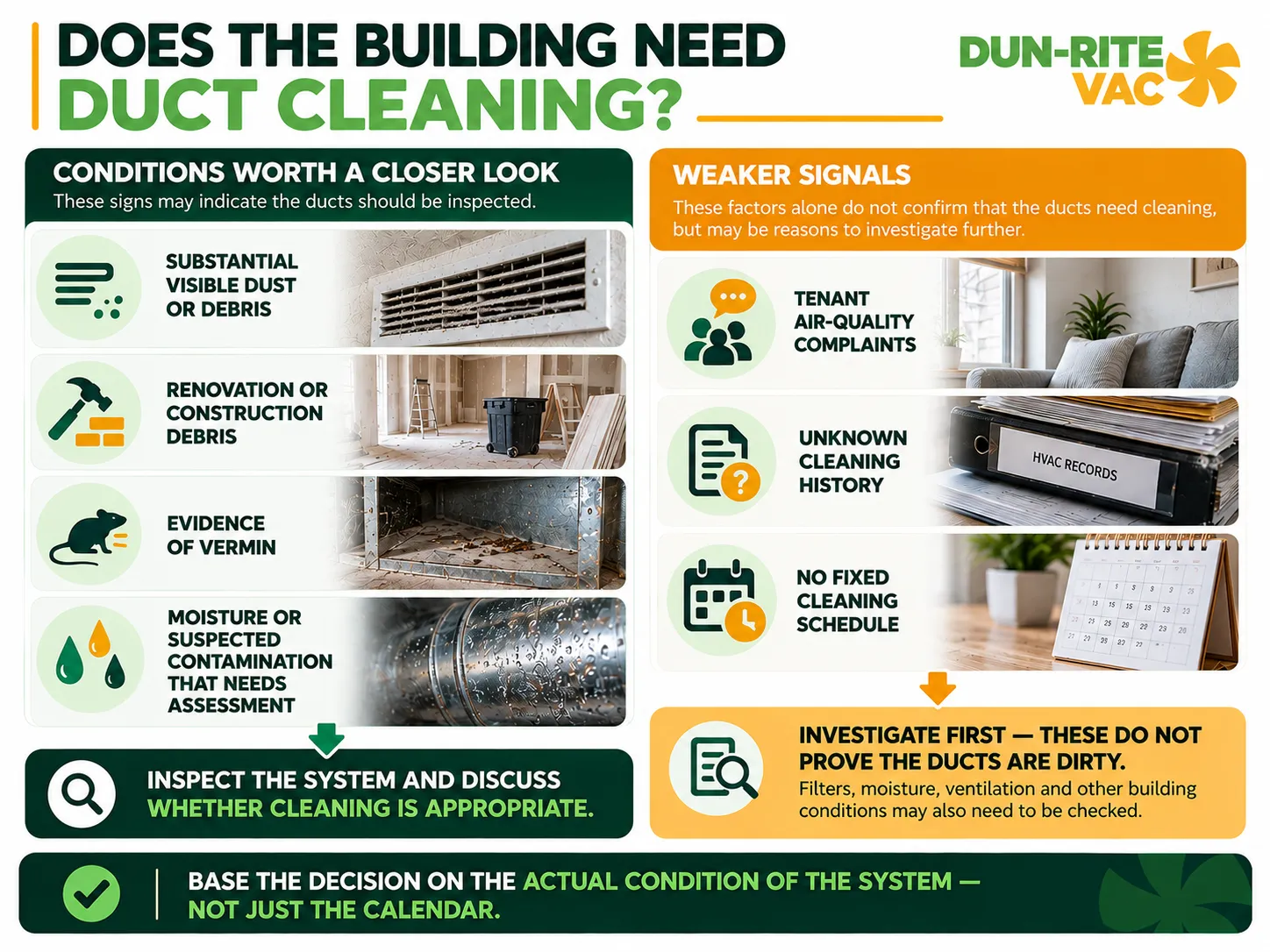
Not every building is overdue. A condition-based approach is more useful than assuming ductwork needs cleaning on a fixed schedule. The U.S. Environmental Protection Agency’s air-duct cleaning guidance points to conditions such as substantial visible dust or debris, vermin, and certain contamination concerns when deciding whether cleaning should be considered. Renovation or construction is also a reason to check whether debris has entered the system. Weaker signals, such as tenant air-quality complaints or no record of previous cleaning, don’t prove the ducts are dirty on their own. Other causes, including filters, moisture, or ventilation, may be involved, so treat those as questions to investigate rather than automatic reasons to clean.
There is no one-size schedule that fits every property, and we’d rather tell you that than sell you a visit you don’t need. When you do hire, credentials can help you gauge a contractor’s training and professional standards. Dun-Rite Vac is a third-generation, family-run company, in business since 1998, with NADCA certification, ASCS-certified technicians, and more than 50,000 completed jobs behind us. The furnace duct cleaning page explains what a certified process involves.
Frequently Asked Questions
If the building has one central system, do we still need to enter every suite?
It depends on the system’s configuration and where the access points are. Confirm suite-entry needs during system mapping and the contractor walkthrough rather than assuming either way.
How much notice do tenants have to get before a cleaning visit?
For rentals, the legal minimum in both provinces is 24 hours’ written notice. Saskatchewan caps advance notice at seven days and Manitoba at two weeks, so notices for a multi-day job should be timed to stay inside that window. Many managers add a short reminder closer to the visit. Confirm current rules with the provincial tenancy office, and check your bylaws for owner-occupied condo suites.
Can dryer vents be done during the same visit as the ducts?
It may be possible to combine them. Mention both when requesting a quote so scope and scheduling can be confirmed.
Let’s make your next building cleaning the easy kind.
Every job is backed by our 100% Satisfaction Guarantee. Tell us about your property and we’ll put together a free quote that fits how your building actually runs.