
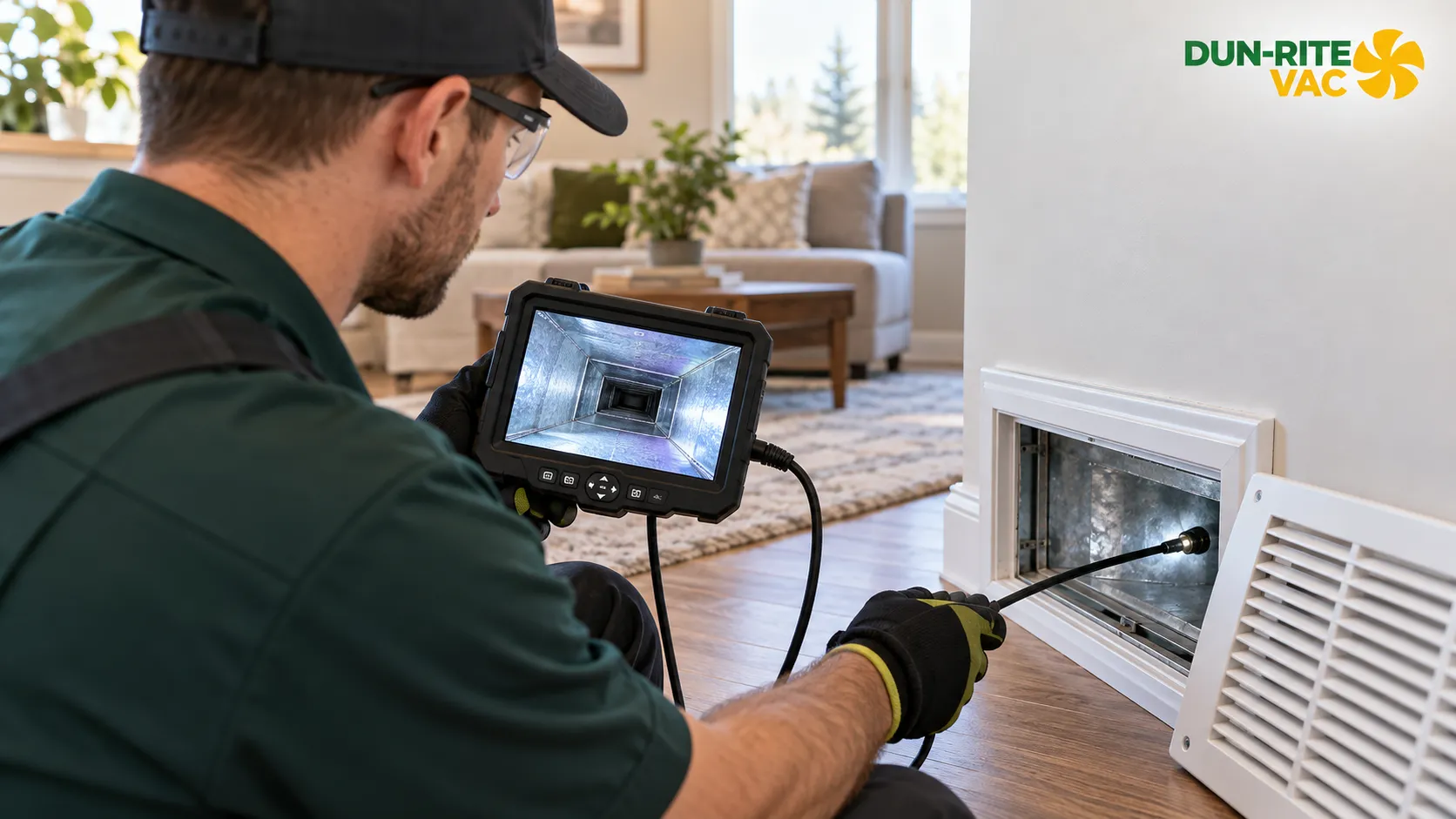
A bedroom that never warms up, a musty smell when the furnace kicks on, or dust that returns days after cleaning: homeowners often wonder whether someone should simply look inside the ducts. An HVAC camera inspection does exactly that, sending a small camera on a flexible cable through accessible ductwork to see what’s happening where nobody can easily reach.
It’s a useful tool, and also one that gets oversold. Here’s what it can reveal, what it can’t, and how to decide whether it’s worth pursuing on your property.
Quick Answer: An HVAC camera inspection can show visible debris, disconnected or crushed ducts, and obstructions in accessible duct runs. NADCA’s air-duct inspection guidance describes video inspection as a way to identify visible blockages and structural issues, while airflow requires separate measuring equipment. Camera footage also can’t confirm mould or inspect a furnace heat exchanger. It’s most useful when you have a specific concern, like a room with weak airflow, and it isn’t something we recommend as a routine check without one.
In this post
- What an HVAC Camera Inspection Actually Sees Inside a Duct Run
- Disconnected and Collapsed Ducts: The Problem Dust Doesn’t Explain
- When a Camera Inspection Is Worth It (and When It Isn’t)
- What a Camera Can’t Tell You
- After the Footage: Cleaning, Repair, or Leave It Alone
- Frequently Asked Questions About HVAC Camera Inspections
What an HVAC Camera Inspection Actually Sees Inside a Duct Run
A duct camera is essentially a small lens and light on a flexible cable, fed in through a vent opening or access point. What it shows is the surface condition of the section it passes through.
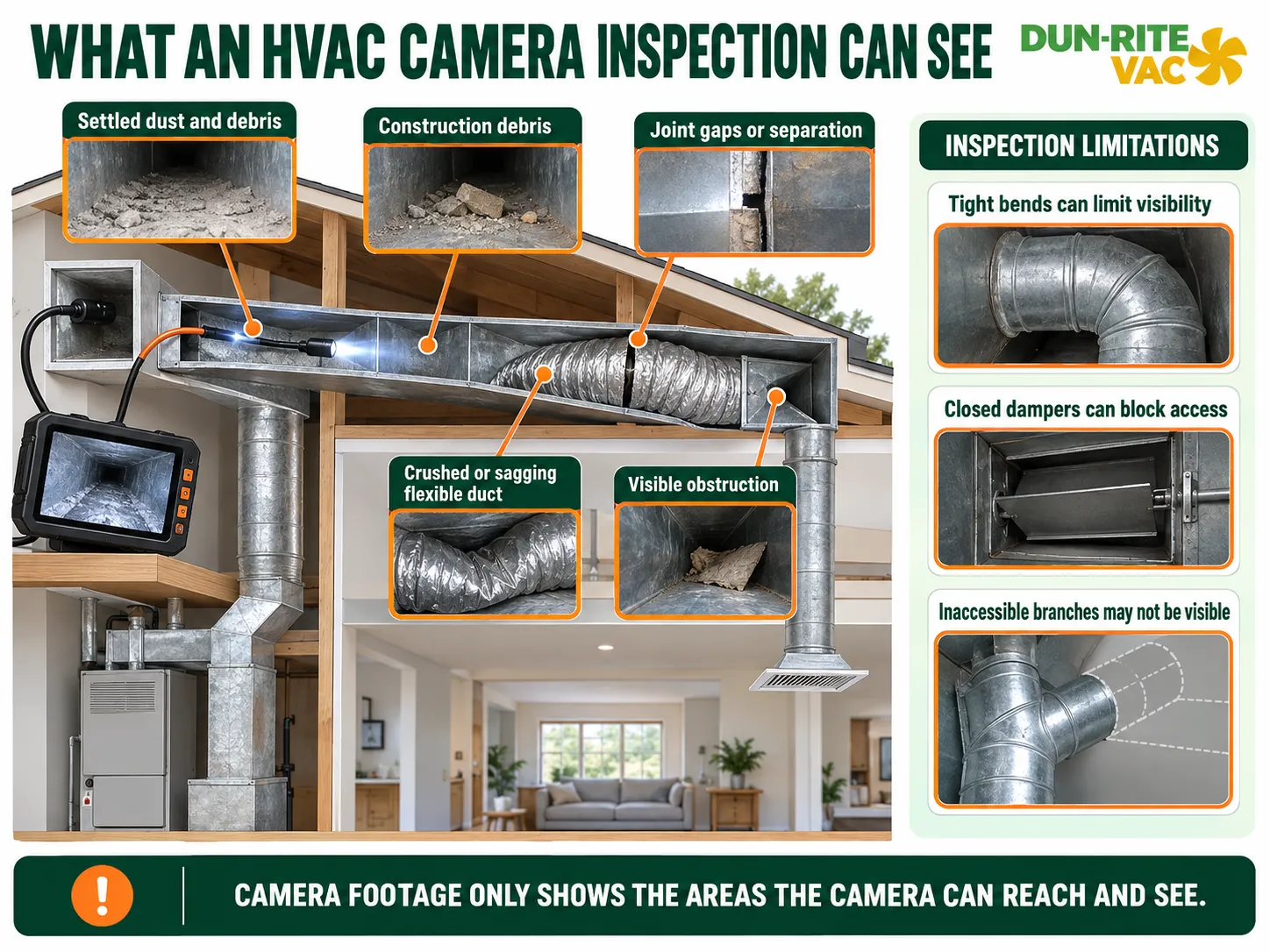
That can include settled dust and debris, construction material left behind, gaps at joints, crushed flexible duct, and sections that run into an obstruction. Straight, accessible runs are generally easier to inspect. Tight bends, closed dampers, and inaccessible branches can limit what you see, which is why footage can look clean in one spot and tell you little about the next stretch.
If you’re weighing an air duct camera inspection against simply looking through your registers with a flashlight, the difference is reach. A flashlight shows the first few feet. A camera can extend farther into accessible runs, subject to bends and access.
Disconnected and Collapsed Ducts: The Problem Dust Doesn’t Explain
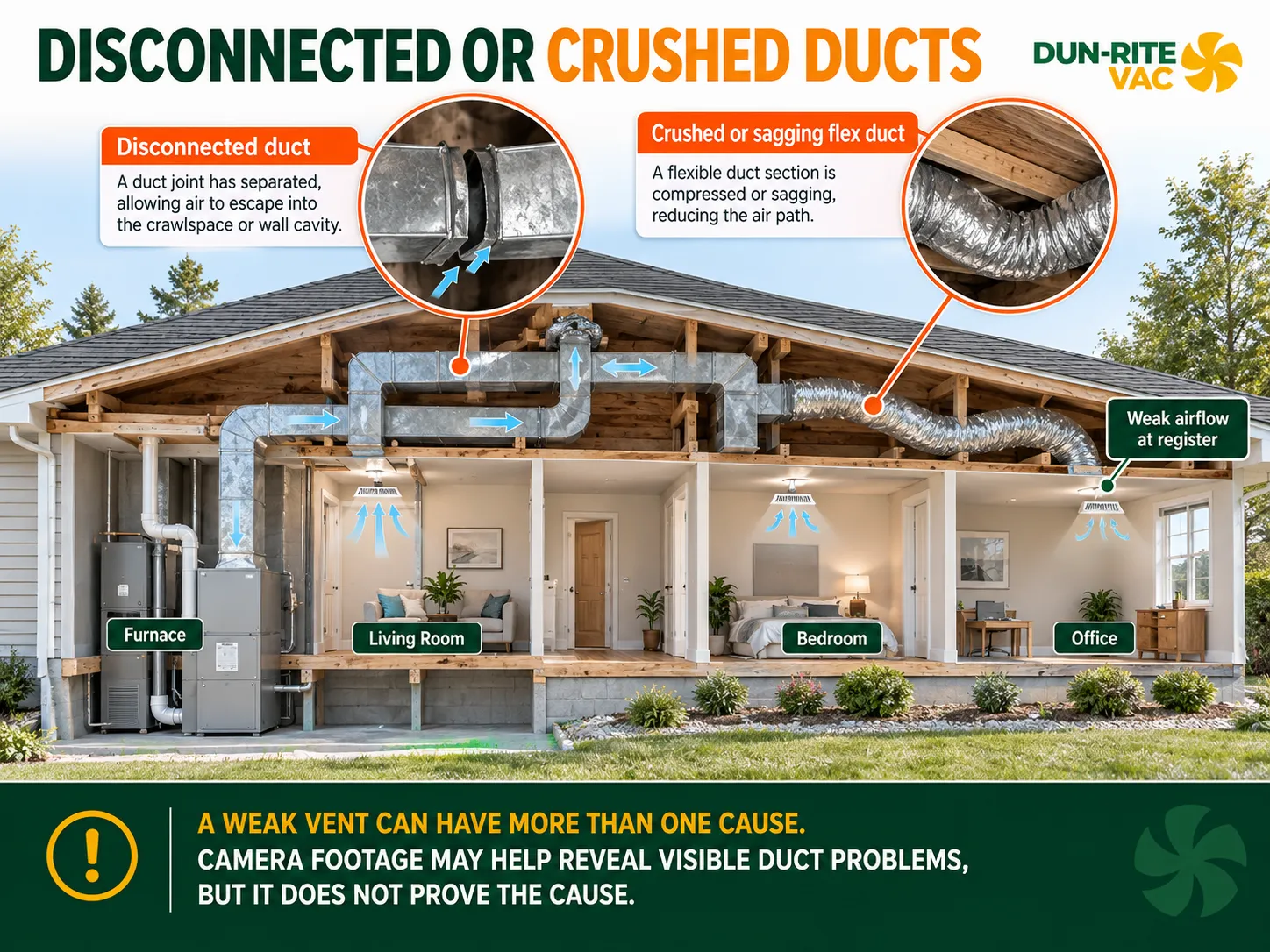
Picture the symptom first: one room at the far end of the house stays cold all winter, even with the vent wide open and the furnace running. Causes can include insulation, airflow balance, or furnace output. One possibility is a duct that has separated from its connection and is sending warm air into a wall cavity or crawlspace instead of the room.
What we’ve come across when we open up the ductwork on older Saskatchewan homes includes joints that had separated and flexible duct that had sagged or been crushed. The U.S. Department of Energy’s Building America guidance on flexible duct installation explains that compressed, kinked, or sharply bent flex duct can restrict airflow. A weak vent can therefore be one clue that the air path deserves a closer look.
A camera may help reveal visible disconnections, crushing, or obstructions in accessible runs. It won’t tell you whether that fault is the reason a particular room is cold.
Dealing with a room that never gets comfortable, or ducts you suspect are carrying more than dust? Reach out for a free quote and we’ll talk through what might be going on before anyone commits to anything.
When a Camera Inspection Is Worth It (and When It Isn’t)
Consider the two homeowners who ask about inspections most often. One has a specific problem: uneven heating, a persistent odour, a renovation that may have left debris behind. The other has a comfortable house and wants reassurance. The first has a concrete reason to look inside.
Something our technicians have run into on renovated basements is drywall dust and offcuts that made it into open duct ends during construction and were never removed. That’s a clear case where seeing inside makes sense. Buying a home with no service history, or finishing a basement that reroutes ducts, are others.
Without a specific concern, we don’t recommend an inspection-only visit, and we’d rather say so than sell you something you don’t need.
One note on how this works with us: Dun-Rite doesn’t offer a stand-alone duct inspection service. With a service area stretching from Yorkton to Saskatoon, Regina, and Weyburn, inspection-only trips aren’t practical. Looking inside the system happens as part of a cleaning visit, where what’s visible helps decide the next step. Findings that fall within cleaning can be handled in that visit, while repair issues may need referral to an HVAC contractor.
What a Camera Can’t Tell You
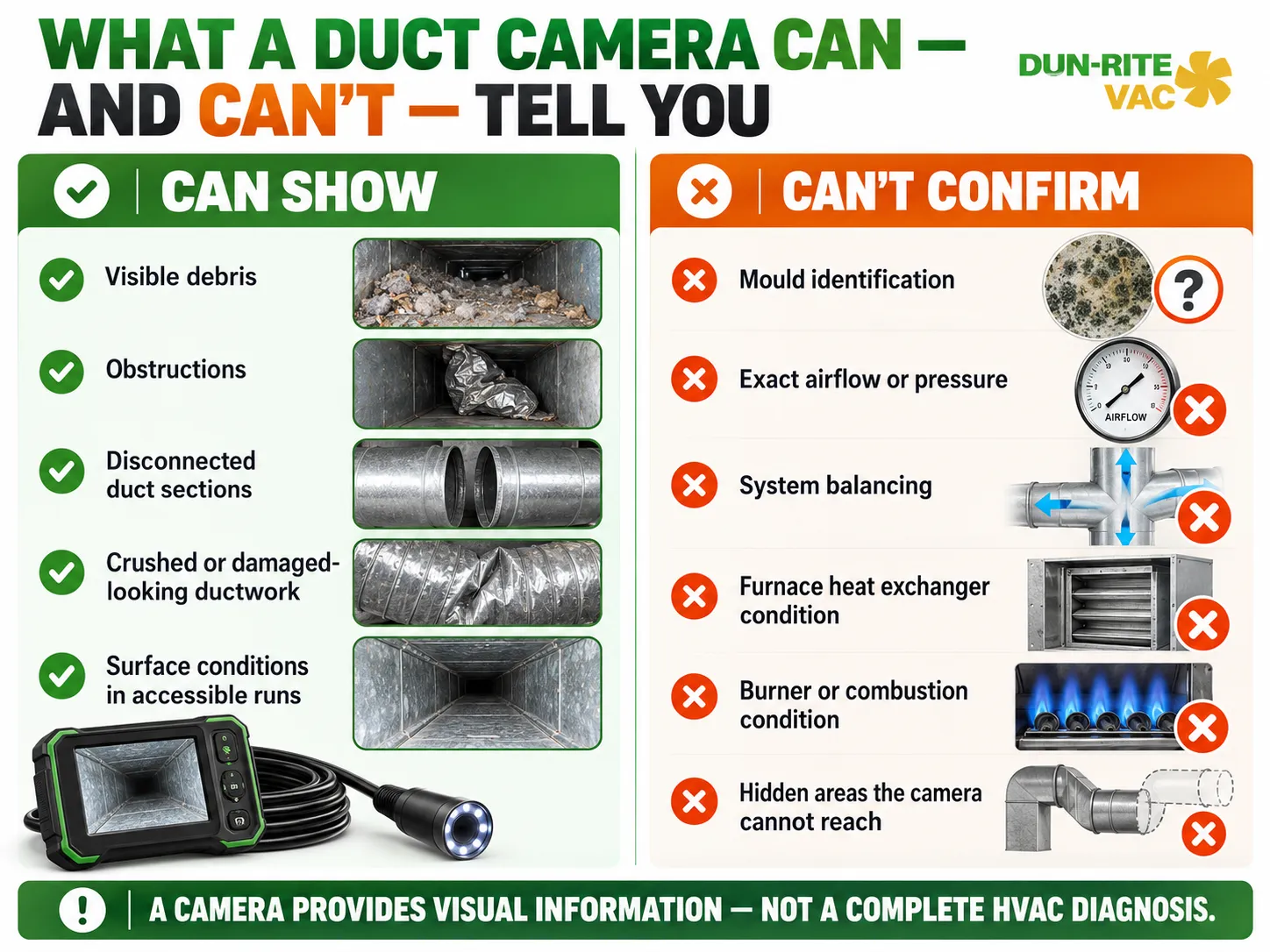
The word “inspection” suggests a verdict, but a camera only provides pictures, and several important questions can’t be answered with a picture.
- Mould versus dirt. Dark spots can look alarming, but camera footage alone can’t establish that a substance is mould. The U.S. Environmental Protection Agency’s air-duct guidance notes that material may look like mould but positive identification may require expert evaluation and laboratory analysis. If you’re concerned, have it properly assessed. HVAC sanitization is a separate service we can discuss once the condition has been assessed; it isn’t a substitute for mould assessment or remediation.
- Airflow and pressure. A camera shows the inside of a duct, not how much air moves through it or whether the system is balanced.
- The furnace itself. A duct camera doesn’t assess burners, heat exchangers, or combustion. Those need a licensed gas technician.
- Hidden runs. Sections behind insulation, inside walls, or past tight bends may not be reachable at all.
Air exchangers are a separate matter. An HRV or ERV has its own filters and core, so it should be assessed on its own rather than through the main ducts. Our air exchanger cleaning page explains that service.
After the Footage: Cleaning, Repair, or Leave It Alone
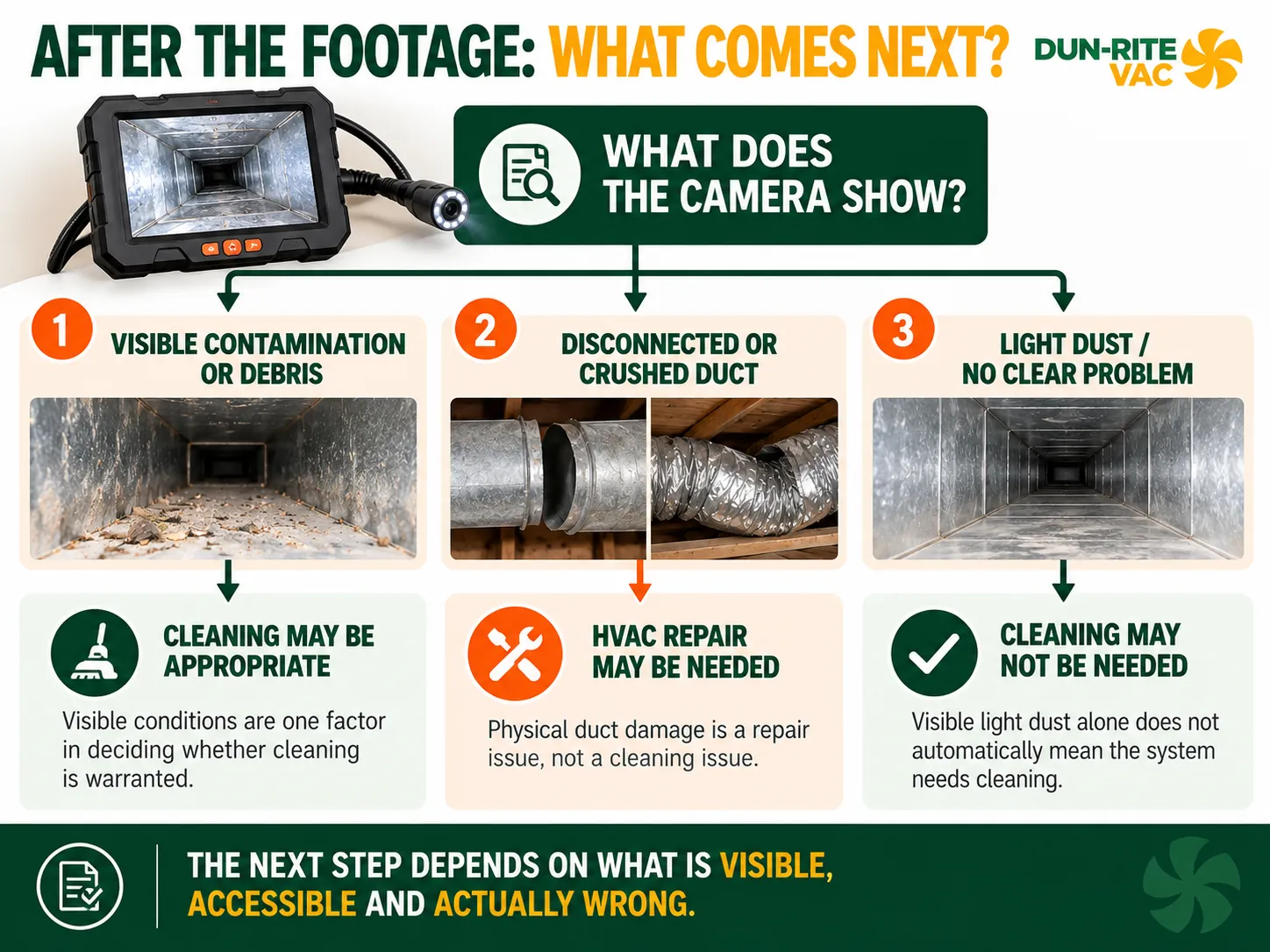
Seeing a problem is only half the decision, and what happens next depends on what the footage shows.
Visible contamination is one factor in deciding whether cleaning is appropriate. The EPA’s air-duct cleaning guidance identifies visible contamination and substantial debris among the conditions homeowners may consider when deciding whether cleaning is warranted. When cleaning is appropriate, we do that work in line with the NADCA ACR Standard, with ASCS-certified technicians, drawing on more than 27 years in business and over 50,000 completed jobs. See our furnace duct cleaning page for what that involves.
A disconnected or crushed duct is a repair rather than a cleaning, and that’s work for an HVAC contractor. A light layer of visible dust doesn’t, on its own, establish that cleaning is needed.
The dryer exhaust is a related question that gets overlooked, but it’s a separate system with its own fire-risk considerations; our dryer vent cleaning page covers it. For the full list of what we do, see our services overview.
Frequently Asked Questions About HVAC Camera Inspections
Can a camera tell me if the dark spots in my vents are mould?
No. Footage can show that something is there, but dust, staining, and mould can look alike, and a camera alone can’t establish which it is. If mould is a concern, it needs proper assessment beyond what video shows.
Will a duct camera explain why one room is always cold?
Sometimes. It may reveal a disconnected, crushed, or blocked duct serving that room. But if the ducts look intact, the cause may be airflow balance, insulation, or the furnace, none of which the camera measures.
Does a camera inspection check my furnace’s heat exchanger?
No. Duct cameras are made for ductwork. Furnace components such as the heat exchanger require a licensed gas technician.
Is a camera inspection worth it before buying an older home?
It may be, particularly if there’s no service history and the ductwork looks original. It can reveal visible issues in accessible duct sections, but it doesn’t replace a home inspection or an HVAC assessment.
Not sure whether your ducts need attention?
Send us a note about what you’re noticing. Every job is backed by our 100% Satisfaction Guarantee, and the quote is free.