
Long dryer vent cleaning is different from clearing a short, straight run. If your dryer vent winds through floors, travels a long way across the house, or ends at a roof cap, the added length and turns can increase airflow resistance and create more opportunities for lint buildup.
This post covers how elbows, cold spaces, roof exits and booster fans each affect a complex vent, and how to tell when the layout deserves a closer look.
Quick Answer: A long dryer vent run, or one with many bends, adds airflow resistance and can make lint buildup and slow drying more likely. If your dryer needs extra cycles or the laundry room runs hot, have the full run cleaned from the dryer to the outside exit, not just the section you can reach.
In this post
- Why long dryer vent cleaning starts with the elbows
- Cold wall condensation: what a Saskatchewan winter does to a long vent
- Roof exits: the end of the run nobody checks
- Booster fans: a fix with its own maintenance rules
- Dryer vent airflow problems or a dryer problem?
- Frequently asked questions about long dryer vent runs
Why Long Dryer Vent Cleaning Starts With the Elbows
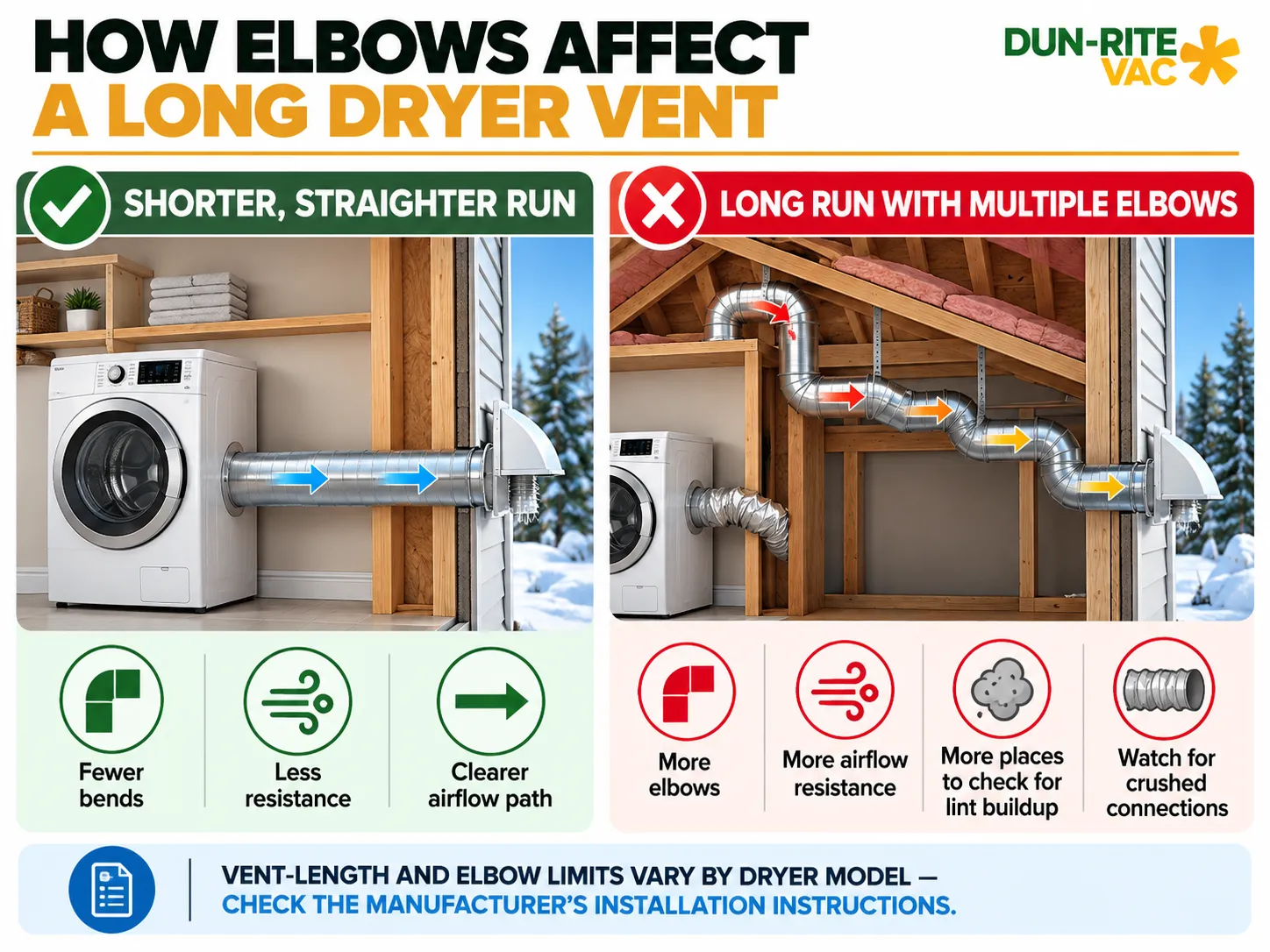
Every elbow in a dryer vent with many bends adds resistance and can reduce how much air the vent moves. A longer run with several turns also creates more opportunities for lint buildup as airflow becomes restricted.
Vent limits are specific to the appliance. Whirlpool’s dryer venting guidance notes that increased vent length and additional elbows can reduce airflow and advises homeowners not to exceed the vent-length limits specified for their dryer. Check your own dryer’s installation instructions because the allowable length and number of turns vary by model.
Tight bends and the connection directly behind the dryer deserve attention too. If the dryer has been pushed back far enough to crush or kink the duct, that restriction can further reduce airflow.
Cold Wall Condensation: What a Saskatchewan Winter Does to a Long Vent
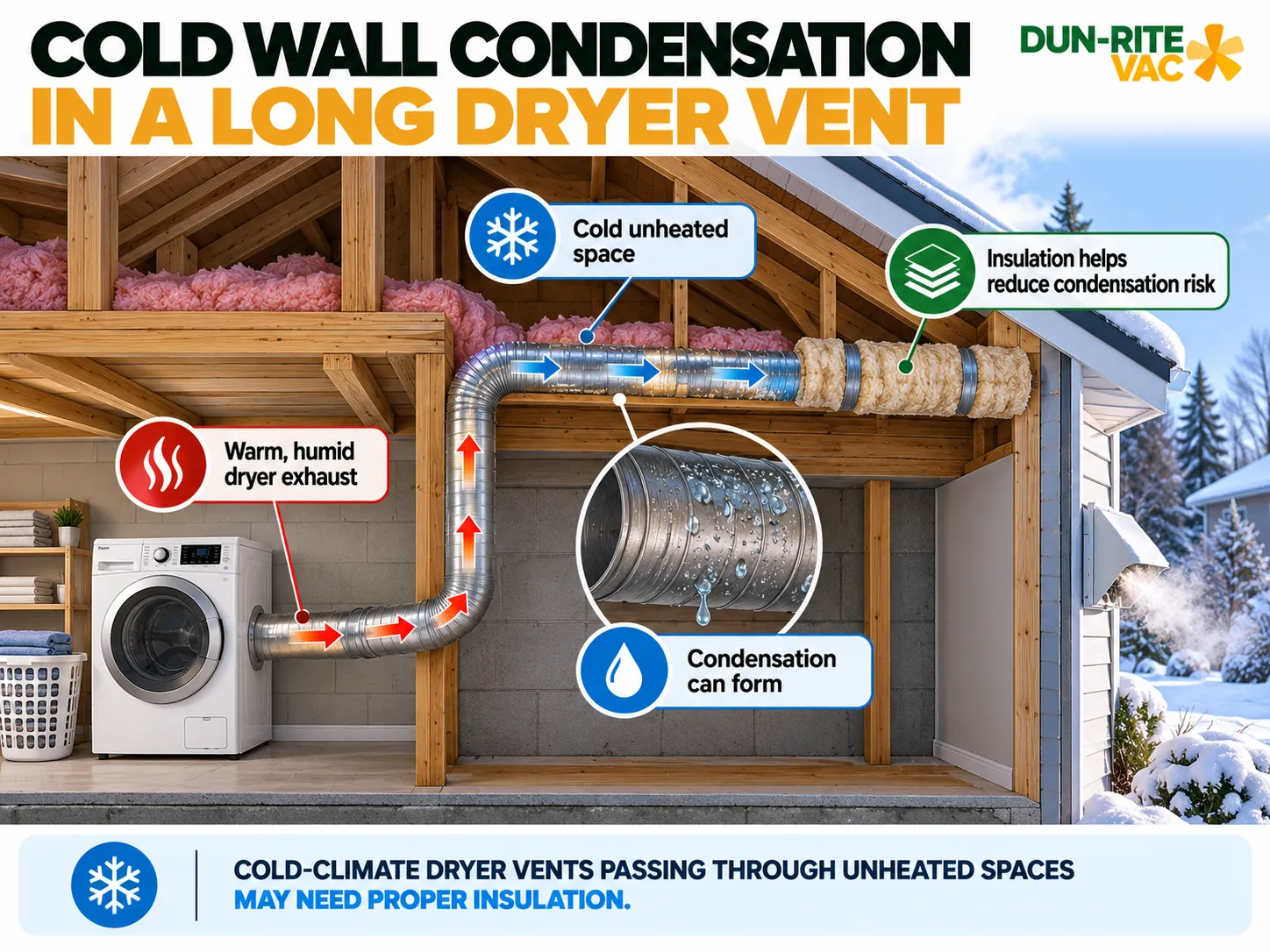
Dryer exhaust is warm and humid. During our long heating season, a long run may pass through exterior walls, attics or other unheated spaces where the duct becomes much colder. The Building America Solution Center’s dryer-vent guidance recommends insulating dryer exhaust ducts that pass through unconditioned spaces, especially in cold climates, to help prevent condensation.
One thing we see regularly with basement laundry rooms where the dryer is far from the outside termination is a dryer that seems fine in early fall but starts taking longer once colder weather arrives. Homeowners may suspect the dryer itself, but the length of the run, cold sections of duct and airflow through the vent are worth checking too.
Roof Exits: The End of the Run Nobody Checks
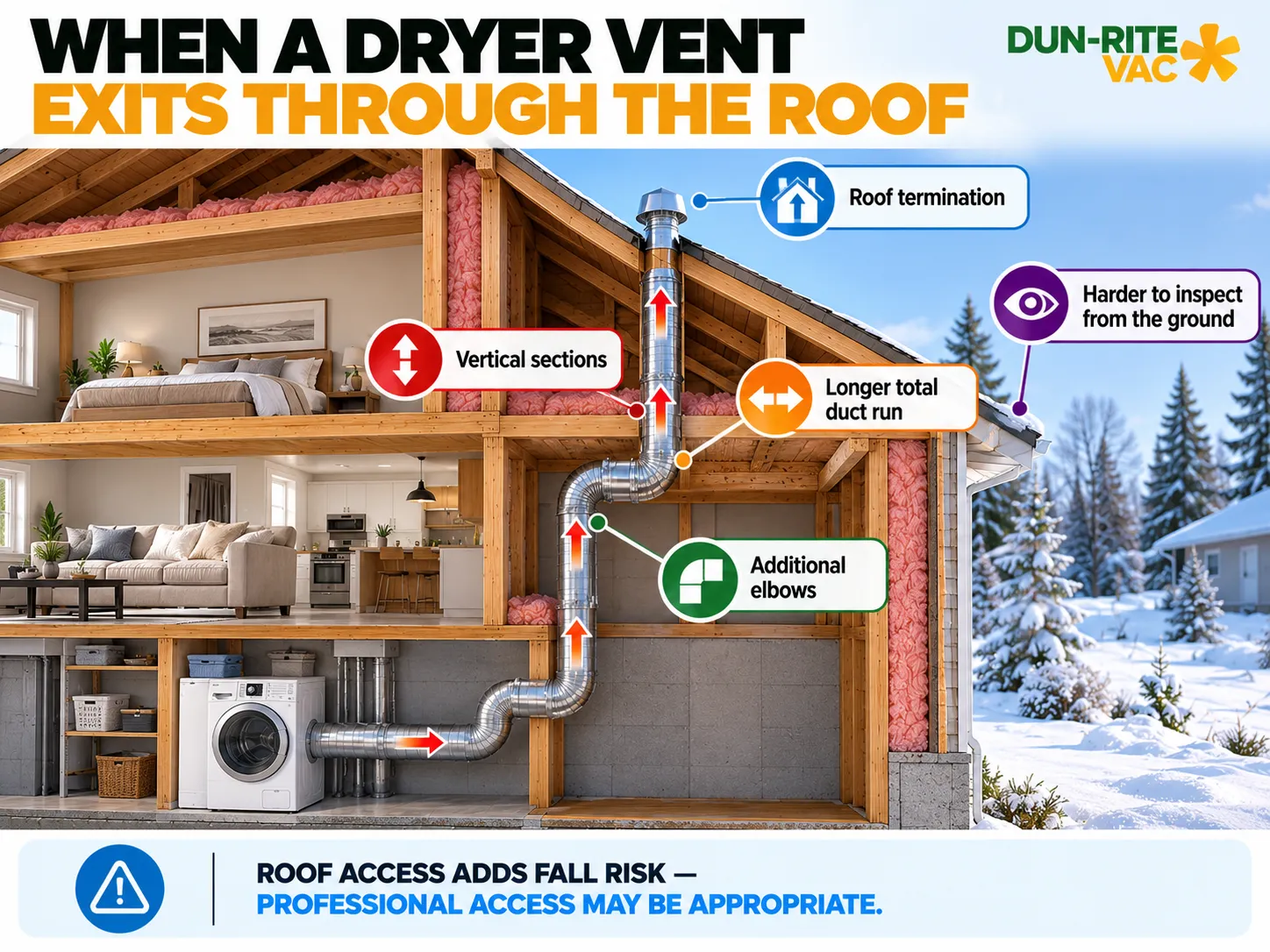
Roof exits are often part of more complex dryer vent layouts, with vertical sections, additional elbows and greater total duct length. Those features increase resistance within the run. The Building America Solution Center recommends keeping dryer exhaust runs as short and straight as practical, avoiding roof terminations where possible, and keeping screens off dryer exhaust terminations because they can restrict airflow as lint collects.
A roof termination can also be harder for a homeowner to inspect from the ground. If the outlet becomes restricted by lint or debris, the problem may not be as obvious as it would be with a wall-mounted vent. Any cap or termination that does not match the dryer’s installation requirements should be evaluated rather than modified casually.
A complex roof-exit run may require professional access from different parts of the system depending on its layout. If accessing the roof itself is necessary, that adds a separate safety concern: Canadian Centre for Occupational Health and Safety guidance on residential roofing highlights the fall hazards involved in roof work. That is a good reason not to treat a roof-exit dryer vent as a casual DIY cleaning job.
If your vent travels up and out through the roof, or you can’t tell where it ends, you don’t have to work it out alone. Reach out through our contact page to talk with our NADCA-certified team about your layout and get a free quote.
Booster Fans: A Fix With Its Own Maintenance Rules
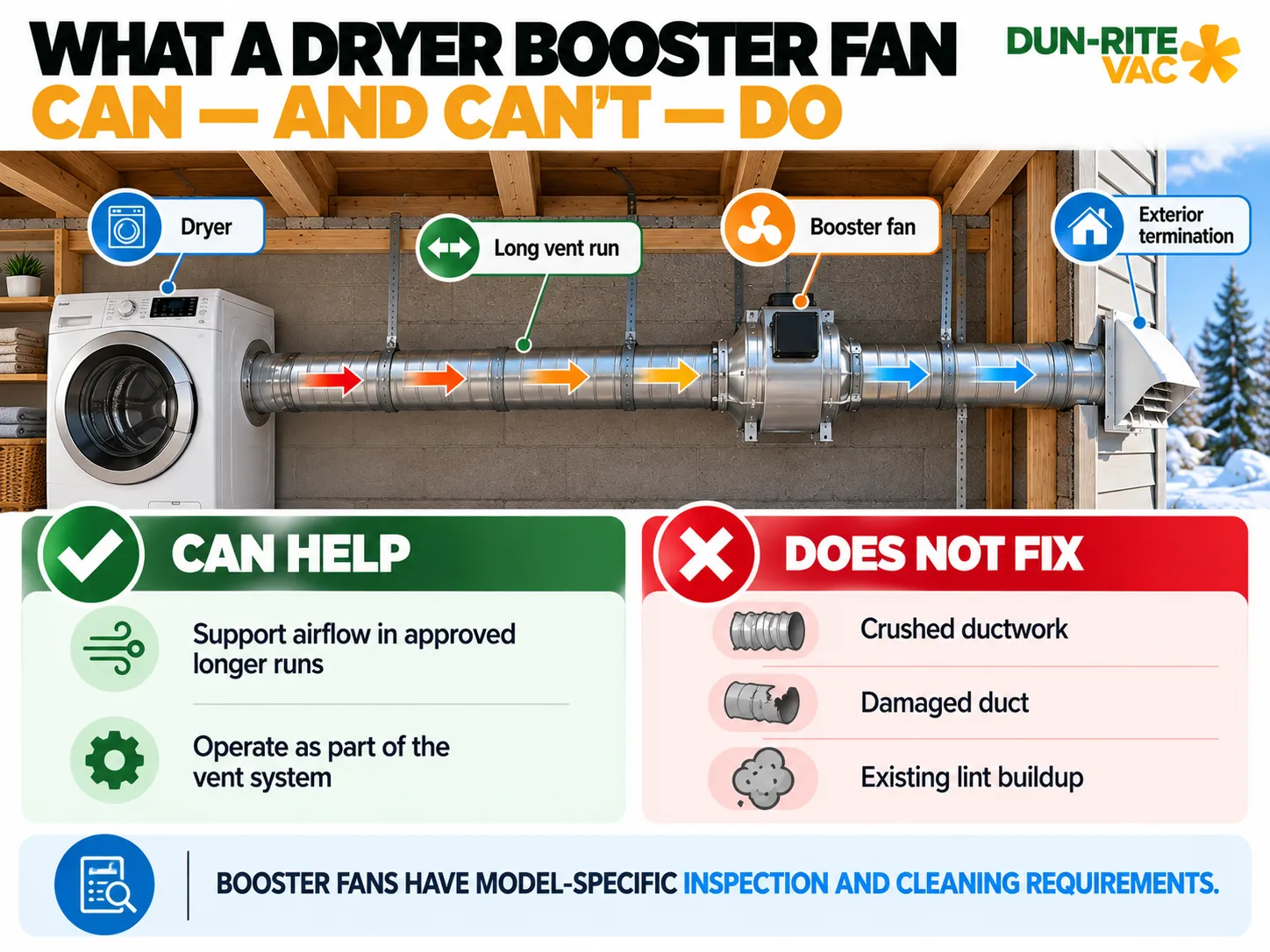
Some long dryer vent systems use an approved dryer exhaust booster fan to help maintain airflow through a longer duct run. These fans have their own installation and maintenance requirements. Fantech’s technical guidance for dryer exhaust power ventilators explains that lint can accumulate on fan components and that periodic inspection and cleaning are required.
If a booster fan is part of your vent, mention it when you contact us so we can talk through the layout and what is accessible. Maintenance should follow the instructions for the specific fan model rather than assuming every booster-fan installation is the same.
A booster fan also has limits. An approved fan may allow a longer duct run when it is installed according to its manufacturer’s specifications, but it does not repair crushed or damaged ductwork and it does not remove lint that has already accumulated in the vent.
Dryer Vent Airflow Problems or a Dryer Problem?
A struggling vent and a dryer with a mechanical problem can produce some of the same symptoms, so these signs do not diagnose the cause by themselves. Whirlpool’s dryer troubleshooting guidance identifies long drying times, excess heat or humidity and restricted outside airflow as reasons to check the dryer venting.
- Loads need a second cycle or stay damp after a normal drying cycle.
- The dryer or laundry area becomes unusually hot during operation.
- The laundry area becomes noticeably humid while the dryer is running.
- There is little or no exhaust airflow at the outside termination while the dryer operates.
- The visible connection behind the dryer is crushed, kinked or otherwise restricted.
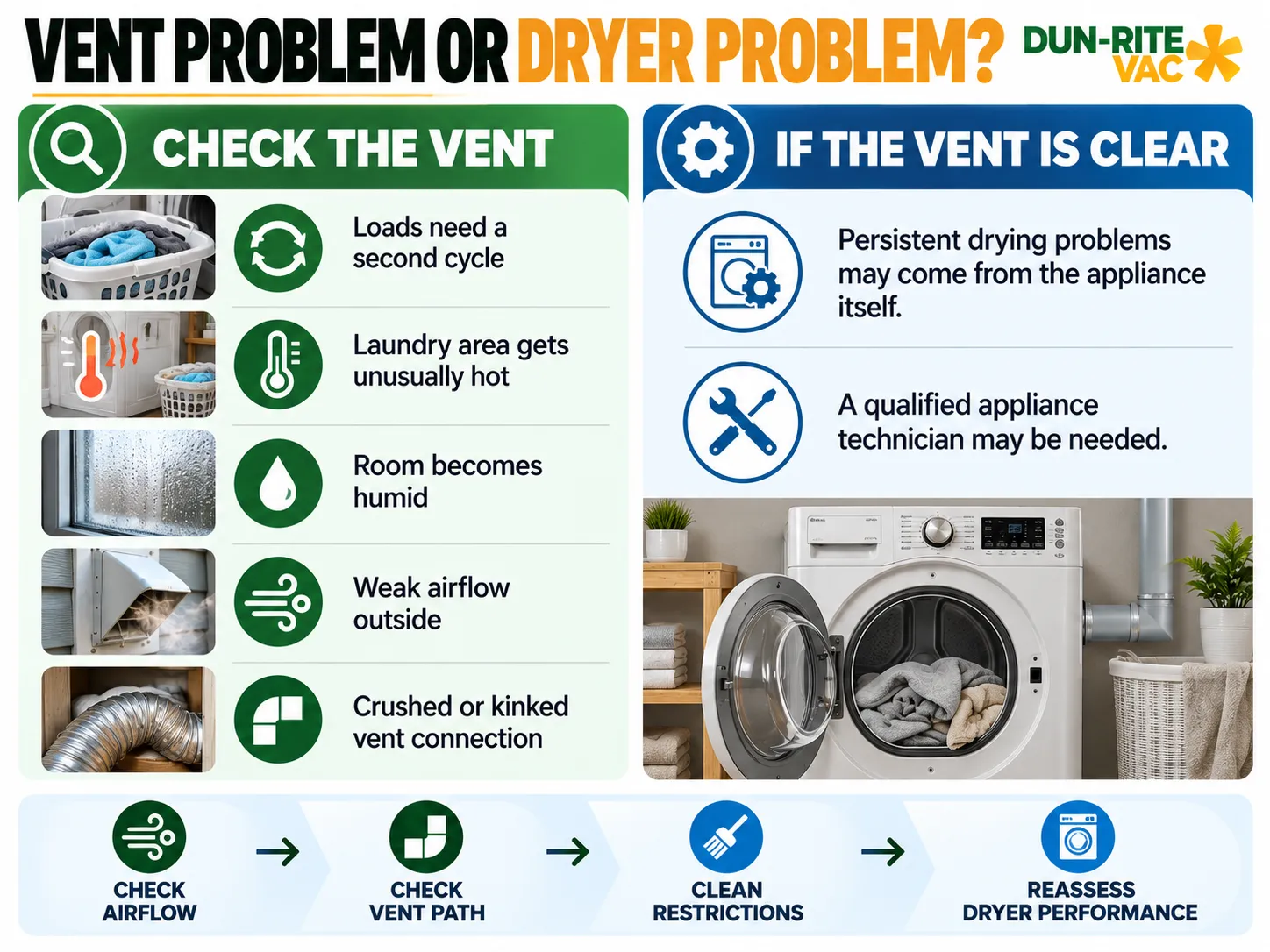
If these symptoms show up, the full vent path is worth checking rather than assuming the dryer itself has failed. During a cleaning visit, we can point out visible or accessible conditions we come across, such as crushed sections, extra bends or a restricted outlet, and we’ll tell you honestly what we find. Cleaning removes lint but doesn’t change the layout. If the route itself is the issue, that is a conversation for whoever installed or can modify the vent. If the vent is clear and the dryer still struggles, the appliance may need its own service.
Not every long vent is an emergency. A compliant, properly maintained long run can perform reliably as long as airflow stays adequate and maintenance follows the appliance and vent requirements. The point is not to wait for the symptoms above before anyone looks at the far end of the pipe.
Dun-Rite Vac has been a family-run business since 1998, with more than 50,000 completed jobs. Our NADCA-certified company and ASCS-certified technicians bring that experience to long dryer vent cleaning and every other job, and you can see what customers say on our reviews page. For the basics of our service, see our dryer vent cleaning page.
Frequently Asked Questions About Long Dryer Vent Runs
Can a booster fan make up for a dryer vent with many bends?
Only partly. A fan may help move air through a longer run, but each elbow still adds resistance, and the fan doesn’t fix lint buildup or damaged ducting. It also needs maintenance according to its manufacturer’s instructions.
Can I clean a vent that exits through the roof with a store-bought brush kit?
A kit may reach part of the run, but long, bent runs are hard to clear fully with a flexible brush, and lint may get pushed further along instead of removed. Working at roof height, especially in winter, adds a safety risk of its own.
Why does my dryer take longer in winter when the vent hasn’t changed?
Cold exterior walls and unheated spaces can cool the humid exhaust, which may cause condensation inside the pipe and make lint cling more readily. A long run gives that cooling more distance to act, so existing buildup can show up as slower drying once the weather turns.
Not sure whether your vent run needs attention? Quotes are free with no obligation, and every Dun-Rite Vac job is backed by our 100% Satisfaction Guarantee.