
The keys are in your hand, the rooms are empty, and nobody has opened a vent cover in who knows how long. Before the furniture arrives, you have a rare window: air duct cleaning before moving in is far easier to schedule and far less disruptive than doing it around couches, kids and pets a few months later.
But “clean everything on day one” isn’t always the right call either. This checklist helps you work out what you’re actually looking at in a new-to-you home, and what’s worth paying for.
Quick Answer: Check the furnace’s age and label, the filter, the registers and any visible ductwork before you move in. If you find substantial visible buildup or renovation debris, or the condition of the system is still uncertain after your inspection, the empty-house period is a convenient time to look into professional cleaning. If the system looks clean and the seller can document its upkeep, cleaning can often wait.
In this post
Why an Empty House Is the Best Time to Clean the Ducts
Most people think about their ducts when something goes wrong: a musty smell, a dusty winter. By then the house is full, and every register has a rug or a bookshelf near it.
Before possession day, technicians can reach every register and the furnace without moving anything. There are no belongings to cover, no one working from home, and no need to air the house out for the afternoon.
If you’re planning renovations, such as painting or new flooring, coordinate the timing. Those projects can create dust of their own, so if cleaning is needed, it generally makes sense to schedule it so construction debris isn’t introduced afterward.
Timing matters on the Prairies too. A home taken over in late summer or early fall has a short runway before the heating season starts and the furnace begins running much more often. Taking over in spring, you have more time, but the system has just worked through a long winter for someone else.

A 15-Minute Furnace and Register Walk-Through
Start with what you can see and touch, and don’t take anything apart. Here is a move-in checklist for the furnace, filters, registers and ductwork:
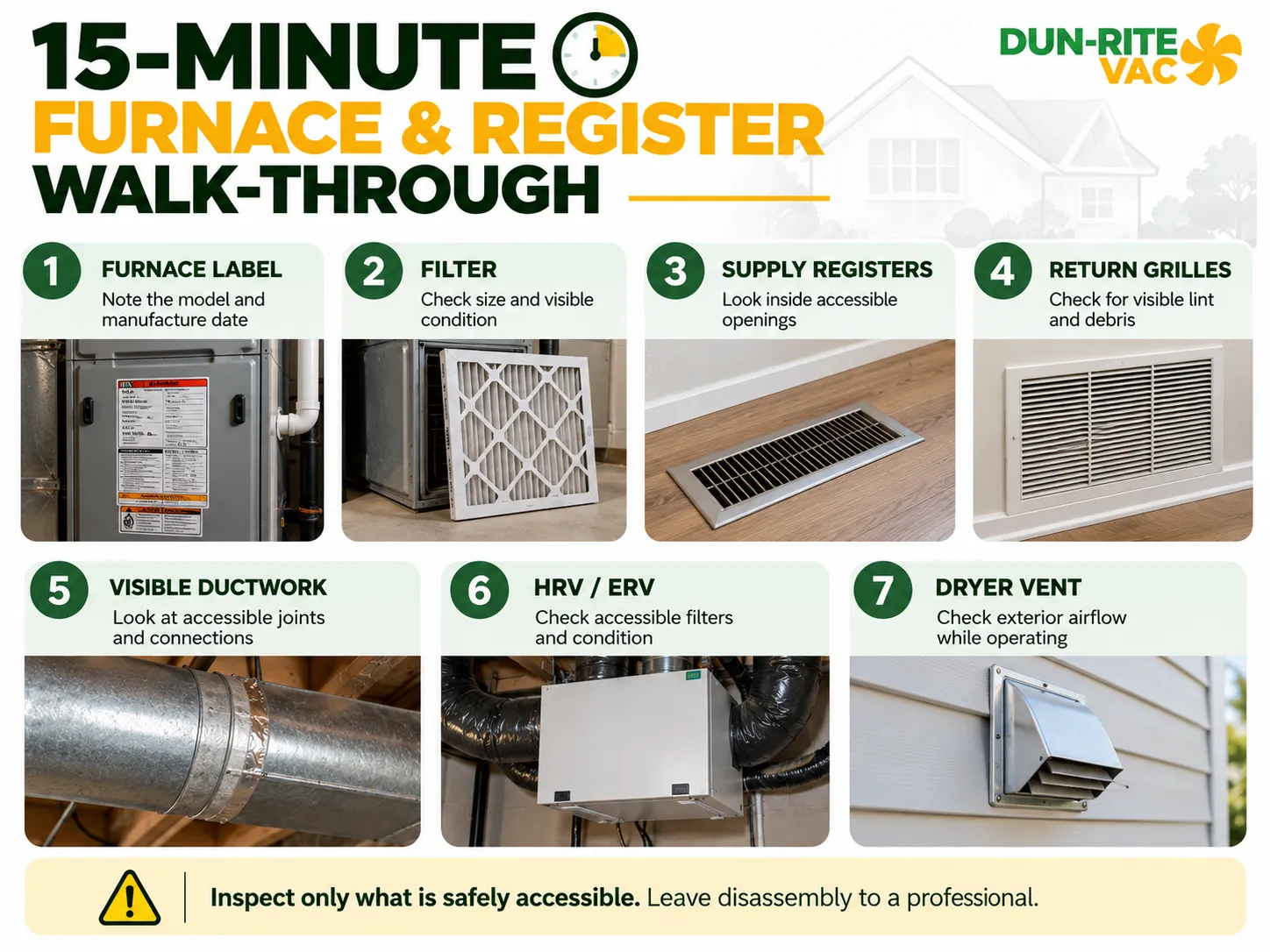
- Furnace label: note the manufacture date and model so you can identify the equipment and compare it with any service records the seller provides.
- Filter slot: pull the filter and note its size, its condition, and whether anything is stuffed in the slot.
- Supply registers: lift a few and look inside with a flashlight, including the one farthest from the furnace.
- Return grilles: check for lint, pet hair, and debris collected on the grille.
- Visible ductwork: in the basement or utility room, look at joints and connections for gaps, tape that has peeled, or dust trails.
- Air exchanger: if the home has an HRV or ERV, find it and check whether the filters and accessible core appear dirty, then ask for maintenance records. (Our air exchanger cleaning page covers why this matters in tightly sealed homes.)
- Dryer vent: run the dryer briefly and check that exhaust air is coming through the exterior vent, and look at the lint trap area. The U.S. Consumer Product Safety Commission recommends checking the outside vent while the dryer is operating and notes that little or no exhaust can indicate a blocked vent or exhaust duct. If airflow seems unusually weak, see our dryer vent cleaning page. Leave any disassembly to a professional.
Also run the furnace for a few minutes and note any odd smells, rattles, or rooms where airflow feels noticeably weak.
What a Seller’s Filter and Registers Quietly Tell You
A filter can say something about how a system has been looked after, but a newly replaced one doesn’t tell you what condition the rest of the system is in. Check the registers and returns as well.
Here’s how to read what you find, keeping in mind that these are clues, not diagnoses:
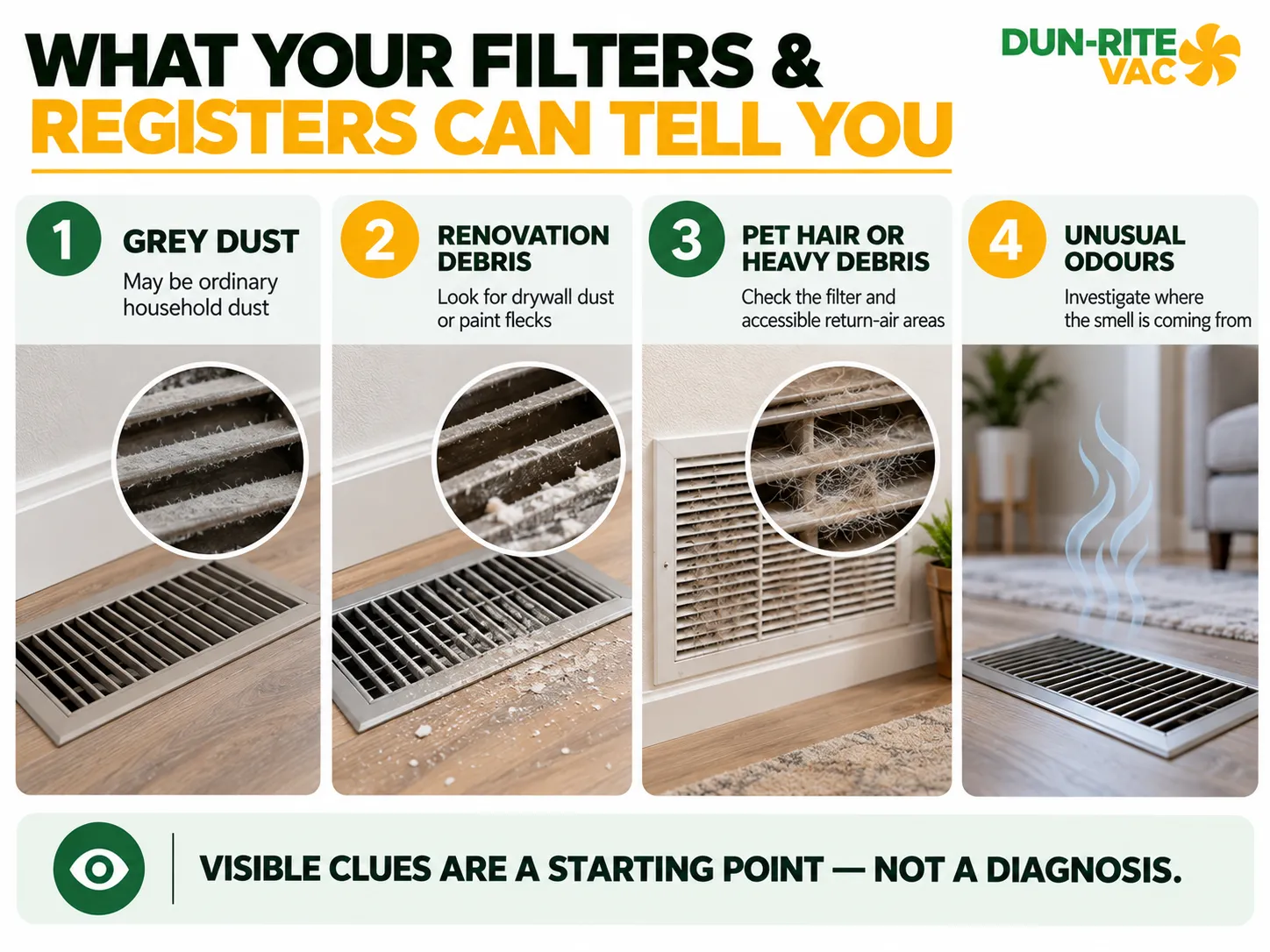
- Grey dust on the register boxes: this may simply be ordinary household dust. Its presence alone doesn’t tell you when the ducts were last cleaned.
- Drywall-coloured powder or paint flecks: these can suggest renovation debris has entered accessible parts of the system, which is worth investigating further. The U.S. EPA recommends sealing supply and return registers during dust-producing renovation work and keeping the HVAC system off until the dust has been cleaned up.
- Pet hair or heavy debris at a return grille: visible buildup there is a reason to check the filter and the rest of the accessible return-air system. The U.S. EPA notes that return registers commonly become dusty because dust-laden air is pulled through the grille.
- A musty or smoky smell when the fan starts: this is worth investigating, because the source may be somewhere in the HVAC system or elsewhere in the home.
What’s visible at a register doesn’t necessarily show the condition of the entire duct system. The U.S. EPA’s air-duct cleaning guidance notes that many parts of a heating and cooling system may not be accessible for visible inspection, so treat a register-level check as a starting point rather than a verdict.
Air Duct Cleaning Before Moving In: When It’s Worth It and When It Can Wait
It’s tempting to book everything automatically, but that isn’t always honest advice. Cleaning is generally worth considering before you move in if any of these apply:
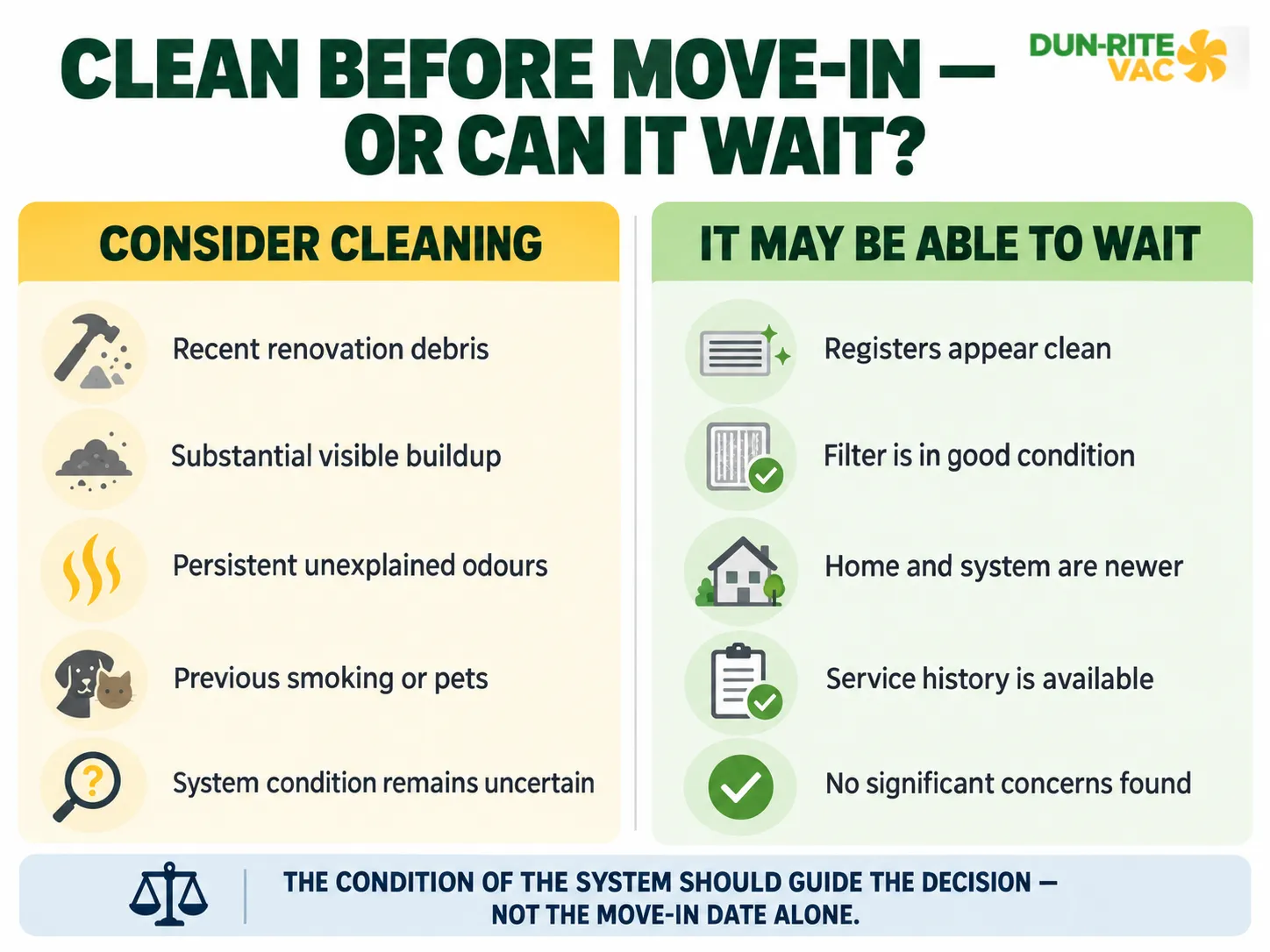
- The home was recently renovated, or the sellers can’t tell you whether the ducts were protected.
- There is substantial visible buildup inside accessible portions of the ductwork.
- The previous owners smoked or kept pets, or the house has a persistent odour that your inspection suggests may be tied to the HVAC system.
- You still can’t tell what condition the system is in after your walk-through. Missing records alone aren’t a reason to clean, but they are a reason to look more closely.
It can reasonably wait if the home is newer, the registers look clean, the filter is in good shape, and the sellers can show service history. In that case, a periodic cleaning on your normal schedule is enough. Our residential furnace duct cleaning page covers what that schedule looks like, and the furnace duct cleaning overview explains what a proper NADCA-standard job involves.
A word on credentials: Dun-Rite Vac is a third-generation, family-run company that has been cleaning systems since 1998. We’re NADCA certified, our technicians hold ASCS certification, we’ve completed over 50,000 jobs, and we back every job with our 100% Satisfaction Guarantee. We’d rather tell you a system can wait than sell you a cleaning you don’t need.
Not sure which side of the line your new house falls on? Send us a few details or photos of your registers and filter, and we’ll give you a straight answer about whether it’s worth cleaning now. Ask us here.
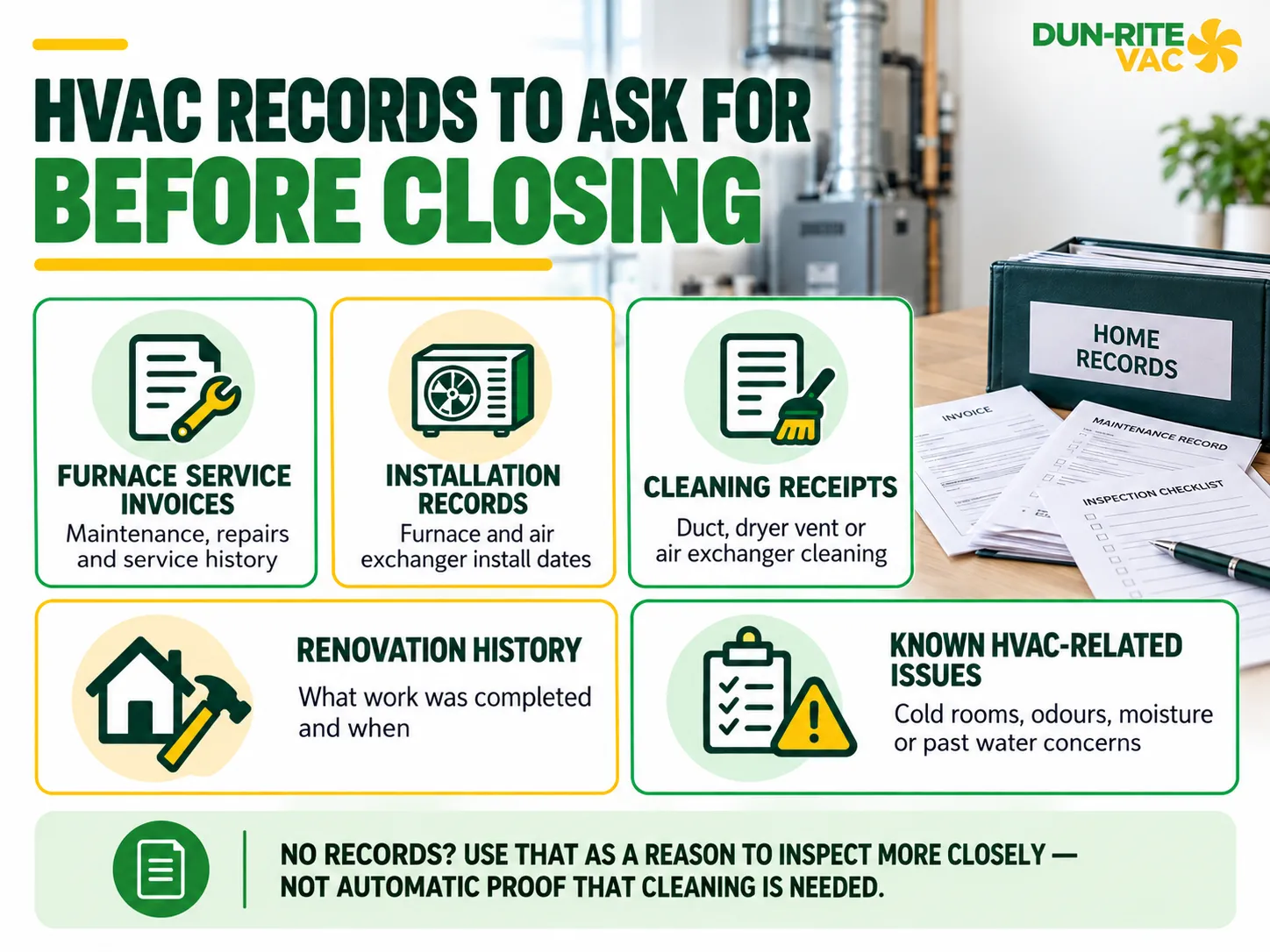
Records to Ask For Before the Closing Date
A furnace with paperwork is a very different purchase from one with none. Ask the sellers, through your agent, for the following.
Equipment maintenance records
- Furnace service invoices: annual tune-ups, parts replaced, and who did the work.
- Furnace and air exchanger install dates: plus any warranty paperwork that may transfer to you.
Cleaning and condition records
- Past duct, dryer vent, or air exchanger cleaning receipts: if any exist, note the date and the company.
- Renovation details: what was done, when, and whether the HVAC system was off or covered during construction.
- Known issues: cold rooms, moisture around the furnace, odours, or past water damage near ducts.
If the answer to most of these is “we don’t know,” treat the condition of the system as uncertain and look more closely. That’s useful information for your first-year budget, and for deciding whether to have the ducts inspected or cleaned, replace the filter right away, or call a furnace technician for the mechanical side.
Frequently Asked Questions
Should I clean the ducts before or after I unpack?
Before, if you can. With the house empty there is nothing to move or cover, and any dust that gets stirred up has nowhere to settle on your belongings.
Does a clean-looking furnace filter mean the ducts are fine?
No. A fresh filter is easy to swap in, so it doesn’t tell you about the rest of the system. Look at the register boxes and return grille as well.
What if the sellers say the ducts were cleaned recently?
Ask for the invoice and the company’s name. A dated invoice showing who performed the work is reassuring. A verbal “I think so” is not, and you can still check the registers yourself.
The house was just renovated. Is that a bigger concern?
It can be. Dust-producing renovation work can introduce debris into the HVAC system if registers are left open and the system operates during the work. The U.S. EPA recommends sealing supply and return registers during renovation work that produces dust and keeping the heating and cooling system off until the dust has been cleaned up. If you find renovation debris inside accessible ductwork afterward, that is a good reason to investigate whether professional cleaning is appropriate.
Closing on a home soon and want a second opinion on the furnace and ducts? Every job we do comes with our 100% Satisfaction Guarantee, and a free quote costs you nothing.