
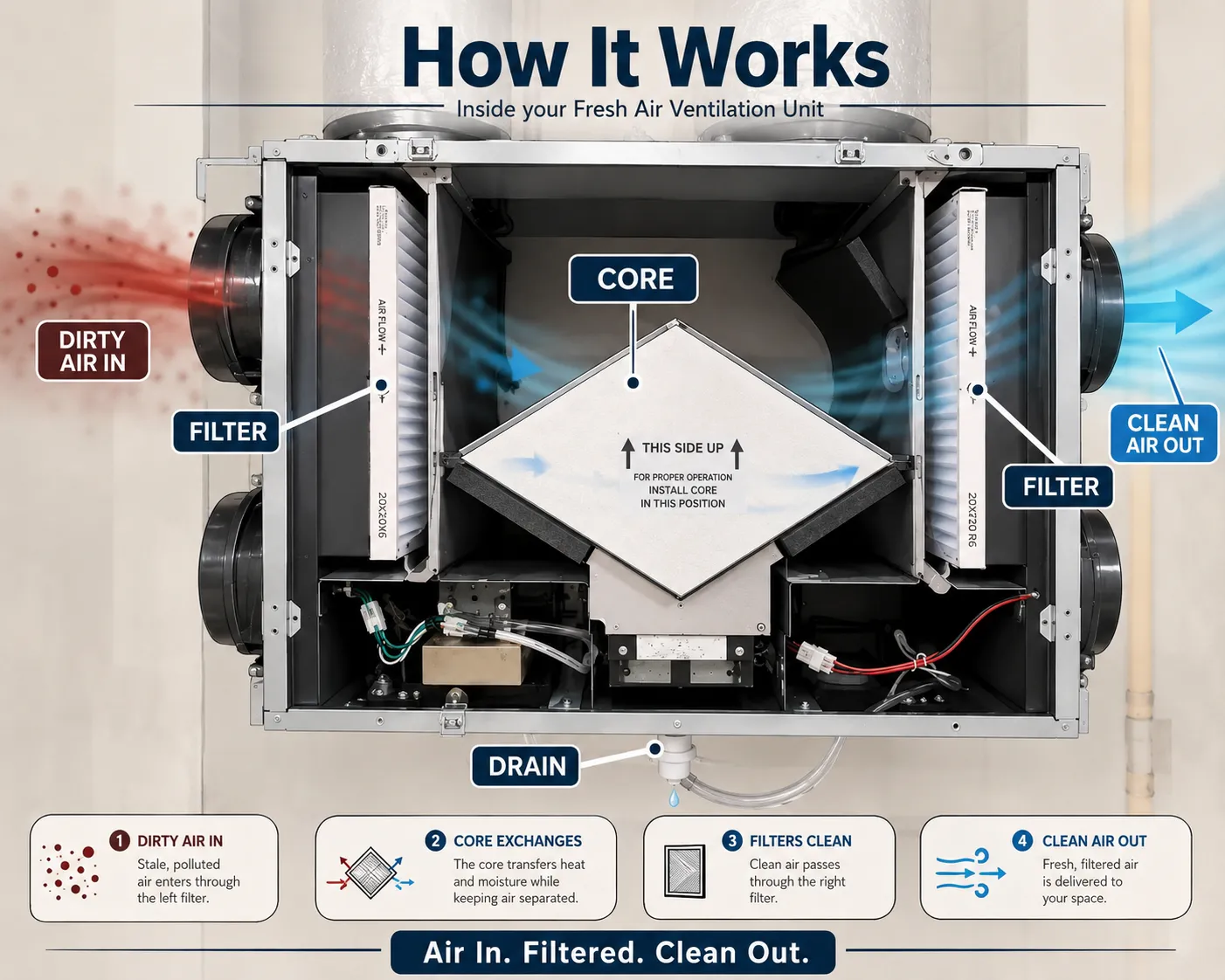
If your air exchanger smells musty, the whole unit is rarely failing. Instead, something inside your ventilation system is holding moisture longer than it should. In a well-sealed Prairie home, that moisture has nowhere to escape. As a result, the odour builds instead of airing out.
The tricky part is that a musty smell can come from four different places, and each one has a different fix. Some of it you can handle yourself. Some of it needs a technician to get inside the unit. And occasionally, the smell is your first warning sign of a moisture problem that has nothing to do with the air exchanger at all.
Quick Answer: An air exchanger smells musty most often because of a dirty filter, a biofilm-coated core, standing water in the drain pan, or contaminated ductwork downstream of the unit. Filters can usually be handled at home; a musty core, drain, or duct system typically needs a professional cleaning to fully clear the odour. The Canada Mortgage and Housing Corporation (CMHC) identifies the filter, core, condensate drain, and ductwork as the primary HRV maintenance areas and recommends professional service when more thorough cleaning is required.
The First Thing to Check When an HRV Starts Smelling Musty
A bad smell from HRV units is almost always traceable to one of four places, and the filter is the cheapest one to rule out first. It’s the cause most homeowners overlook because the filter looks “fine” from a quick glance — dust doesn’t always look wet, but it holds moisture the same way a damp towel does.
A filter that goes six, eight, or twelve months without a rinse or replacement collects dust and humidity. It starts acting more like a sponge than a filter. Air moving through it picks up a faint musty smell. Homeowners usually notice it first near a supply vent instead of at the unit.
If you haven’t checked your filters in the last few months, that’s the logical starting point. We’ve got a step-by-step walkthrough in how to clean your HRV filter that covers exactly what to look for and how often it needs doing on a typical Saskatchewan heating cycle.
Why Your Air Exchanger Smells Musty Even After Cleaning the Filter
Here’s where a lot of homeowners get stuck: they clean the filter, the smell doesn’t go away, and they assume the whole system needs replacing. In most cases, that’s the wrong conclusion. The next likely culprit is the heat-recovery core itself.
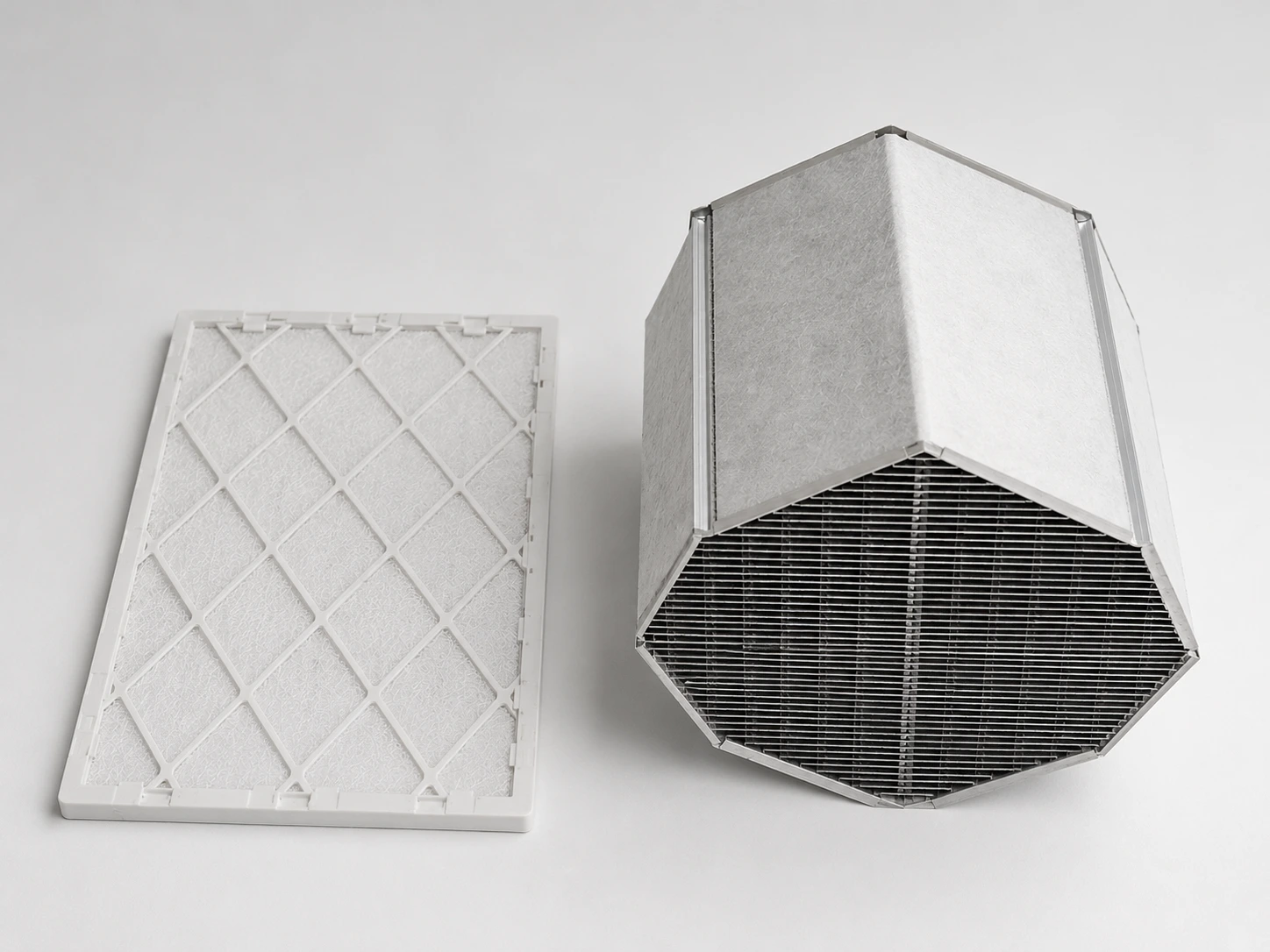
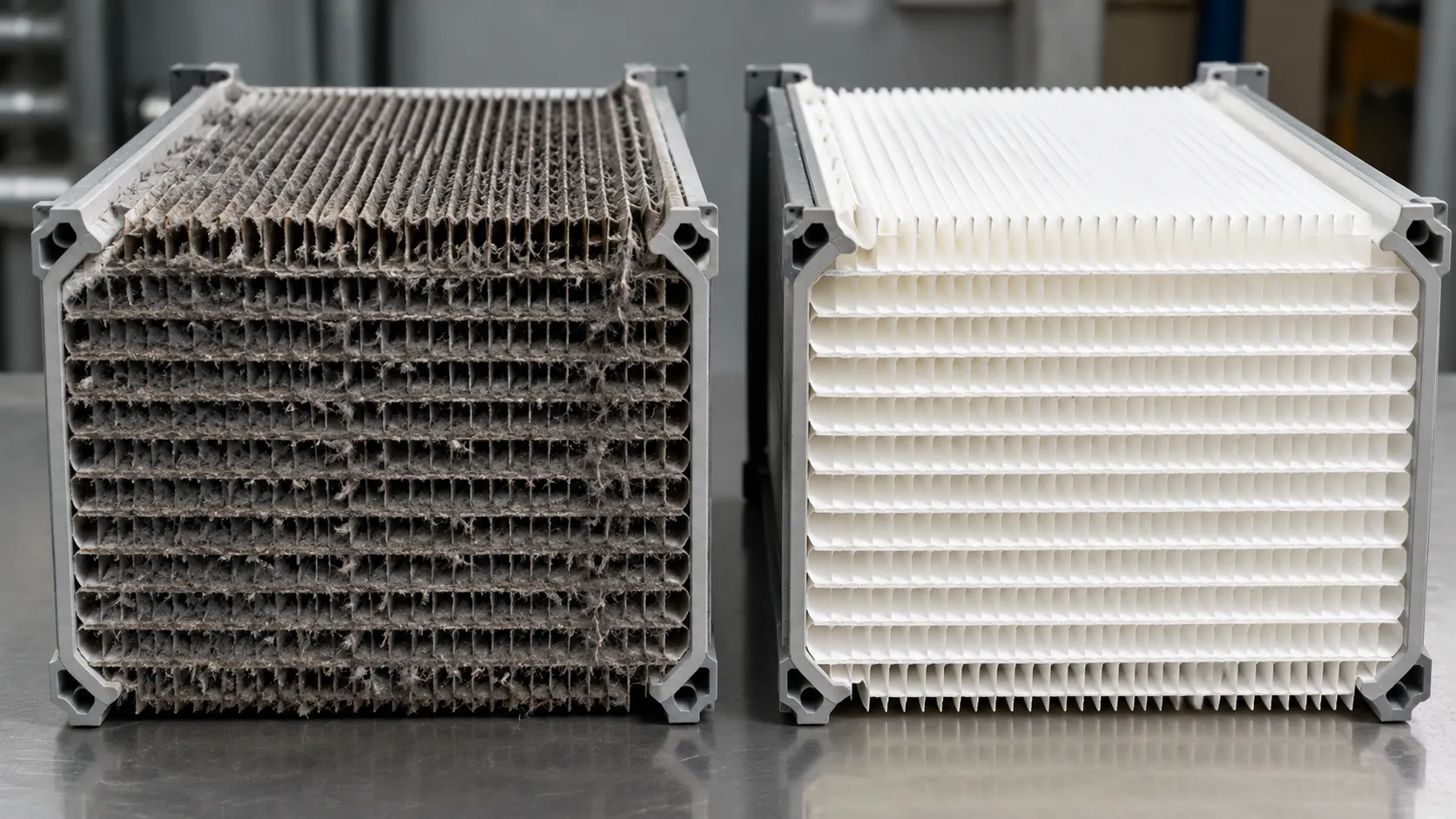
The core lets incoming and outgoing air pass each other to exchange heat. Because it constantly handles humid exhaust air, condensation naturally forms inside it. BC Housing’s HRV maintenance guide explains that condensation normally forms inside the heat-recovery core during operation. Over time, especially after a heating season or two without service, that condensation leaves a thin residue on the core’s internal surfaces. As a NADCA certified company with ASCS-certified technicians, we see this regularly. When we pull a core from a musty-smelling unit, we often find a thin film of biofilm along the pleats. You usually can’t see it from the outside, but it often causes the odour when the unit cycles.
A core in this state isn’t necessarily unsafe to run short-term, but it is working against the exact reason a sealed Prairie home needs an air exchanger in the first place — it’s supposed to be moving fresh, dry air through the house, not recirculating a stale one. This is a component that generally needs to come out for a proper cleaning; it’s not something a filter swap or a vacuum through the vent will reach.
Standing Water: Another Reason Your Air Exchanger Smells Musty
If your air exchanger smells musty specifically right after it runs, or the smell has a faintly sour, almost sewer-like edge rather than a plain “stale air” smell, the filter and core usually aren’t the whole story — the condensate drain is worth checking next.
Air exchangers drain collected moisture through a condensate line. When that line partially clogs, water backs up into the drain pan instead of draining away. CMHC’s HRV maintenance guidance recommends checking and clearing the condensate drain as part of routine maintenance. Health Canada also notes that excess moisture promotes mould growth and poor indoor air quality. On acreage properties with well water, we also see mineral buildup contribute to drainage problems. Hard water leaves scale inside the line, narrowing it over time and slowing drainage.
Here’s where it pays to be upfront. Active standing water or visible mold in the drain pan isn’t just a cleaning issue. It can point to a failed drain slope, a cracked pan, or a blocked line. Fix those problems first, or the smell will return.
If you’re noticing a musty or sour smell every time your HRV runs, it’s worth having someone actually open the unit rather than guessing. Get in touch for a free quote and we’ll tell you honestly whether it’s a cleaning or something more.
When an Air Exchanger Smells Musty but the Ductwork Is the Cause
Sometimes the air exchanger itself is clean, and what looks like an air exchanger odour problem is actually ductwork carrying the smell to the vents where you notice it. This is easy to mix up because the symptom looks identical — musty air coming from the vents — but the fix is completely different.
We often find this in older homes. Over the years, ductwork collects dust and sometimes moisture, especially in unheated crawlspaces or damp basement sections. As air moves through those ducts, it carries the smell into the room even when the HRV itself is clean.
If you’ve had the filter and core checked and the smell persists, or it seems to be coming from vents in one specific area of the house rather than everywhere at once, the ductwork is worth ruling in or out. That’s a slightly different service than air exchanger cleaning — you can read more about how that process works on our furnace duct cleaning page.
If Your Air Exchanger Smells Musty Even After Cleaning
A musty ventilation system doesn’t always mean the same level of problem, and it’s worth being straightforward about which situations are a routine cleaning and which ones deserve a closer look before you spend money on a service call.
A proper cleaning usually fixes a dirty filter, a coated core, and a partially clogged drain line. Those issues are normal wear, not signs of a failed unit. However, visible mold beyond the unit, water damage near the HRV, or a smell that returns within weeks deserves a closer inspection. Those signs usually point to a drainage or moisture problem in the mechanical room. Cleaning the unit again won’t solve that issue.
✅ Cleaning resolves it: dirty filter, biofilm-coated core, mineral-clogged drain line, dusty ductwork.
✅ Needs a closer look first: visible mold on nearby framing, standing water outside the unit, recurring smell within weeks of service.
We’re NADCA certified and employ ASCS-certified technicians. After 27+ years and more than 50,000 completed jobs across Saskatchewan and Western Manitoba, musty HRVs remain one of our most common service calls. Identifying which of these four causes is responsible tells us whether a cleaning will solve the problem or whether the system needs additional repairs.
FAQ
Can I clean the core myself if my air exchanger smells musty?
Some homeowners remove and rinse the core themselves. However, it’s easy to damage the pleated surface or reinstall it incorrectly. That can reduce the unit’s efficiency. Core material also matters. Water can ruin paper-based cores, so use a dry vacuum unless you know your unit uses a washable core. If you see biofilm or notice a persistent musty smell, professional cleaning reaches deeper into the pleats than a typical home rinse.
Will a musty smell from my air exchanger go away on its own if I just run it more?
No — running the unit more often usually spreads the smell further through the house rather than clearing it, since the source (filter, core, drain, or ductwork) is still contaminated. The smell needs to be addressed at the source, not aired out.
Is a musty air exchanger smell a health concern?
A musty odour on its own is usually a maintenance issue rather than an emergency, but it can indicate mold or bacterial growth inside the unit, which is worth addressing for indoor air quality — particularly in a tightly sealed home where that air keeps recirculating. Health Canada identifies musty odours as a common sign of moisture and mould problems that should be investigated.
How do I know why my air exchanger smells musty?
As a starting point: if the smell is strongest right at the vents throughout the whole house, it’s usually the unit. If it’s noticeably stronger in one room or area, the ductwork serving that area is more likely involved — though a technician confirming it during a cleaning is the reliable way to know for sure.
You Might Also Find This Helpful
- HRV System Maintenance: What Homeowners Should Be Doing Between Cleanings
- How Often to Clean Your Air Exchanger in a Saskatchewan Climate
Not sure which part of your system is causing the smell? We’ll take a look, tell you straight what’s going on, and back the work with our 100% Satisfaction Guarantee. Request your free quote and we’ll get it sorted.